Pretender.js
Pretender.js: A focused open-source choice for intercepting browser API requests in tests. Ranked #21 of 26 in API Mocking Tools by our editors (6.9/10); pricing: Open source; best for minimal browser request interception.
At a glance
- Editor score6.9 / 10
- PricingOpen source
- Best forMinimal browser request interception
- Paid fromFree
- Dynamic responsesYes
- Facts checked20 Sep 2026
Where it wins
- Intercepts both XMLHttpRequest and Fetch requests
- Supports dynamic routes, query parameters, and custom responses
- Adds delays, passthroughs, request tracking, and manual resolution
Where it doesn't
- Browser-only focus limits use in non-browser mock environments
- No OpenAPI import or generated mock-data workflow
- Not a hosted mock API service or standalone local server
Our verdict on Pretender.js
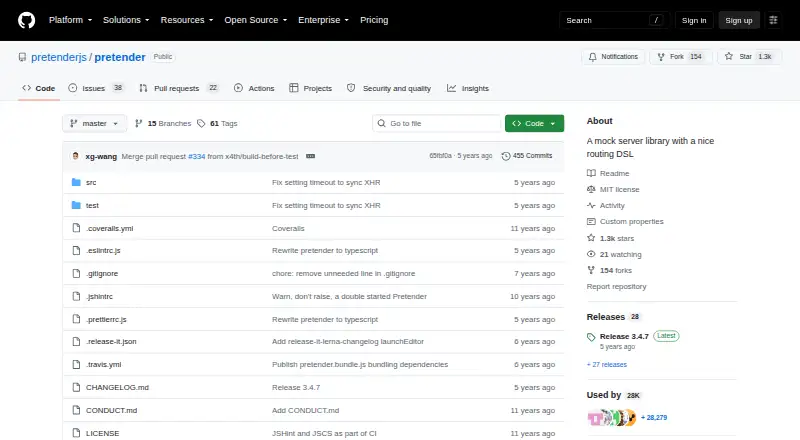
Pretender.js is an open-source JavaScript mock server library for browser applications and tests. It temporarily replaces native XMLHttpRequest and Fetch, then routes requests to developer-defined handlers. The Express- and Sinatra-inspired DSL supports GET, PUT, POST, DELETE, PATCH, and HEAD routes, making it suited to frontend developers who need controlled API behavior during browser testing without adopting a hosted mock service.
Its main strength is request-level control. Routes can use static or dynamic path segments, route parameters, and query-parameter access through request objects. Handlers can return custom status codes, headers, and response bodies, with promise-based, delayed, synchronous, or manually resolved responses. Passthrough routes allow selected requests to reach the real network, while request tracking and handler call counts help inspect interaction patterns during tests.
The trade-off is a narrow browser-first scope. Pretender.js is distributed as an npm package for web use rather than as a standalone local mock server or hosted mock API service. It also does not provide an OpenAPI import workflow or generated mock-data feature. Choose it when browser request interception, route matching, and programmable responses are the priority. Teams seeking specification-driven mocks, broader platform coverage, or a separately deployed mock API should choose a tool built around those needs instead.
Your product? Our editors can test Pretender.js in depth and publish a review, labelled as paid · from $149/mo →
Pretender.js pricing
Pretender.js fact sheet
| Free plan | Not verified |
|---|---|
| Paid from | Free |
| Dynamic responses | Yes |
| OpenAPI import | Not verified |
| Request matching | Not verified |
| Mock data generation | Not verified |
| Local deployment | Not verified |
| Supported protocols | Not verified |
| Deployment | Cloud |
| Platforms | Web |
| Support | Docs |
| Built for | Solo, Small business (editorial estimate) |
| Pricing | Open source |
| Website | github.com |
| Facts checked | 20 Sep 2026 |
Alternatives to Pretender.js
- BeeceptorA broad API mocking platform with protocol coverage, contract testing, and hosted or self-hosted deployment.9.4
- MockServerA free, open-source choice for teams that need broad, self-hosted API control.9.1
- WireMockA flexible mocking platform spanning hosted, local, CI/CD, Kubernetes, and self-managed use.9.0



See all Pretender.js alternatives →
Used Pretender.js? Be the first to review it
The editor score above is our own research. What this page doesn't have yet is a reader's view — what you used Pretender.js for, what worked and what didn't. No stars are seeded and no review is paid for; an editor reads every one before it appears.
Write a reviewTwo minutes · verified accounts only · read by an editor before it appears
Featured on iTechGuides

Pretender.js is listed in our API Mocking Tools directory. Add the badge to your site — it links back to this page.
<a href="https://www.itechguides.com/products/pretender-js/"><img src="https://www.itechguides.com/best/badge/pretender-js.svg" alt="Featured on iTechGuides" width="230" height="46"></a>
Reviewed by iTechGuides Editors · Editorial team · Updated Oct 2026
Advertiser disclosure: iTechGuides is reader-supported. Vendors can pay for top positions in our rankings and for a place on other products' pages, and we may earn a commission when you click some links. Bought places stand at the number bought; this page and our disclosure say so. Paying vendors may get a fuller, more detailed review from our editors, and that review can change their score. How we rank.
Last updated · How we research and update