
Pomerium
Pomerium: A flexible open-source ZTNA proxy for teams that value self-hosting and policy control. Ranked #22 of 39 in Zero Trust Network Access Software by our editors (7.1/10); pricing: Free plan; best for open-source and self-hosting teams.
At a glance
- Editor score7.1 / 10
- PricingFree plan
- Best forOpen-source and self-hosting teams
- Free planYes
- Paid from$7/user/mo
- Access methodsBrowser
- Facts checked20 Sep 2026
Where it wins
- Open-source deployment with self-hosted proxy and data plane
- Clientless browser access plus SSH, TCP, UDP, and web protocols
- Policy-as-code, RBAC, SSO, and continuous context checks
Where it doesn't
- Personal Free is limited to 10 users and 10 routes
- Session recording is available only with Enterprise
- Platform coverage centers on web, Linux, API, and self-hosted deployments
Our verdict on Pomerium
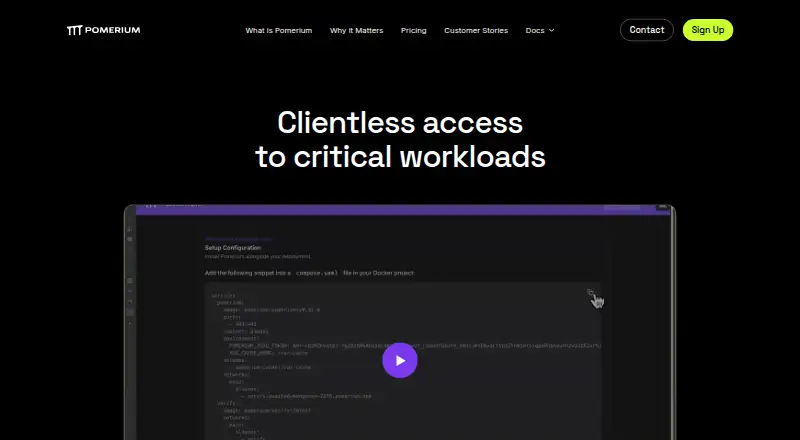
Pomerium is an identity-aware Layer 7 reverse proxy for securing access to internal and external applications. It suits teams that need zero trust access without requiring a client for browser-based applications, while also supporting protocol-aware connections such as HTTP, SSH, TCP, UDP, WebSocket, and gRPC-related traffic. Open-source deployment, policy-as-code, SSO and OIDC integration, and self-hosted data-plane options make it particularly relevant to infrastructure, platform, and security teams that want control over deployment and access policy.
Pomerium’s plans cover both entry-level evaluation and managed control-plane use. Personal Free includes web-based secure application access, a self-hosted data plane, up to 10 users, and up to 10 routes. Business costs $7 per user per month when billed annually and adds a hosted control plane, advanced access-control criteria, and an API for programmatic management while retaining a self-hosted data plane. Enterprise is designed for fully self-hosted and on-premise deployments, with full API access and no usage limits. The structure makes the free plan suitable for smaller environments, while paid tiers address managed control and larger deployment requirements.
Its main strength is breadth within an infrastructure-focused access model: Pomerium combines browser-based access with native SSH proxying, TCP and UDP routing, device-posture and request-context evaluation, audit logging, and integrations including Grafana, Kubernetes, and Okta. The trade-off is that teams seeking broad endpoint coverage or a client-led access model may need to compare other products. Session recording is tied to Enterprise, and the free tier has explicit user and route limits. Choose Pomerium for open-source flexibility, self-hosting, and programmable policy enforcement; consider an alternative if those priorities are secondary to wider platform coverage or fewer plan boundaries.
Your product? Our editors can test Pomerium in depth and publish a review, labelled as paid · from $149/mo →
Pomerium pricing
All 3 Pomerium plans and prices →
Pomerium fact sheet
| Free plan | Yes |
|---|---|
| Paid from | $7/user/mo |
| Deployment model | Hybrid |
| Access methods | Browser |
| Device posture checks | Yes |
| Private app connectors | Not verified |
| Supported app protocols | HTTP, HTTPS, HTTP/2, HTTP/3, WebSocket, gRPC, TCP, UDP, SSH |
| SIEM log export | Not verified |
| Session recording | Yes |
| Deployment | Cloud, Self-hosted |
| Platforms | Web, Linux |
| Support | Email, Community, Docs |
| Built for | Solo, Small business, Mid-market, Enterprise (editorial estimate) |
| Integrations | 3 integrations: Grafana, Kubernetes, Okta See all → |
| Pricing | Free plan (source) |
| Website | pomerium.com |
| Facts checked | 20 Sep 2026 |
Pomerium integrations
Pomerium lists 3 integrations on its own site.
- Grafana
- Kubernetes
- Okta
See all Pomerium integrations →
Alternatives to Pomerium
- Cloudflare AccessBroad cloud ZTNA coverage with a free plan, clientless access, and device posture checks.9.3
- Zscaler Private AccessA broad ZTNA platform for enterprises needing application-level and privileged access controls.9.1
- Akamai Enterprise Application AccessA deep hybrid ZTNA service for complex private-app environments, with contact-sales pricing.9.0



See all Pomerium alternatives →
Also Ranked In
Pomerium is ranked in 3 of our directories.
Used Pomerium? Be the first to review it
The editor score above is our own research. What this page doesn't have yet is a reader's view — what you used Pomerium for, what worked and what didn't. No stars are seeded and no review is paid for; an editor reads every one before it appears.
Write a reviewTwo minutes · verified accounts only · read by an editor before it appears
Featured on iTechGuides

Pomerium is listed in our Zero Trust Network Access Software directory. Add the badge to your site — it links back to this page.
<a href="https://www.itechguides.com/products/pomerium/"><img src="https://www.itechguides.com/best/badge/pomerium.svg" alt="Featured on iTechGuides" width="230" height="46"></a>
Reviewed by iTechGuides Editors · Editorial team · Updated Oct 2026
Advertiser disclosure: iTechGuides is reader-supported. Vendors can pay for top positions in our rankings and for a place on other products' pages, and we may earn a commission when you click some links. Bought places stand at the number bought; this page and our disclosure say so. Paying vendors may get a fuller, more detailed review from our editors, and that review can change their score. How we rank.
Last updated · How we research and update