Pingora
Pingora: A flexible, self-hosted Rust foundation for programmable proxies and network services. Ranked #15 of 33 in Reverse Proxy Software by our editors (7.4/10); pricing: Free plan; best for programmable modern proxy development.
At a glance
- Editor score7.4 / 10
- PricingFree plan
- Best forProgrammable modern proxy development
- Free planYes
- Paid fromFree
- Deployment modelSelf-hosted
- Founded2024
- Facts checked20 Sep 2026
Where it wins
- Supports HTTP/1, HTTP/2, gRPC, WebSockets, and multiple TLS libraries
- Provides customizable balancing, filters, callbacks, health checks, and failover
- Includes caching, rate limiting, graceful restarts, and observability integrations
Where it doesn't
- Requires teams to build and operate the resulting service themselves
- Caching is explicitly described as experimental
- Windows support is preliminary and macOS support may vary
Our verdict on Pingora
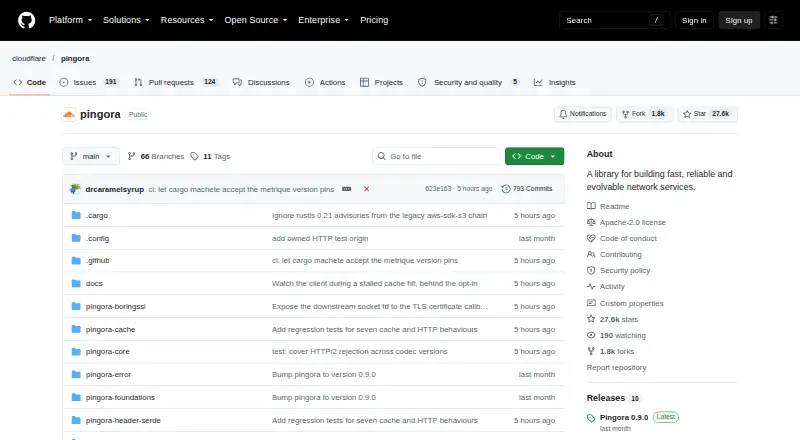
Pingora is an open-source Rust framework from Cloudflare for building programmable network services. It can serve as the foundation for HTTP proxies, load balancers, clients, and servers, making it a fit for developers and infrastructure teams that need a customizable, performance-sensitive gateway. The project is self-hosted, available on Windows, macOS, and Linux, and its published positioning centers on programmable proxy development rather than a ready-made managed proxy product.
Its technical scope is broad for teams building a gateway in Rust. Pingora supports HTTP/1 and HTTP/2 end-to-end proxying, gRPC and WebSocket proxying, TLS through OpenSSL, BoringSSL, s2n-tls, and experimental rustls, plus customizable load balancing and failover strategies. Request filters and programmable proxy callbacks provide control over request handling, while health checks, rate limiting utilities, graceful restart and shutdown, and async in-memory response caching cover important proxy operations. Prometheus, Sentry, OpenTelemetry, and Syslog integrations extend its observability options.
The main trade-off is ownership of the implementation and operations. Pingora is open source with a free plan, but teams should expect to build the resulting service themselves rather than select from hosted tiers. Its platform fit is strongest on Linux, identified as the tier 1 environment; macOS support may vary, and Windows support is preliminary. Caching is also experimental, so it is better suited to teams that want programmable control and can account for those platform and feature considerations. Choose Pingora for a self-hosted Rust-based proxy foundation; consider another option if you want a finished service with managed deployment or a more uniform cross-platform experience.
Your product? Our editors can test Pingora in depth and publish a review, labelled as paid · from $149/mo →
Pingora pricing
Pingora fact sheet
| Free plan | Yes |
|---|---|
| Paid from | Free |
| Deployment model | Self-hosted |
| TLS termination | Yes |
| Web application firewall | Not verified |
| Response caching | Yes |
| Configuration method | File |
| WebSocket support | Yes |
| Rate limiting | Yes |
| Deployment | Self-hosted |
| Platforms | Windows, macOS, Linux |
| Support | Docs |
| Built for | Small business, Mid-market, Enterprise (editorial estimate) |
| Integrations | 4 integrations: Prometheus, Sentry, OpenTelemetry, Syslog |
| Pricing | Free plan |
| Website | github.com |
| Facts checked | 20 Sep 2026 |
Pingora integrations
Pingora lists 4 integrations on its own site.
- Prometheus
- Sentry
- OpenTelemetry
- Syslog
Alternatives to Pingora
- NGINXA flexible self-hosted reverse proxy with caching, load balancing, TLS, and protocol support.9.3
- HAProxy Community EditionA capable reverse proxy for teams managing high-volume TCP and HTTP traffic themselves.9.1
- Cloudflare TunnelA free outbound tunnel for publishing private services through Cloudflare’s edge.8.9


See all Pingora alternatives →
Used Pingora? Be the first to review it
The editor score above is our own research. What this page doesn't have yet is a reader's view — what you used Pingora for, what worked and what didn't. No stars are seeded and no review is paid for; an editor reads every one before it appears.
Write a reviewTwo minutes · verified accounts only · read by an editor before it appears
Featured on iTechGuides

Pingora is listed in our Reverse Proxy Software directory. Add the badge to your site — it links back to this page.
<a href="https://www.itechguides.com/products/pingora/"><img src="https://www.itechguides.com/best/badge/pingora.svg" alt="Featured on iTechGuides" width="230" height="46"></a>
Reviewed by iTechGuides Editors · Editorial team · Updated Oct 2026
Advertiser disclosure: iTechGuides is reader-supported. Vendors can pay for top positions in our rankings and for a place on other products' pages, and we may earn a commission when you click some links. Bought places stand at the number bought; this page and our disclosure say so. Paying vendors may get a fuller, more detailed review from our editors, and that review can change their score. How we rank.
Last updated · How we research and update