Phobos
Phobos: A self-hosted orchestrator for teams defining controlled releases in HCL. Ranked #21 of 28 in Release Orchestration Software by our editors (7.2/10); pricing: Open source; best for open-source teams wanting policy-driven pipelines.
At a glance
- Editor score7.2 / 10
- PricingOpen source
- Best forOpen-source teams wanting policy-driven pipelines
- Paid fromFree
- Facts checked20 Sep 2026
Where it wins
- HCL definitions cover pipelines, environments, approvals, and variables
- Supports scheduling, environment protection, RBAC, and deployment tracking
- Open-source deployment with web, API, CLI, and agent options
Where it doesn't
- Self-hosted operation requires teams to manage their own infrastructure
- HCL-based workflows may not suit teams seeking visual-only configuration
- Teams needing broad named integrations may need a more ecosystem-focused tool
Our verdict on Phobos
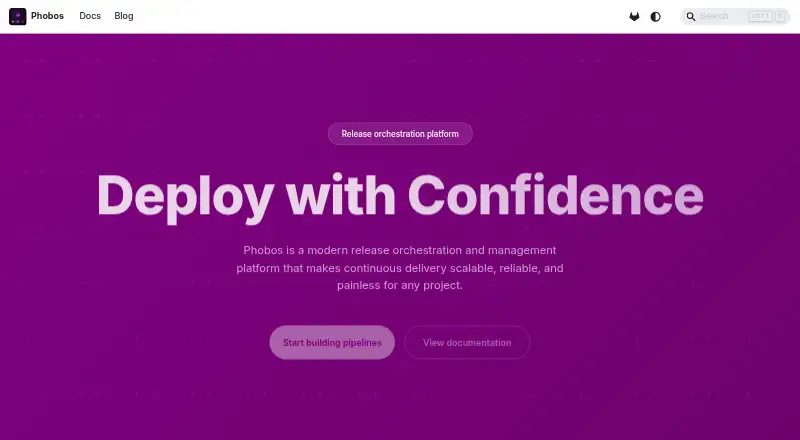
Phobos is an open-source, self-hosted release orchestration and management platform for teams coordinating application deployments across multiple environments. It uses HashiCorp Configuration Language to define release workflows, pipelines, environments, approvals, and variables. The product combines a web UI, API, CLI, agents, release lifecycles, environment controls, plugin extensibility, and deployment activity views. It is a strong fit for engineering organizations that want policy-driven delivery with control over where jobs run, whether on user infrastructure or shared agent pools.
Its workflow depth is the main reason to consider it. Phobos supports environment promotion, approval gates for tasks, nested pipelines, and deployments, plus deployment scheduling and deferral. Protection rules add control around environments, while pipeline templates with semantic versioning can standardize repeatable release definitions. Service-account authentication and role-based access control support controlled access, and the release activity feed provides deployment status tracking. Teams that need release dependencies, lifecycle orchestration, and auditable activity in one system may find this scope well aligned with their operating model.
The trade-off is operational ownership and ecosystem breadth. Self-hosting gives teams control over deployment infrastructure, but it also places that infrastructure within their responsibilities. The HCL-centered approach is suited to teams comfortable managing release configuration as code, less so to organizations looking primarily for a visual release builder. Plugin support and a registry provide extensibility, yet teams prioritizing a broad set of established third-party integrations should compare tools with a stronger integration-led focus. Choose Phobos for open-source, policy-controlled orchestration; look elsewhere if managed hosting or a wide prebuilt ecosystem is the priority.
Your product? Our editors can test Phobos in depth and publish a review, labelled as paid · from $149/mo →
Phobos pricing
Phobos fact sheet
| Free plan | Not verified |
|---|---|
| Paid from | Free |
| Multi-application releases | Not verified |
| Environment promotion | Yes |
| Approval gates | Yes |
| Dependency tracking | Yes |
| Release scheduling | Yes |
| Release audit trail | Yes |
| Deployment strategies | Both |
| Deployment | Self-hosted |
| Platforms | Web |
| Support | Docs |
| Built for | Small business, Mid-market, Enterprise (editorial estimate) |
| Pricing | Open source |
| Website | phobos.martian-cloud.io |
| Facts checked | 20 Sep 2026 |
Alternatives to Phobos
- IBM DevOps ReleaseA feature-rich choice for coordinating complex, multi-application enterprise releases.9.2
- CA Release Automation (Nolio)A coordinated release platform for enterprises managing complex, multi-team deployments.9.0
- Harness Continuous DeliveryA broad release orchestration platform for controlled enterprise deployments.8.9


Used Phobos? Be the first to review it
The editor score above is our own research. What this page doesn't have yet is a reader's view — what you used Phobos for, what worked and what didn't. No stars are seeded and no review is paid for; an editor reads every one before it appears.
Write a reviewTwo minutes · verified accounts only · read by an editor before it appears
Featured on iTechGuides

Phobos is listed in our Release Orchestration Software directory. Add the badge to your site — it links back to this page.
<a href="https://www.itechguides.com/products/phobos/"><img src="https://www.itechguides.com/best/badge/phobos.svg" alt="Featured on iTechGuides" width="230" height="46"></a>
Reviewed by iTechGuides Editors · Editorial team · Updated Oct 2026
Advertiser disclosure: iTechGuides is reader-supported. Vendors can pay for top positions in our rankings and for a place on other products' pages, and we may earn a commission when you click some links. Bought places stand at the number bought; this page and our disclosure say so. Paying vendors may get a fuller, more detailed review from our editors, and that review can change their score. How we rank.
Last updated · How we research and update