OrangeFS
OrangeFS: A flexible self-hosted parallel file system for mixed clients and data-access paths. Ranked #24 of 32 in Distributed File System Software by our editors (7.0/10); pricing: Free plan; best for open-source parallel storage across diverse clients.
At a glance
- Editor score7.0 / 10
- PricingFree plan
- Best forOpen-source parallel storage across diverse clients
- Free planYes
- Paid fromFree
- Deployment modelSelf_hosted
- Facts checked22 Sep 2026
Where it wins
- Parallel storage with configurable file striping
- Access through Linux, Windows, macOS, Hadoop, WebDAV, and S3
- Distributed metadata with MPI-IO and direct application interfaces
Where it doesn't
- Requires user-managed server and client infrastructure
- Commercial, research, and teaching support is quote-based
- Replication and encryption are not part of the documented feature set
Our verdict on OrangeFS
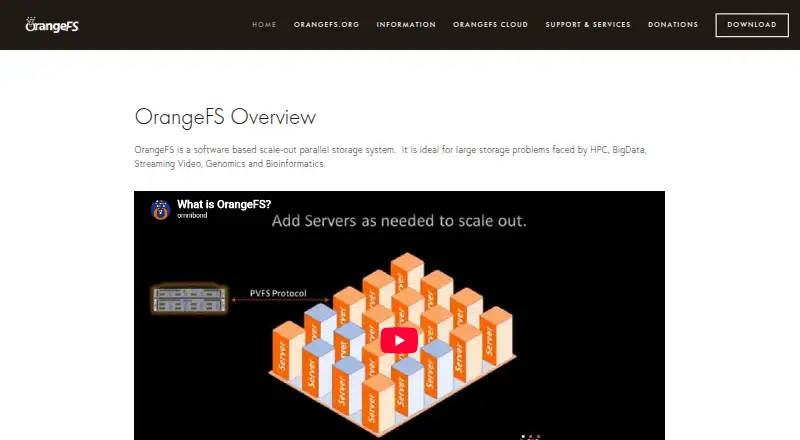
OrangeFS is an open-source, software-based parallel file system for organizations that need scale-out storage across multiple servers. Omnibond positions it for high-performance computing, big data, streaming video, genomics, and bioinformatics. It is a fit for technical teams managing their own infrastructure and serving workloads across Linux, Windows, and macOS, as well as applications using APIs or self-hosted deployments.
Its strongest differentiator is breadth of access for a parallel file system. OrangeFS supports configurable file striping, distributed metadata, Linux kernel and direct application interfaces, FUSE on macOS and Linux, and a Windows native client. Its ecosystem connections include ROMIO for MPI-IO, Hadoop HCFS, Java JNI, Apache WebDAV, and Apache S3 modules. That combination gives teams multiple routes into the same storage environment, particularly where high-performance computing and big-data workflows need to coexist with file, object, or web-based access.
The tradeoff is operational responsibility. OrangeFS is deployed as server and client software on infrastructure managed by the user, so it suits teams prepared to handle architecture, deployment, and ongoing administration rather than buyers seeking a hosted service. The software is free and open source, while commercial, research, and teaching support subscriptions are quoted. The documented scope also does not include replication or encryption as established capabilities, which makes those requirements important evaluation points. Choose OrangeFS for open-source parallel storage across diverse clients and interfaces; consider another system when managed delivery or those protection features are central requirements.
Your product? Our editors can test OrangeFS in depth and publish a review, labelled as paid · from $149/mo →
OrangeFS pricing
OrangeFS fact sheet
| Free plan | Yes |
|---|---|
| Paid from | Free |
| Deployment model | Self_hosted |
| Data replication | Not verified |
| Multi-site support | Not verified |
| File access protocols | Linux kernel module, direct interface, FUSE, MPI-IO, WebDAV, S3, Hadoop HCFS |
| Maximum nodes | Not verified |
| Encryption at rest | Not verified |
| Deployment | Self-hosted |
| Platforms | Windows, macOS, Linux |
| Support | Email, Community, Docs |
| Built for | Mid-market, Enterprise (editorial estimate) |
| Integrations | 5 integrations: Apache WebDAV, Apache S3, Hadoop HCFS, ROMIO MPI-IO, Java JNI |
| Pricing | Free plan |
| Website | orangefs.com |
| Facts checked | 22 Sep 2026 |
OrangeFS integrations
OrangeFS lists 5 integrations on its own site.
- Apache WebDAV
- Apache S3
- Hadoop HCFS
- ROMIO MPI-IO
- Java JNI
Alternatives to OrangeFS
- IBM Storage ScaleA clustered file and object platform for enterprises managing distributed, data-intensive workloads.9.3
- PowerScale OneFSA broad, enterprise-focused file system for clustered NAS and cloud deployments.9.2
- GlusterA resilient distributed filesystem for Linux-based, self-hosted storage environments.9.1


See all OrangeFS alternatives →
Used OrangeFS? Be the first to review it
The editor score above is our own research. What this page doesn't have yet is a reader's view — what you used OrangeFS for, what worked and what didn't. No stars are seeded and no review is paid for; an editor reads every one before it appears.
Write a reviewTwo minutes · verified accounts only · read by an editor before it appears
Featured on iTechGuides

OrangeFS is listed in our Distributed File System Software directory. Add the badge to your site — it links back to this page.
<a href="https://www.itechguides.com/products/orangefs/"><img src="https://www.itechguides.com/best/badge/orangefs.svg" alt="Featured on iTechGuides" width="230" height="46"></a>
Reviewed by iTechGuides Editors · Editorial team · Updated Oct 2026
Advertiser disclosure: iTechGuides is reader-supported. Vendors can pay for top positions in our rankings and for a place on other products' pages, and we may earn a commission when you click some links. Bought places stand at the number bought; this page and our disclosure say so. Paying vendors may get a fuller, more detailed review from our editors, and that review can change their score. How we rank.
Last updated · How we research and update