
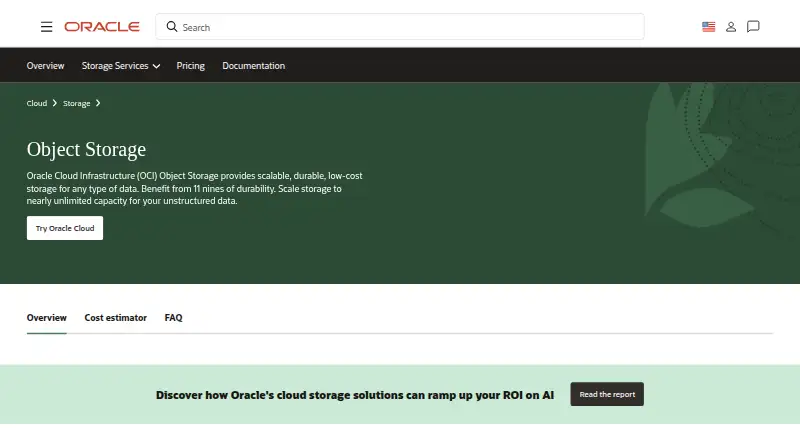
Oracle Cloud Infrastructure Object Storage
Oracle Cloud Infrastructure Object Storage: A capable general-purpose object store, especially for OCI users and S3-compatible workflows. Ranked #4 of 150 in Object Storage Services by our editors (9.0/10); pricing: Free plan; best for OCI users needing capable general storage.
At a glance
- Editor score9.0 / 10
- PricingFree plan
- Best forOCI users needing capable general storage
- Free planYes
- S3 compatibilityYes
- Facts checked20 Sep 2026
Where it wins
- S3 compatibility supports familiar tools, SDKs, and workflows.
- Versioning, lifecycle policies, retention, and legal holds support governance.
- Replication, encryption, bulk operations, and multiple tiers cover varied workloads.
Where it doesn't
- Choosing among Standard, Infrequent Access, and Archive adds planning overhead.
- Regional storage may require replication planning for broader geographic coverage.
- Its broad feature set may be more than needed for simple storage tasks.
Our verdict on Oracle Cloud Infrastructure Object Storage
Oracle Cloud Infrastructure Object Storage is a regional service for storing and retrieving unstructured data, including media, backups, archives, and analytics data. Its bucket-based model supports storage through the web console, CLI, APIs, SDKs, and bulk object operations. The service is a strong fit for OCI users needing general-purpose object storage, while Amazon S3 compatibility, the HDFS connector, and the Swift API extend its usefulness across existing storage tools and environments.
Storage design is one of its stronger areas. Standard, Infrequent Access, and Archive tiers provide distinct options for data with different access patterns. Lifecycle policies can automate archiving and deletion, while object versioning helps preserve earlier states. Retention rules and legal holds add controls for data that must be protected from changes or deletion. Server-side encryption is included, and replication can operate between buckets within the same region or across OCI regions. These capabilities make the service suitable for active data, backups, long-term archives, and workflows that need retention or geographic copies.
The main tradeoff is operational choice: teams need to select tiers, lifecycle behavior, retention settings, and replication scope to match each workload. A free plan provides an entry point, while paid usage follows the service’s storage billing model. The maximum object size is 10 TiB, and the published access options support both console-led administration and programmatic workflows. Choose Oracle Cloud Infrastructure Object Storage when OCI alignment, S3 compatibility, governance controls, and storage-tier flexibility matter. A simpler storage requirement may not justify its wider configuration surface.
Oracle Cloud Infrastructure Object Storage pricing
Oracle Cloud Infrastructure Object Storage fact sheet
| Free plan | Yes |
|---|---|
| Paid from | Not verified |
| S3 compatibility | Yes |
| Max object size | 10240 GB |
| Object versioning | Yes |
| Lifecycle rules | Yes |
| Object immutability | Yes |
| Replication scope | Cross-region |
| Deployment | Cloud |
| Platforms | Web |
| Integrations | 6 integrations: Amazon S3-compatible tools and SDKs, OCI Console, OCI CLI, OCI SDKs, HDFS connector, Swift API |
| Pricing | Free plan (source) |
| Website | oracle.com |
| Facts checked | 20 Sep 2026 |
Oracle Cloud Infrastructure Object Storage integrations
Oracle Cloud Infrastructure Object Storage lists 6 integrations on its own site.
- Amazon S3-compatible tools and SDKs
- OCI Console
- OCI CLI
- OCI SDKs
- HDFS connector
- Swift API
Alternatives to Oracle Cloud Infrastructure Object Storage
- Google Cloud StorageA broad object storage service for teams that need cloud integrations and control.9.4
- Amazon S3Deep AWS-native object storage with powerful controls, replication, and usage-based pricing.9.3
- Alibaba Cloud Object Storage Service (OSS)A low-cost object storage service with broad lifecycle, replication, and retention controls.9.1



See all Oracle Cloud Infrastructure Object Storage alternatives →
Oracle Cloud Infrastructure Object Storage vs the competition
- Oracle Cloud Infrastructure Object Storage vs Google Cloud Storage
- Oracle Cloud Infrastructure Object Storage vs Amazon S3
- Oracle Cloud Infrastructure Object Storage vs Alibaba Cloud Object Storage Service (OSS)
- Oracle Cloud Infrastructure Object Storage vs Yandex Object Storage
- Oracle Cloud Infrastructure Object Storage vs Backblaze B2 Cloud Storage
- Oracle Cloud Infrastructure Object Storage vs MinIO AIStor


Compare Oracle Cloud Infrastructure Object Storage with any tool side by side →
Also Ranked In
Oracle Cloud Infrastructure Object Storage is ranked in 4 of our directories.
Used Oracle Cloud Infrastructure Object Storage? Be the first to review it
The editor score above is our own research. What this page doesn't have yet is a reader's view — what you used Oracle Cloud Infrastructure Object Storage for, what worked and what didn't. No stars are seeded and no review is paid for; an editor reads every one before it appears.
Write a reviewTwo minutes · verified accounts only · read by an editor before it appears
Featured on iTechGuides

Oracle Cloud Infrastructure Object Storage is listed in our Object Storage Services directory. Add the badge to your site — it links back to this page.
<a href="https://www.itechguides.com/products/oracle-cloud-infrastructure-object-storage/"><img src="https://www.itechguides.com/best/badge/oracle-cloud-infrastructure-object-storage.svg" alt="Featured on iTechGuides" width="230" height="46"></a>
Reviewed by iTechGuides Editors · Editorial team · Updated Oct 2026
Advertiser disclosure: iTechGuides is reader-supported. Vendors can pay for top positions in our rankings and for a place on other products' pages, and we may earn a commission when you click some links. Bought places stand at the number bought; this page and our disclosure say so. Paying vendors may get a fuller, more detailed review from our editors, and that review can change their score. How we rank.
Last updated · How we research and update