
OpsLevel
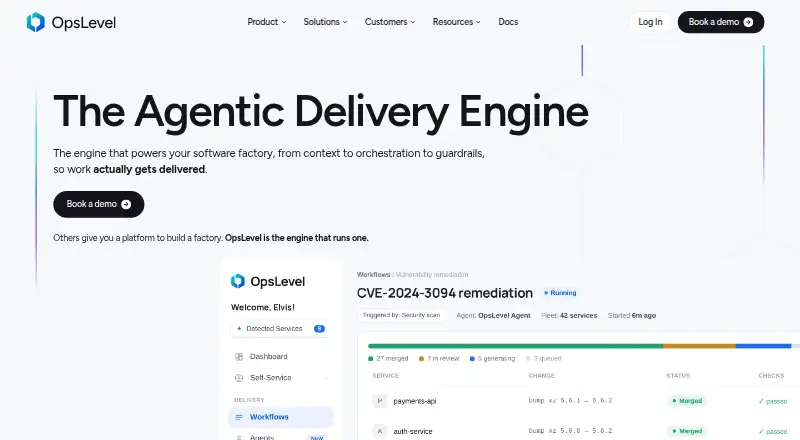
OpsLevel: A broad internal developer portal for catalog governance, workflows, and engineering standards. Ranked #6 of 27 in Internal Developer Portals by our editors (8.8/10); pricing: Pricing on request; best for enterprises needing mature catalog governance.
At a glance
- Editor score8.8 / 10
- PricingPricing on request
- Best forEnterprises needing mature catalog governance
- Self-service workflowsYes
- Facts checked20 Sep 2026
Where it wins
- Catalogs services, APIs, infrastructure, repositories, and custom components
- Combines scorecards, checks, rubrics, campaigns, and ownership management
- Supports self-service actions, templates, API docs, Kubernetes, RBAC, and SSO
Where it doesn't
- Pricing requires contacting sales rather than reviewing published amounts
- Standard is limited to up to 50 users
- On-premises and single-tenancy options are limited to Enterprise
Our verdict on OpsLevel
OpsLevel is an internal developer portal for engineering and platform teams that need a central view of services, APIs, infrastructure, repositories, and other software components. Its catalog connects ownership, team hierarchies, documentation, engineering checks, scorecards, rubrics, and campaigns. Self-service Actions add forms, workflows, and optional approvals, while service templates support scaffolding for new services. It is suited to enterprises seeking governed catalog management across a broad engineering environment.
The published plans are Standard and Enterprise, with contact-sales pricing. Standard includes up to 50 users, unlimited cataloged components, scorecards, Self-service Actions, turnkey integrations, and SSO. Enterprise adds unlimited users, a Global Rubric, custom integrations, custom checks, and on-prem and single-tenancy options. The plan structure makes the main upgrade path clear: larger user populations and deeper governance or deployment customization sit in Enterprise. Organizations comparing tools by published price will need to engage with OpsLevel before evaluating cost.
Platform fit is a major part of the product. Integrations cover GitHub, GitLab, Bitbucket, Azure, Kubernetes, AWS, Datadog, Slack, Microsoft Teams, PagerDuty, Terraform, and New Relic, alongside support for Git, Kubernetes, CI/CD, cloud, observability, incident, and communication tools. OpsLevel is available through web and API interfaces, as a SaaS product, and as a self-hosted deployment in an organization's own Kubernetes environment. Enterprises that want catalog governance, standards tracking, workflow automation, and broad ecosystem connections should consider it. Smaller teams with more than 50 users on Standard, or buyers who require upfront pricing, may prefer an alternative with simpler commercial terms.
Your product? Our editors can test OpsLevel in depth and publish a review, labelled as paid · from $149/mo →
OpsLevel pricing
All 2 OpsLevel plans and prices →
OpsLevel fact sheet
| Free plan | Not verified |
|---|---|
| Paid from | Not verified |
| Software catalog | Yes |
| Self-service workflows | Yes |
| Engineering scorecards | Yes |
| Kubernetes support | Yes |
| Deployment model | Both |
| Ownership documentation | Yes |
| Deployment | Cloud, Self-hosted |
| Platforms | Web |
| Compliance & security | SOC 2, SSO/SAML, 2FA |
| Support | Email, Live chat |
| Built for | Small business, Mid-market, Enterprise (editorial estimate) |
| Integrations | 12 integrations: GitHub, GitLab, Bitbucket, Azure, Kubernetes, AWS … See all → |
| Pricing | Pricing on request (source) |
| Website | opslevel.com |
| Facts checked | 20 Sep 2026 |
OpsLevel integrations
OpsLevel lists 12 integrations on its own site.
- GitHub
- GitLab
- Bitbucket
- Azure
- Kubernetes
- AWS
- Datadog
- Slack
- Microsoft Teams
- PagerDuty
- Terraform
- New Relic
See all OpsLevel integrations →
Alternatives to OpsLevel
- BackstageA flexible self-hosted portal for cataloging software and enabling developer self-service.9.4
- configure8A broad internal developer portal with no-code actions, scorecards, Kubernetes discovery, and a free plan.9.3
- Harness Internal Developer PortalA broad managed portal with strong catalog and self-service coverage, plus a free starting tier.9.2



See all OpsLevel alternatives →
OpsLevel vs the competition
- OpsLevel vs Backstage
- OpsLevel vs configure8
- OpsLevel vs Harness Internal Developer Portal
- OpsLevel vs Port
- OpsLevel vs Roadie
- OpsLevel vs Red Hat Developer Hub


Compare OpsLevel with any tool side by side →
Also Ranked In
OpsLevel is ranked in 4 of our directories.
Used OpsLevel? Be the first to review it
The editor score above is our own research. What this page doesn't have yet is a reader's view — what you used OpsLevel for, what worked and what didn't. No stars are seeded and no review is paid for; an editor reads every one before it appears.
Write a reviewTwo minutes · verified accounts only · read by an editor before it appears
Featured on iTechGuides

OpsLevel is listed in our Internal Developer Portals directory. Add the badge to your site — it links back to this page.
<a href="https://www.itechguides.com/products/opslevel/"><img src="https://www.itechguides.com/best/badge/opslevel.svg" alt="Featured on iTechGuides" width="230" height="46"></a>
Reviewed by iTechGuides Editors · Editorial team · Updated Oct 2026
Advertiser disclosure: iTechGuides is reader-supported. Vendors can pay for top positions in our rankings and for a place on other products' pages, and we may earn a commission when you click some links. Bought places stand at the number bought; this page and our disclosure say so. Paying vendors may get a fuller, more detailed review from our editors, and that review can change their score. How we rank.
Last updated · How we research and update