
OpenZipkin
OpenZipkin: A focused, self-hosted Zipkin system for collecting and exploring service traces. Ranked #7 of 32 in Distributed Tracing Tools by our editors (8.6/10); pricing: Free plan; best for teams wanting simple open-source Zipkin tracing.
At a glance
- Editor score8.6 / 10
- PricingFree plan
- Best forTeams wanting simple open-source Zipkin tracing
- Free planYes
- Paid fromFree
- OpenTelemetry supportYes
- Facts checked20 Sep 2026
Where it wins
- Search traces by service, operation, tags, duration, or trace ID
- Dependency diagrams and web trace views clarify service behavior
- Supports HTTP, Kafka, gRPC, RabbitMQ, and configurable storage backends
Where it doesn't
- Self-hosted deployment requires managing the Java executable, Docker, or source setup
- OpenTelemetry OTLP/HTTP ingestion is provided through an experimental extension
- No documented tail-sampling capability for trace volume control
Our verdict on OpenZipkin
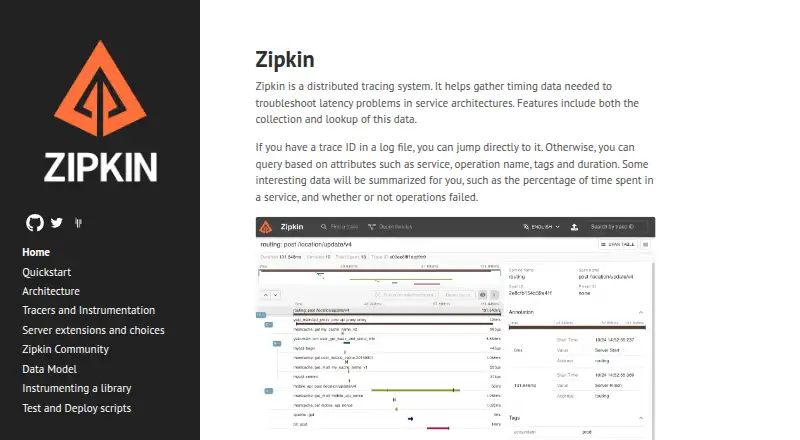
OpenZipkin is an open-source distributed tracing system for service architectures. It collects, stores, searches, and visualizes trace data through a web UI and query API. Teams can look up traces by service, operation, tags, duration, or trace ID, then review service timing, failures, and dependency diagrams. It is aimed at organizations that want a focused, self-hosted tracing system rather than a vendor-hosted service, with deployment available as a Java executable, Docker container, or source installation.
Its main strength is coverage across the core tracing workflow. Applications can report spans through HTTP, Kafka, gRPC, RabbitMQ, Apache ActiveMQ, or Apache Pulsar, while storage can be configured for in-memory use or persistent backends such as Cassandra, Elasticsearch, or MySQL. The web interface and dependency diagrams support investigation across service architectures, and the trace and span query API provides a programmatic access path. OpenTelemetry OTLP/HTTP ingestion is available through a documented experimental Zipkin module, which may suit teams evaluating an OpenTelemetry-connected setup but calls for care in production planning.
OpenZipkin is a strong fit for teams that value open-source deployment, direct control over infrastructure, and straightforward trace collection and lookup. Its scope is narrower than a broader observability platform: the published category specifications show self-hosted deployment and no tail-sampling capability. Teams that need managed hosting, advanced trace-volume controls, or a wider verified feature set should evaluate alternatives. Choose OpenZipkin when a focused Zipkin tracing stack, flexible collectors, and selectable storage backends are the priority; look elsewhere when operational ownership or feature breadth is the deciding factor.
Your product? Our editors can test OpenZipkin in depth and publish a review, labelled as paid · from $149/mo →
OpenZipkin pricing
OpenZipkin fact sheet
| Free plan | Yes |
|---|---|
| Paid from | Free |
| OpenTelemetry support | Yes |
| Service map | Yes |
| Tail-based sampling | No |
| Trace retention | Not verified |
| Deployment model | Self_hosted |
| Pricing basis | Not verified |
| Deployment | Cloud, Self-hosted |
| Platforms | Web |
| Support | Community, Docs |
| Built for | Small business, Mid-market, Enterprise (editorial estimate) |
| Integrations | 10 integrations: HTTP, Kafka, Apache ActiveMQ, gRPC, RabbitMQ, Apache Pulsar … See all → |
| Pricing | Free plan |
| Website | zipkin.io |
| Facts checked | 20 Sep 2026 |
OpenZipkin integrations
OpenZipkin lists 10 integrations on its own site.
- HTTP
- Kafka
- Apache ActiveMQ
- gRPC
- RabbitMQ
- Apache Pulsar
- Cassandra
- Elasticsearch
- MySQL
- OpenTelemetry
See all OpenZipkin integrations →
Alternatives to OpenZipkin
- Apache SkyWalkingA broad self-hosted stack that connects traces, topology, metrics, logs, profiles, and alerts.9.4
- JaegerA flexible self-hosted tracer for teams that need control over sampling and storage.9.2
- SigNozFull-stack tracing and observability with a free edition and $49 monthly Teams tier.9.1



See all OpenZipkin alternatives →
OpenZipkin vs the competition
- OpenZipkin vs Apache SkyWalking
- OpenZipkin vs Jaeger
- OpenZipkin vs SigNoz
- OpenZipkin vs Grafana Tempo
- OpenZipkin vs Uptrace
- OpenZipkin vs Pinpoint


Compare OpenZipkin with any tool side by side →
Also Ranked In
OpenZipkin is ranked in 3 of our directories.
Used OpenZipkin? Be the first to review it
The editor score above is our own research. What this page doesn't have yet is a reader's view — what you used OpenZipkin for, what worked and what didn't. No stars are seeded and no review is paid for; an editor reads every one before it appears.
Write a reviewTwo minutes · verified accounts only · read by an editor before it appears
Featured on iTechGuides

OpenZipkin is listed in our Distributed Tracing Tools directory. Add the badge to your site — it links back to this page.
<a href="https://www.itechguides.com/products/openzipkin/"><img src="https://www.itechguides.com/best/badge/openzipkin.svg" alt="Featured on iTechGuides" width="230" height="46"></a>
Reviewed by iTechGuides Editors · Editorial team · Updated Oct 2026
Advertiser disclosure: iTechGuides is reader-supported. Vendors can pay for top positions in our rankings and for a place on other products' pages, and we may earn a commission when you click some links. Bought places stand at the number bought; this page and our disclosure say so. Paying vendors may get a fuller, more detailed review from our editors, and that review can change their score. How we rank.
Last updated · How we research and update