
Open Diffix
Open Diffix: A focused open-source toolkit for synthetic data and dynamic PostgreSQL anonymization. Ranked #19 of 25 in Data Masking Software by our editors (7.4/10); pricing: Open source; best for open-source teams needing dynamic anonymization.
At a glance
- Editor score7.4 / 10
- PricingOpen source
- Best forOpen-source teams needing dynamic anonymization
- Paid fromNone
- Masking methodsDynamic
- Facts checked22 Sep 2026
Where it wins
- Generates synthetic data for analytics and machine learning
- Supports multi-table generation and protected-entity handling
- Provides dynamic PostgreSQL query anonymization
Where it doesn't
- pg_diffix development is currently paused
- The focus is structured data rather than broader data types
- Referential-integrity support is not part of the stated capability set
Our verdict on Open Diffix
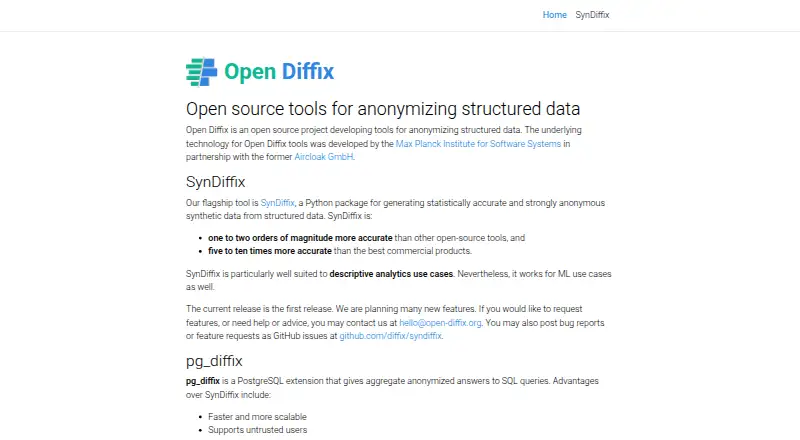
Open Diffix is an open-source project for anonymizing structured data, aimed at analysts, developers, and data owners who need to share or analyze datasets while reducing disclosure risk. Its tools cover synthetic data generation, dynamic anonymization for PostgreSQL queries, and a desktop data anonymization application. Deployment is on-premises, with API access and support for Windows, macOS, Linux, and self-hosted environments.
Its strongest area is the breadth of its synthetic-data workflow. The SynDiffix Python package supports descriptive analytics, including histograms and heatmaps, as well as machine-learning dataset generation. It can also generate synthetic data across multiple tables, create and read SynDiffix blobs, and handle protected entities in event and time-series data. This makes Open Diffix a fit for teams that need more than simple field masking and want anonymized datasets for analysis or model development.
The PostgreSQL component adds a separate path for dynamic anonymization by providing aggregate anonymized answers to SQL queries through the pg_diffix extension. However, development on pg_diffix is currently paused, which matters for teams choosing a PostgreSQL-centered workflow. Open Diffix should suit open-source teams seeking on-premises tooling for structured-data anonymization, synthetic datasets, and analytics. Teams that need an actively developed PostgreSQL component or a broader data-protection scope should assess alternatives alongside it.
Open Diffix pricing
Open Diffix fact sheet
| Free plan | Not verified |
|---|---|
| Paid from | None |
| Masking methods | Dynamic |
| Synthetic data | Yes |
| Referential integrity | Not verified |
| Deployment options | On-premises |
| Data subsetting | Not verified |
| API access | Yes |
| Database connectors | Not verified |
| Deployment | Self-hosted, Desktop |
| Platforms | Windows, macOS, Linux |
| Support | Email, Docs |
| Built for | Solo, Small business, Mid-market, Enterprise (editorial estimate) |
| Pricing | Open source |
| Website | open-diffix.org |
| Facts checked | 22 Sep 2026 |
Alternatives to Open Diffix
- IBM Optim Data PrivacyA broad enterprise privacy toolkit with sales-led pricing and a 90-day trial reference.9.4
- DataVeilA focused masking tool with broad database coverage and a useful free Community plan.9.2
- BigID Data MaskingA policy-driven masking platform for governed data across hybrid enterprise environments.9.1


See all Open Diffix alternatives →
Used Open Diffix? Be the first to review it
The editor score above is our own research. What this page doesn't have yet is a reader's view — what you used Open Diffix for, what worked and what didn't. No stars are seeded and no review is paid for; an editor reads every one before it appears.
Write a reviewTwo minutes · verified accounts only · read by an editor before it appears
Featured on iTechGuides

Open Diffix is listed in our Data Masking Software directory. Add the badge to your site — it links back to this page.
<a href="https://www.itechguides.com/products/open-diffix/"><img src="https://www.itechguides.com/best/badge/open-diffix.svg" alt="Featured on iTechGuides" width="230" height="46"></a>
Reviewed by iTechGuides Editors · Editorial team · Updated Oct 2026
Advertiser disclosure: iTechGuides is reader-supported. We may earn a commission when you click some links. How we rank.
Last updated · How we research and update