McSema
McSema: A focused open-source lifter for applying LLVM analysis and fuzzing to supported binaries. Ranked #24 of 72 in Reverse Engineering Tools by our editors (6.3/10); pricing: Free plan; best for analysts moving supported binaries into LLVM workflows.
At a glance
- Editor score6.3 / 10
- PricingFree plan
- Best forAnalysts moving supported binaries into LLVM workflows
- Free planYes
- Paid fromFree
- DecompilerNo
- Facts checked23 Sep 2026
Where it wins
- Lifts 32-bit and 64-bit Linux ELF and Windows PE files to LLVM bitcode
- Supports x86 and x86-64 plus subsets of AArch64 and SPARC instructions
- Enables LLVM analysis, libFuzzer fuzzing, and recompilation of lifted bitcode
Where it doesn't
- Requires an external disassembler frontend; IDA Pro is the documented default
- DynInst support is experimental and not officially maintained
- Default scripts do not support raw firmware blobs
Our verdict on McSema
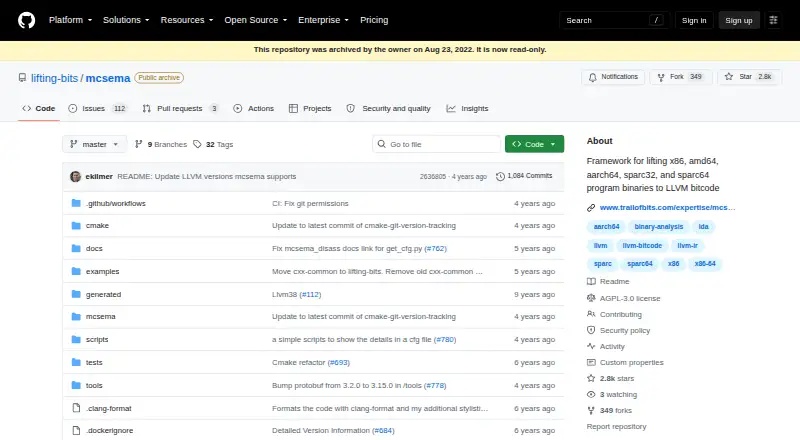
McSema, from Trail of Bits, is an open-source executable lifter for analysts who need to work with supported native binaries without their source code. It converts Linux ELF and Windows PE executables and shared libraries into LLVM bitcode, creating a path to LLVM-based analysis, fuzzing, symbolic execution, or binary rewriting. Its scope is specific: it handles executable inputs rather than raw firmware blobs, and is suited to researchers and reverse engineers comfortable working with disassembly and LLVM tooling.
The core workflow separates control-flow recovery from instruction translation: mcsema-disass recovers control flow, and mcsema-lift translates instructions using Remill semantics. Support covers many x86 and x86-64 instructions, including integer, X87, MMX, SSE, and AVX, alongside subsets of AArch64, SPARC32, and SPARC64. Lifted bitcode can be analyzed with LLVM tools, fuzzed with libFuzzer, or recompiled into a runnable executable. McSema also supports cross-lifting Linux binaries on Windows and Windows binaries on Linux. IDA Pro is the documented default disassembler frontend; DynInst is experimental, so the frontend dependency is a meaningful part of evaluating fit.
The project is open source and self-hosted, with a free plan. Its listed integrations include IDA Pro, DynInst, Remill, Anvill, and LLVM. Linux and Windows are the documented binary targets; macOS is described as a possible build and run platform, but is not explicitly tested and may not work. Community and email are the listed support channels. Choose McSema when the target binary fits its formats and architectures and LLVM-based analysis is central to the workflow. Look elsewhere if the primary need is firmware or raw-blob analysis, or if the external disassembler requirement does not fit your environment.
Your product? Our editors can test McSema in depth and publish a review, labelled as paid · from $149/mo →
McSema pricing
McSema fact sheet
| Free plan | Yes |
|---|---|
| Paid from | Free |
| Decompiler | No |
| Firmware analysis | No |
| Analysis mode | Static |
| Plugin API | Not verified |
| Supported platforms | Linux, Windows, macOS |
| Supported architectures | x86, x86-64, AArch64, SPARC32, SPARC64 |
| Deployment | Self-hosted |
| Platforms | Windows, Linux, macOS |
| Support | Community, Email |
| Built for | Solo, Small business, Mid-market, Enterprise (editorial estimate) |
| Integrations | 5 integrations: IDA Pro, DynInst (experimental), Remill, Anvill, LLVM |
| Pricing | Free plan |
| Website | github.com |
| Facts checked | 23 Sep 2026 |
McSema integrations
McSema lists 5 integrations on its own site.
- IDA Pro
- DynInst (experimental)
- Remill
- Anvill
- LLVM
Alternatives to McSema
- GhidraA broad, free toolkit for native-code and bytecode reverse engineering.9.4
- IDA ProA comprehensive native reverse-engineering suite with substantial annual licensing costs.9.2
- ImHexA desktop binary inspection workbench with editing, patterns, comparison, and disassembly.8.7


Used McSema? Be the first to review it
The editor score above is our own research. What this page doesn't have yet is a reader's view — what you used McSema for, what worked and what didn't. No stars are seeded and no review is paid for; an editor reads every one before it appears.
Write a reviewTwo minutes · verified accounts only · read by an editor before it appears
Featured on iTechGuides

McSema is listed in our Reverse Engineering Tools directory. Add the badge to your site — it links back to this page.
<a href="https://www.itechguides.com/products/mcsema/"><img src="https://www.itechguides.com/best/badge/mcsema.svg" alt="Featured on iTechGuides" width="230" height="46"></a>
Reviewed by iTechGuides Editors · Editorial team · Updated Oct 2026
Advertiser disclosure: iTechGuides is reader-supported. Vendors can pay for top positions in our rankings and for a place on other products' pages, and we may earn a commission when you click some links. Bought places stand at the number bought; this page and our disclosure say so. Paying vendors may get a fuller, more detailed review from our editors, and that review can change their score. How we rank.
Last updated · How we research and update