
Manticore Search
Manticore Search: A broad, free search database for teams that want SQL and self-hosted control. Ranked #1 of 30 in Search Databases by our editors (9.4/10); pricing: Free plan; best for free search with SQL and broad integrations.
At a glance
- Editor score9.4 / 10
- PricingFree plan
- Best forFree search with SQL and broad integrations
- Free planYes
- Paid fromFree
- Vector searchYes
- Founded2017 · Chatham, Kent, United Kingdom
- Facts checked20 Sep 2026
Where it wins
- Full-text, vector, hybrid, faceted, and geospatial search
- SQL through the MySQL protocol plus HTTP/JSON interfaces
- Runs on Windows, macOS, Linux, Docker, and Kubernetes
Where it doesn't
- Self-hosted deployment requires infrastructure management
- Its 2017 founding makes it less mature than Solr or Elasticsearch
- Broad capabilities may require more configuration than a narrow search tool
Our verdict on Manticore Search
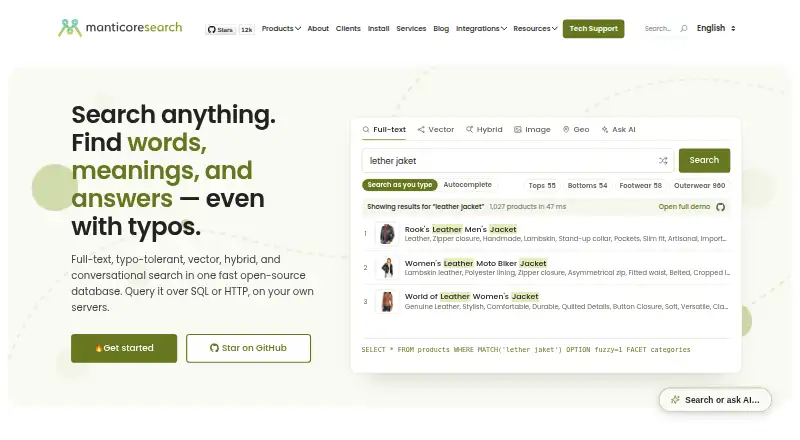
Manticore Search is an open-source database and search engine for applications that need full-text, faceted, vector, hybrid, geographic, or analytics search. It fits developers and technical teams building website search, product search, document retrieval, log analytics, recommendations, or conversational search. The free, self-hosted model supports Windows, macOS, Linux, Docker, and Kubernetes, giving teams control over deployment and infrastructure.
Its strongest differentiator is breadth. Full-text search includes stemming, lemmatization, stopwords, synonyms, wordforms, fuzzy search, and highlighting. Teams can combine vector retrieval with full-text search, use automatic embeddings and multiple distance metrics, and add faceting, aggregations, geospatial filtering, autocomplete, or percolate tables for incoming data streams. Real-time indexing and real-time tables also suit applications where indexed content changes continuously. This makes Manticore a useful fit when one search layer needs to cover several retrieval patterns rather than only keyword search.
The integration surface is similarly broad. SQL querying works through the MySQL protocol, while HTTP/HTTPS and JSON interfaces support application and service integrations. Listed connections include MySQL, MariaDB, PostgreSQL, Microsoft SQL Server, ODBC, XML, CSV, TSV, Logstash, Apache Superset, Grafana, Kibana, Kafka, and ProxySQL. The tradeoff is operational: self-hosted deployment places infrastructure responsibility on the adopting team, and Manticore has less maturity than Solr or Elasticsearch. Choose it for broad free capabilities, SQL access, and deployment control; consider a more mature alternative when ecosystem longevity is the primary requirement.
Your product? Our editors can test Manticore Search in depth and publish a review, labelled as paid · from $149/mo →
Manticore Search pricing
Manticore Search fact sheet
| Free plan | Yes |
|---|---|
| Paid from | Free |
| Primary search mode | Not verified |
| Vector search | Yes |
| Faceted search | Yes |
| Deployment | Self-hosted |
| Index limit | Not verified |
| Query interface | SQL |
| Deployment | Self-hosted |
| Platforms | Windows, macOS, Linux |
| Support | Email, Community, Docs |
| Built for | Solo, Small business, Mid-market, Enterprise (editorial estimate) |
| Integrations | 14 integrations: MySQL, MariaDB, PostgreSQL, Microsoft SQL Server, ODBC, XML … |
| Pricing | Free plan |
| Website | manticoresearch.com |
| Facts checked | 20 Sep 2026 |
Manticore Search integrations
Manticore Search lists 14 integrations on its own site.
- MySQL
- MariaDB
- PostgreSQL
- Microsoft SQL Server
- ODBC
- XML
- CSV
- TSV
- Logstash
- Apache Superset
- Grafana
- Kibana
- Kafka
- ProxySQL
Alternatives to Manticore Search
- Apache SolrA self-hosted search server with broad query, indexing, and distributed deployment capabilities.9.3
- ElasticsearchA broad hybrid search engine for teams that need scale, analytics, and vector retrieval.9.2
- AlgoliaA cloud search platform combining hybrid search, relevance controls, and discovery tools.9.1



See all Manticore Search alternatives →
Manticore Search vs the competition
- Manticore Search vs Apache Solr
- Manticore Search vs Elasticsearch
- Manticore Search vs Algolia
- Manticore Search vs Meilisearch
- Manticore Search vs Typesense
- Manticore Search vs Datafari



Compare Manticore Search with any tool side by side →
Also Ranked In
Manticore Search is ranked in 2 of our directories.
Used Manticore Search? Be the first to review it
The editor score above is our own research. What this page doesn't have yet is a reader's view — what you used Manticore Search for, what worked and what didn't. No stars are seeded and no review is paid for; an editor reads every one before it appears.
Write a reviewTwo minutes · verified accounts only · read by an editor before it appears
Featured on iTechGuides

Manticore Search is listed in our Search Databases directory. Add the badge to your site — it links back to this page.
<a href="https://www.itechguides.com/products/manticore-search/"><img src="https://www.itechguides.com/best/badge/manticore-search.svg" alt="Featured on iTechGuides" width="230" height="46"></a>
Reviewed by iTechGuides Editors · Editorial team · Updated Oct 2026
Advertiser disclosure: iTechGuides is reader-supported. Vendors can pay for top positions in our rankings and for a place on other products' pages, and we may earn a commission when you click some links. Bought places stand at the number bought; this page and our disclosure say so. Paying vendors may get a fuller, more detailed review from our editors, and that review can change their score. How we rank.
Last updated · How we research and update