
Kamu
Kamu: A broad open-source data fabric for teams managing auditable, distributed data flows. Ranked #14 of 24 in Data Fabric Software by our editors (7.6/10); pricing: Free plan; best for technical teams wanting open-source data fabric.
At a glance
- Editor score7.6 / 10
- PricingFree plan
- Best forTechnical teams wanting open-source data fabric
- Free planYes
- Paid fromFree
- Deployment modelHybrid
- Facts checked22 Sep 2026
Where it wins
- Verifiable provenance, lineage, and immutable data history
- Temporal pipelines with federated queries across data locations
- Integrations spanning Jupyter, Spark, Flink, S3, GCS, and Azure
Where it doesn't
- Self-hosted and private-cloud deployments require infrastructure ownership
- Its broad platform may exceed the needs of basic ETL or query workflows
- The protocol-centered approach may require specialized technical expertise
Our verdict on Kamu
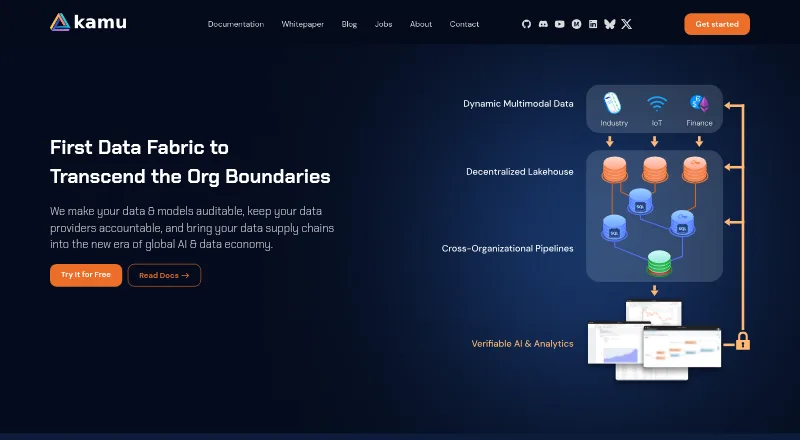
Kamu is an open-source data-fabric platform for managing, transforming, querying, and sharing dynamic structured data across organizational boundaries. It is aimed at data publishers, data scientists, governments, researchers, and technical organizations that need auditable, reusable, near-real-time data flows. The platform combines a CLI and web experience with API access, local deployment, server operation, Kubernetes-based private cloud, and on-premises environments. Its category capabilities include data cataloging, lineage, governance controls, data virtualization, and both supported data delivery modes.
The standout capability is Kamu’s treatment of data history and provenance. Its immutable, history-preserving ledger records how datasets change, while temporal and stream-processing pipelines support time-aware transformations. Federated querying can work across data locations, and the platform includes an embedded SQL shell, web SQL editor, and integrated Jupyter notebooks. Data can be ingested from external sources and extractors, then shared through conventional or decentralized storage. Node-level permissions and dataset encryption add controls for collaborative environments where access and traceability matter.
Integration coverage connects Kamu with Debezium, MQTT, S3, GCS, Azure, IPFS, Apache Superset, Jupyter, Apache Flink, Apache Spark, Apache DataFusion, and RisingWave. That range suits teams assembling a distributed data workflow rather than adopting a narrow point tool. The tradeoff is operational scope: local, server, Kubernetes, private-cloud, and on-premises options place more responsibility on the technical team than a purely managed service would. Organizations seeking verifiable lineage, immutable history, and cross-boundary data sharing should consider Kamu; teams needing only straightforward extraction and querying may prefer a simpler platform.
Your product? Our editors can test Kamu in depth and publish a review, labelled as paid · from $149/mo →
Kamu pricing
Kamu fact sheet
| Free plan | Yes |
|---|---|
| Paid from | Free |
| Deployment model | Hybrid |
| Data catalog | Yes |
| Data lineage | Yes |
| Governance controls | Yes |
| Data virtualization | Yes |
| Data delivery modes | Both |
| Connector count | Not verified |
| Deployment | Cloud, Self-hosted, Desktop |
| Platforms | Web, Windows, macOS, Linux |
| Support | Community, Docs |
| Built for | Small business, Mid-market, Enterprise (editorial estimate) |
| Integrations | 12 integrations: Debezium, MQTT, S3, GCS, Azure, IPFS … |
| Pricing | Free plan |
| Website | kamu.dev |
| Facts checked | 22 Sep 2026 |
Kamu integrations
Kamu lists 12 integrations on its own site.
- Debezium
- MQTT
- S3
- GCS
- Azure
- IPFS
- Apache Superset
- Jupyter
- Apache Flink
- Apache Spark
- Apache DataFusion
- RisingWave
Alternatives to Kamu
- IBM Cloud Pak for DataA broad hybrid data fabric platform for cataloging, governance, delivery and AI workflows.9.3
- Informatica Intelligent Data Management CloudA broad hybrid data management platform for governed enterprise data operations.9.1
- K2View FabricA broad hybrid data fabric for governed entity data delivery across enterprise systems.8.8



Used Kamu? Be the first to review it
The editor score above is our own research. What this page doesn't have yet is a reader's view — what you used Kamu for, what worked and what didn't. No stars are seeded and no review is paid for; an editor reads every one before it appears.
Write a reviewTwo minutes · verified accounts only · read by an editor before it appears
Featured on iTechGuides

Kamu is listed in our Data Fabric Software directory. Add the badge to your site — it links back to this page.
<a href="https://www.itechguides.com/products/kamu/"><img src="https://www.itechguides.com/best/badge/kamu.svg" alt="Featured on iTechGuides" width="230" height="46"></a>
Reviewed by iTechGuides Editors · Editorial team · Updated Oct 2026
Advertiser disclosure: iTechGuides is reader-supported. Vendors can pay for top positions in our rankings and for a place on other products' pages, and we may earn a commission when you click some links. Bought places stand at the number bought; this page and our disclosure say so. Paying vendors may get a fuller, more detailed review from our editors, and that review can change their score. How we rank.
Last updated · How we research and update