
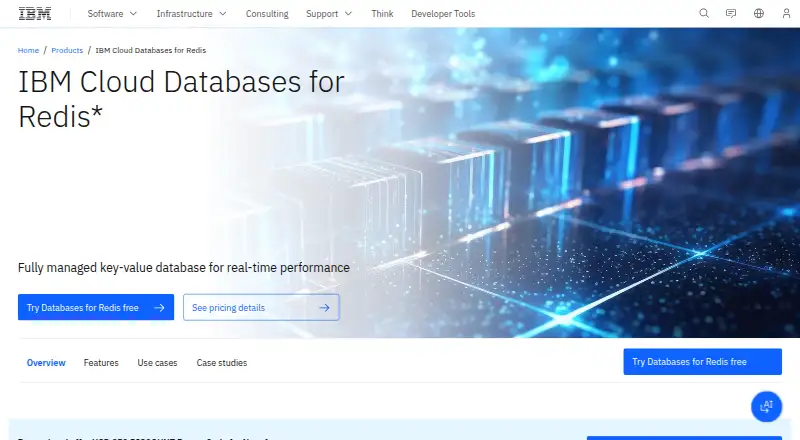
IBM Cloud Databases for Redis
IBM Cloud Databases for Redis: A managed Redis service for IBM Cloud teams running persistent, highly available workloads. Ranked #7 of 27 in Redis Hosting by our editors (8.6/10); pricing: Paid; best for IBM Cloud teams needing managed Redis operations.
At a glance
- Editor score8.6 / 10
- PricingPaid
- Best forIBM Cloud teams needing managed Redis operations
- Free planNo
- Facts checked21 Sep 2026
Where it wins
- Automatic failover with two-member primary/replica replication
- Daily backups retained for 30 days by default
- Independent disk and RAM scaling with public or private endpoints
Where it doesn't
- No product-level free plan
- Pricing is resource-based rather than a fixed monthly price
- The listed plan is limited to the Standard configuration
Our verdict on IBM Cloud Databases for Redis
IBM Cloud Databases for Redis is a fully managed, cloud-hosted key-value database service for applications that need low-latency data access. It supports Redis APIs, data formats, and clients, making it suitable for caching, real-time leaderboards, and publisher-subscriber messaging. Developers and organizations already running workloads on IBM Cloud can use its web and API interfaces, with public or private network connectivity for application access.
The service handles patching, monitoring, scaling, backups, and other database operations. Its Standard plan provides a highly available Redis cluster with two data members, replicated data, and configurable disk, RAM, and CPU resources. IBM publishes resource-based pricing rather than a fixed starting monthly price, and the paid service has no product-level free plan. Independent disk and RAM scaling can help teams adjust those resources separately as workload needs change.
For continuity and data protection, deployments support automatic failover, persistent storage through RDB snapshots and AOF, and daily automated backups retained for 30 days by default. Backup restoration creates a new database deployment. TLS 1.2 connections and encrypted storage address transport and data protection needs, while integrations with IBM Key Protect, IBM Cloud Object Storage, IBM Cloud Monitoring, Terraform, and the IBM Cloud API support an IBM-centered operating model. Choose it when managed Redis operations, replication, backups, and IBM Cloud integration matter. Consider another option if a free plan or fixed monthly pricing is essential.
Your product? Our editors can test IBM Cloud Databases for Redis in depth and publish a review, labelled as paid · from $149/mo →
IBM Cloud Databases for Redis pricing
All 1 IBM Cloud Databases for Redis plans and prices →
IBM Cloud Databases for Redis fact sheet
| Free plan | No |
|---|---|
| Paid from | Not verified |
| Memory limit | Not verified |
| Persistent storage | Yes |
| High availability | Yes |
| Redis compatibility | Redis |
| Private networking | Yes |
| Automatic backups | Yes |
| TLS encryption | Yes |
| Deployment | Cloud |
| Platforms | Web |
| Compliance & security | SOC 2, GDPR, HIPAA, PCI DSS |
| Support | Tickets, Docs |
| Built for | Mid-market, Enterprise (editorial estimate) |
| Integrations | 5 integrations: IBM Key Protect, IBM Cloud Object Storage, IBM Cloud Monitoring, Terraform, IBM Cloud API |
| Pricing | Paid (source) |
| Website | ibm.com |
| Facts checked | 21 Sep 2026 |
IBM Cloud Databases for Redis integrations
IBM Cloud Databases for Redis lists 5 integrations on its own site.
- IBM Key Protect
- IBM Cloud Object Storage
- IBM Cloud Monitoring
- Terraform
- IBM Cloud API
Alternatives to IBM Cloud Databases for Redis
- Aiven for ValkeyA managed Valkey service with a free tier, private networking, backups, and high availability.9.4
- Amazon ElastiCacheA broad managed cache service for applications already built around AWS.9.2
- Upstash RedisA flexible Redis service with REST access, usage pricing, and strong edge-platform support.9.0



See all IBM Cloud Databases for Redis alternatives →
IBM Cloud Databases for Redis vs the competition
- IBM Cloud Databases for Redis vs Aiven for Valkey
- IBM Cloud Databases for Redis vs Amazon ElastiCache
- IBM Cloud Databases for Redis vs Upstash Redis
- IBM Cloud Databases for Redis vs Amazon MemoryDB
- IBM Cloud Databases for Redis vs Azure Managed Redis
- IBM Cloud Databases for Redis vs Alibaba Cloud Tair



Compare IBM Cloud Databases for Redis with any tool side by side →
Also Ranked In
IBM Cloud Databases for Redis is ranked in 2 of our directories.
Used IBM Cloud Databases for Redis? Be the first to review it
The editor score above is our own research. What this page doesn't have yet is a reader's view — what you used IBM Cloud Databases for Redis for, what worked and what didn't. No stars are seeded and no review is paid for; an editor reads every one before it appears.
Write a reviewTwo minutes · verified accounts only · read by an editor before it appears
Featured on iTechGuides

IBM Cloud Databases for Redis is listed in our Redis Hosting directory. Add the badge to your site — it links back to this page.
<a href="https://www.itechguides.com/products/ibm-cloud-databases-for-redis/"><img src="https://www.itechguides.com/best/badge/ibm-cloud-databases-for-redis.svg" alt="Featured on iTechGuides" width="230" height="46"></a>
Reviewed by iTechGuides Editors · Editorial team · Updated Oct 2026
Advertiser disclosure: iTechGuides is reader-supported. Vendors can pay for top positions in our rankings and for a place on other products' pages, and we may earn a commission when you click some links. Bought places stand at the number bought; this page and our disclosure say so. Paying vendors may get a fuller, more detailed review from our editors, and that review can change their score. How we rank.
Last updated · How we research and update