
Hypothesis
Hypothesis: A focused Python library for generated properties, shrinking, and stateful tests. Ranked #24 of 32 in Unit Testing Frameworks by our editors (6.7/10); pricing: Open source; best for python teams focused on property-based testing.
At a glance
- Editor score6.7 / 10
- PricingOpen source
- Best forPython teams focused on property-based testing
- Paid fromFree
- Supported languagesPython
- Facts checked21 Sep 2026
Where it wins
- Generates edge cases from declarative strategies
- Shrinks failures to simpler examples
- Supports stateful testing with rule-based state machines
Where it doesn't
- Supports Python rather than multiple programming languages
- Requires pytest or unittest for common test workflows
- Focuses on property-based testing instead of broad test coverage
Our verdict on Hypothesis
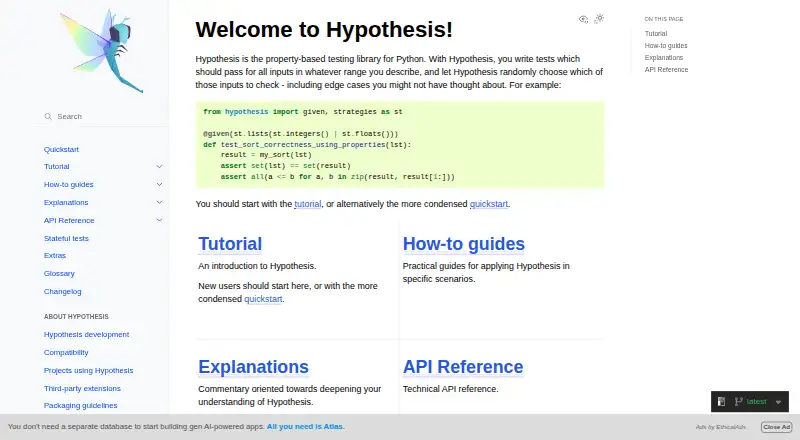
Hypothesis is an open-source property-based testing library for Python developers. It generates inputs from declarative strategies, including edge cases, then runs tests against those inputs. When a test fails, it searches for a simpler failing example, helping teams inspect the underlying behavior. Hypothesis fits Python projects that want generated cases, parameterized inputs, and deeper exploration of a property than a fixed list of examples provides. It runs on Windows, macOS, and Linux and integrates with pytest and unittest.
Its strongest capability is the combination of generated inputs and automatic shrinking. The @given decorator supports parameterized input generation, while pytest.mark.parametrize can be used for parameterized cases in pytest workflows. Filtering is available through filter() and assume(). For more involved behavior, Hypothesis provides rule-based state machines for stateful testing, along with reusable generated-value bundles for stateful tests. Thread-safe execution across processes and threads is also included. Integrations with Django, coverage.py, and HypoFuzz extend its fit within Python testing workflows.
Hypothesis is a focused library rather than a broad standalone testing framework. That focus makes it a strong choice for Python teams that want property-based testing, generated edge cases, simpler failure examples, or stateful test models. It is less suitable for teams seeking one framework that supports multiple languages or a general-purpose testing workflow without pytest or unittest. The open-source model and free plan make it accessible for teams evaluating generated testing approaches, while its Python-only scope keeps the product centered on that ecosystem.
Your product? Our editors can test Hypothesis in depth and publish a review, labelled as paid · from $149/mo →
Hypothesis pricing
Hypothesis fact sheet
| Free plan | Not verified |
|---|---|
| Paid from | Free |
| Supported languages | Python |
| Built-in mocks | Not verified |
| Parameterized cases | Yes |
| Parallel execution | Not verified |
| Snapshot testing | Not verified |
| Property-based checks | Yes |
| Support | Docs |
| Built for | Solo, Small business, Mid-market, Enterprise (editorial estimate) |
| Integrations | 2 integrations: pytest, unittest |
| Pricing | Open source |
| Website | hypothesis.readthedocs.io |
| Facts checked | 21 Sep 2026 |
Hypothesis integrations
Hypothesis lists 2 integrations on its own site.
- pytest
- unittest
Alternatives to Hypothesis
- pytestA free, full-featured Python testing framework with fixtures, plugins, and parametrization.9.4
- GoogleTestA strong free choice for C++ teams that need mocks, parameterized tests, and parallel options.9.2
- JUnitAn open-source Java and JVM framework with broad tooling support and flexible test models.9.1

See all Hypothesis alternatives →
Used Hypothesis? Be the first to review it
The editor score above is our own research. What this page doesn't have yet is a reader's view — what you used Hypothesis for, what worked and what didn't. No stars are seeded and no review is paid for; an editor reads every one before it appears.
Write a reviewTwo minutes · verified accounts only · read by an editor before it appears
Featured on iTechGuides

Hypothesis is listed in our Unit Testing Frameworks directory. Add the badge to your site — it links back to this page.
<a href="https://www.itechguides.com/products/hypothesis/"><img src="https://www.itechguides.com/best/badge/hypothesis.svg" alt="Featured on iTechGuides" width="230" height="46"></a>
Reviewed by iTechGuides Editors · Editorial team · Updated Oct 2026
Advertiser disclosure: iTechGuides is reader-supported. Vendors can pay for top positions in our rankings and for a place on other products' pages, and we may earn a commission when you click some links. Bought places stand at the number bought; this page and our disclosure say so. Paying vendors may get a fuller, more detailed review from our editors, and that review can change their score. How we rank.
Last updated · How we research and update