grpcurl
grpcurl: A focused, free command-line tool for inspecting and invoking gRPC services. Ranked #18 of 38 in API Clients by our editors (7.3/10); pricing: Free plan; best for command-line gRPC operations.
At a glance
- Editor score7.3 / 10
- PricingFree plan
- Best forCommand-line gRPC operations
- Free planYes
- Paid fromFree
- Automated test runsNo
- Facts checked20 Sep 2026
Where it wins
- Supports unary and all major gRPC streaming RPC patterns
- Handles TLS, mutual-TLS, and plaintext connections
- Discovers and describes schemas through reflection or proto files
Where it doesn't
- Focused on gRPC rather than GraphQL or WebSocket APIs
- Does not include automated testing workflows
- Does not include team workspaces or API documentation
Our verdict on grpcurl
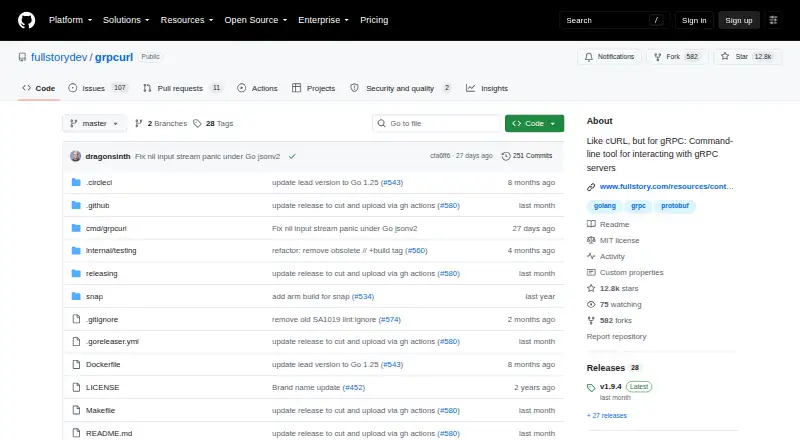
grpcurl is an open-source command-line client for developers who need to interact with gRPC servers directly. It sends and receives JSON-encoded request data, invokes RPC methods, and works with unary, client-streaming, server-streaming, and bidirectional-streaming calls. The tool is suited to desktop command-line workflows where inspecting services or making targeted requests matters more than using a hosted interface or graphical workspace.
Its strongest capability is schema-aware gRPC exploration. Server reflection can expose available services and methods, while local .proto source files and compiled protoset files provide another way to load service definitions. grpcurl can list services and methods, describe services, methods, and message types, and export proto files or protoset descriptors. It also supports request headers and gRPC metadata, giving developers control over call context while working from the terminal. TLS, mutual-TLS, and plaintext connections are supported, so the same command-line focus applies across different endpoint configurations.
The trade-off is its narrow scope. grpcurl is built for gRPC operations rather than broader API coverage: it does not support GraphQL or WebSocket APIs, and it does not provide automated tests, API documentation, or team workspaces. Its free, open-source model fits developers who want a specialized utility for service discovery, schema inspection, and RPC invocation, including those building command-line tools with its Go library. Teams seeking shared workspaces, documented API collections, or testing workflows should choose a product designed around those capabilities instead.
Your product? Our editors can test grpcurl in depth and publish a review, labelled as paid · from $149/mo →
grpcurl pricing
grpcurl fact sheet
| Free plan | Yes |
|---|---|
| Paid from | Free |
| GraphQL support | No |
| gRPC support | Yes |
| WebSocket support | No |
| Automated test runs | No |
| API documentation | No |
| Team workspaces | No |
| Available platforms | Desktop |
| Pricing | Free plan |
| Website | github.com |
| Facts checked | 20 Sep 2026 |
Alternatives to grpcurl
- PostmanA broad API workspace spanning requests, testing, mocking, specifications, and delivery workflows.9.4
- SoapUIA mature, testing-focused API client for REST, SOAP, GraphQL, and CI workflows.9.2
- ApidogA broad API workspace for teams that want design, testing, mocks, and CI/CD together.8.8



See all grpcurl alternatives →
Also Ranked In
grpcurl is ranked in 2 of our directories.
Used grpcurl? Be the first to review it
The editor score above is our own research. What this page doesn't have yet is a reader's view — what you used grpcurl for, what worked and what didn't. No stars are seeded and no review is paid for; an editor reads every one before it appears.
Write a reviewTwo minutes · verified accounts only · read by an editor before it appears
Featured on iTechGuides

grpcurl is listed in our API Clients directory. Add the badge to your site — it links back to this page.
<a href="https://www.itechguides.com/products/grpcurl/"><img src="https://www.itechguides.com/best/badge/grpcurl.svg" alt="Featured on iTechGuides" width="230" height="46"></a>
Reviewed by iTechGuides Editors · Editorial team · Updated Oct 2026
Advertiser disclosure: iTechGuides is reader-supported. Vendors can pay for top positions in our rankings and for a place on other products' pages, and we may earn a commission when you click some links. Bought places stand at the number bought; this page and our disclosure say so. Paying vendors may get a fuller, more detailed review from our editors, and that review can change their score. How we rank.
Last updated · How we research and update