Google Cloud Knowledge Catalog
Google Cloud Knowledge Catalog: A broad lineage and governance catalog for teams centered on Google Cloud. Ranked #14 of 41 in Data Lineage Tools by our editors (7.9/10); pricing: Paid; best for google Cloud-centric catalog teams.
At a glance
- Editor score7.9 / 10
- PricingPaid
- Best forGoogle Cloud-centric catalog teams
- Free planNo
- Column-level lineageYes
- Founded1998 · Mountain View, California, USA
- Facts checked21 Sep 2026
Where it wins
- Table- and column-level lineage with upstream and downstream impact analysis
- Automatic metadata discovery across supported Google Cloud sources
- Quality, profiling, glossaries, connectors, and Looker lineage in one catalog
Where it doesn't
- Usage-based pricing varies by region and processing type
- Some Looker and connector capabilities are in Preview
- Its strongest fit is organizations using Google Cloud and connected platforms
Our verdict on Google Cloud Knowledge Catalog
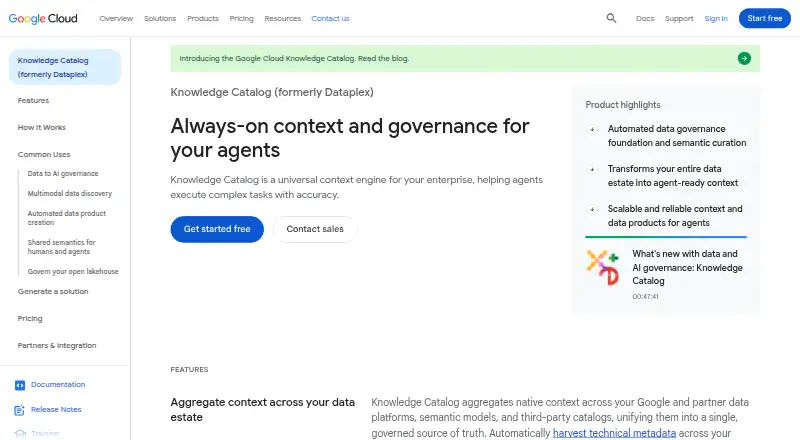
Google Cloud Knowledge Catalog is a managed catalog and governance service for organizations working with Google Cloud and connected data platforms. It centralizes technical and business metadata for data and AI assets, with semantic and keyword search across cataloged resources. Automatic metadata discovery and ingestion from supported sources help teams build a searchable inventory, while APIs and custom-source ingestion extend the catalog beyond native integrations. It is suited to catalog teams that need lineage, governance, and enterprise context across data assets rather than a narrowly focused lineage viewer.
The published pricing structure separates standard processing, premium processing, metadata storage, API calls, and shuffle storage. A free tier includes 100 DCU-hours per month for standard processing at no charge. Standard processing covers data discovery and automatic metadata discovery from Cloud Storage. Premium processing adds data lineage, data quality, data profiling, and a data exploration workbench. Metadata storage is billed by monthly average volume, while Data Catalog API and Data Lineage API usage are billed separately. Shuffle storage applies to configured data exploration workbench environments, so teams should map expected discovery, lineage, API, and exploration workloads before selecting a configuration.
Lineage coverage is a central strength: views can show table, column, pipeline transformation, process, and supported BI-asset relationships, with upstream and downstream impact analysis. Integrations include BigQuery, Cloud Storage, AlloyDB, Spanner, Cloud SQL, Firestore, Looker, Managed Service for Apache Spark, dbt Core, Oracle, MySQL, PostgreSQL, SQL Server, Collibra, and Atlan. Data quality checks, profiling, business glossaries, custom metadata aspects, and AI features broaden its governance role. Choose it when Google Cloud alignment and broad catalog capabilities matter; consider alternatives if Preview functionality or a cloud-centered ecosystem does not fit your operating model.
Your product? Our editors can test Google Cloud Knowledge Catalog in depth and publish a review, labelled as paid · from $149/mo →
Google Cloud Knowledge Catalog pricing
All 6 Google Cloud Knowledge Catalog plans and prices →
Google Cloud Knowledge Catalog fact sheet
| Free plan | No |
|---|---|
| Paid from | Not verified |
| Automated discovery | Yes |
| Column-level lineage | Yes |
| Impact analysis | Yes |
| Pipeline lineage | Yes |
| Report lineage | Yes |
| Deployment | Cloud |
| Deployment | Cloud |
| Platforms | Web |
| Compliance & security | HIPAA |
| Support | Email, Live chat, Phone, Tickets, Community, Docs |
| Built for | Small business, Mid-market, Enterprise (editorial estimate) |
| Integrations | 19 integrations: BigQuery, Cloud Storage, AlloyDB, Spanner, Cloud SQL, Firestore … See all → |
| Pricing | Paid (source) |
| Website | cloud.google.com |
| Facts checked | 21 Sep 2026 |
Google Cloud Knowledge Catalog integrations
Google Cloud Knowledge Catalog lists 19 integrations on its own site.
- BigQuery
- Cloud Storage
- AlloyDB
- Spanner
- Cloud SQL
- Firestore
- Looker
- Managed Service for Apache Spark
- dbt Core
- Oracle
- MySQL
- PostgreSQL
- SQL Server
- Collibra
- Atlan
- Ab Initio
- Anomalo
- DataHub
- Vertex AI
See all Google Cloud Knowledge Catalog integrations →
Alternatives to Google Cloud Knowledge Catalog
- Alation Data LineageA broad lineage system for tracing data from source systems through BI outputs.9.2
- Informatica Cloud Data Governance and CatalogA broad governance and lineage service for complex cloud, on-premises and hybrid data estates.9.1
- Talend Data CatalogA broad catalog and lineage product for complex enterprise data architectures.9.0



See all Google Cloud Knowledge Catalog alternatives →
Also Ranked In
Google Cloud Knowledge Catalog is ranked in 2 of our directories.
Used Google Cloud Knowledge Catalog? Be the first to review it
The editor score above is our own research. What this page doesn't have yet is a reader's view — what you used Google Cloud Knowledge Catalog for, what worked and what didn't. No stars are seeded and no review is paid for; an editor reads every one before it appears.
Write a reviewTwo minutes · verified accounts only · read by an editor before it appears
Featured on iTechGuides

Google Cloud Knowledge Catalog is listed in our Data Lineage Tools directory. Add the badge to your site — it links back to this page.
<a href="https://www.itechguides.com/products/google-cloud-knowledge-catalog/"><img src="https://www.itechguides.com/best/badge/google-cloud-knowledge-catalog.svg" alt="Featured on iTechGuides" width="230" height="46"></a>
Reviewed by iTechGuides Editors · Editorial team · Updated Oct 2026
Advertiser disclosure: iTechGuides is reader-supported. Vendors can pay for top positions in our rankings and for a place on other products' pages, and we may earn a commission when you click some links. Bought places stand at the number bought; this page and our disclosure say so. Paying vendors may get a fuller, more detailed review from our editors, and that review can change their score. How we rank.
Last updated · How we research and update