
Fedora Repository
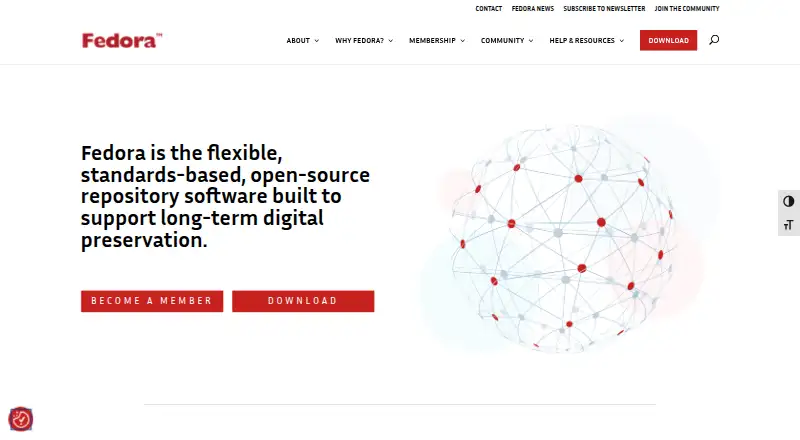
Fedora Repository: A flexible preservation backend for teams building open digital repositories. Ranked #27 of 29 in Data Archiving Software by our editors (6.5/10); pricing: Free plan; best for developers building open digital repositories.
At a glance
- Editor score6.5 / 10
- PricingFree plan
- Best forDevelopers building open digital repositories
- Free planYes
- Paid fromFree
- DeploymentHybrid
- Founded2003
- Facts checked20 Sep 2026
Where it wins
- OCFL persistence, fixity checking, checksums, versioning, and auditability
- RESTful APIs, RDF modeling, SPARQL queries, and Linked Data support
- Works with any file type and supports local filesystem or Amazon S3 storage
Where it doesn't
- Does not provide verified retention or legal-hold capabilities
- No explicit deduplication or search-and-restore workflows
- Requires repository applications or services for a complete end-user experience
Our verdict on Fedora Repository
Fedora Repository is an open-source backend for storing, managing, preserving, and providing access to digital content and metadata. It is designed for libraries, archives, museums, universities, research organizations, and government agencies. Developers can manage any digital resource, XML, JSON, or RDF metadata, and external content through a self-hosted or hybrid deployment. The platform runs across web, Windows, macOS, Linux, API, and self-hosted environments.
Fedora’s preservation foundation centers on OCFL-based persistence, automated fixity checking, checksums, versioning, and auditability. RESTful APIs, RDF metadata modeling, SPARQL queries, and Linked Data Platform support make it suitable for teams designing repository workflows around structured metadata. Access control and authentication support are provided through WebAC. Storage can use a local filesystem or Amazon S3, while integrations include Solr, Islandora, Samvera, PHAIDRA, ARGOS — OpenAIRE, Camel Toolbox, and ActiveMQ. These capabilities favor organizations that want to assemble an open repository ecosystem rather than adopt a self-contained archive application.
Fedora is free, community-owned software with Lyrasis as its organizational home, and its published model does not include paid software tiers. The trade-off is scope: Fedora is a repository foundation, not a focused retention-management product. Verified retention, legal hold, immutable archive controls, deduplication, and explicit search-and-restore workflows are outside its stated feature set. Choose Fedora when your team needs open APIs, metadata flexibility, preservation controls, and integration options. Choose an alternative when operational archiving requires built-in retention governance, legal holds, deduplication, or a ready-made restoration workflow.
Your product? Our editors can test Fedora Repository in depth and publish a review, labelled as paid · from $149/mo →
Fedora Repository pricing
Fedora Repository fact sheet
| Free plan | Yes |
|---|---|
| Paid from | Free |
| Deployment | Hybrid |
| Retention policies | Not verified |
| Legal hold | Not verified |
| Immutable archive | Not verified |
| Deduplication | Not verified |
| Search and restore | Not verified |
| Supported data sources | any digital resource; XML metadata; JSON metadata; RDF metadata; external content |
| Deployment | Cloud, Self-hosted |
| Platforms | Web, Windows, macOS, Linux |
| Support | Community, Docs |
| Built for | Small business, Mid-market, Enterprise (editorial estimate) |
| Integrations | 7 integrations: Solr, Islandora, Samvera, PHAIDRA, ARGOS — OpenAIRE, Camel Toolbox … |
| Pricing | Free plan |
| Website | fedorarepository.org |
| Facts checked | 20 Sep 2026 |
Fedora Repository integrations
Fedora Repository lists 7 integrations on its own site.
- Solr
- Islandora
- Samvera
- PHAIDRA
- ARGOS — OpenAIRE
- Camel Toolbox
- ActiveMQ
Alternatives to Fedora Repository
- Archon Data StoreA broad hybrid archive for regulated enterprises retiring legacy systems.9.4
- Infobelt Enterprise Information ArchivingBroad archive coverage, governance controls, and AI search for complex enterprise environments.9.3
- PreservicaA broad preservation and archiving platform with a free entry plan and hybrid deployment.9.1



See all Fedora Repository alternatives →
Used Fedora Repository? Be the first to review it
The editor score above is our own research. What this page doesn't have yet is a reader's view — what you used Fedora Repository for, what worked and what didn't. No stars are seeded and no review is paid for; an editor reads every one before it appears.
Write a reviewTwo minutes · verified accounts only · read by an editor before it appears
Featured on iTechGuides

Fedora Repository is listed in our Data Archiving Software directory. Add the badge to your site — it links back to this page.
<a href="https://www.itechguides.com/products/fedora-repository/"><img src="https://www.itechguides.com/best/badge/fedora-repository.svg" alt="Featured on iTechGuides" width="230" height="46"></a>
Reviewed by iTechGuides Editors · Editorial team · Updated Oct 2026
Advertiser disclosure: iTechGuides is reader-supported. Vendors can pay for top positions in our rankings and for a place on other products' pages, and we may earn a commission when you click some links. Bought places stand at the number bought; this page and our disclosure say so. Paying vendors may get a fuller, more detailed review from our editors, and that review can change their score. How we rank.
Last updated · How we research and update