
DVID
DVID: A specialized self-hosted repository for versioned imaging and neuroscience data. Ranked #28 of 36 in Data Version Control Tools by our editors (6.4/10); pricing: Open source; best for neuroscience and 3D volume repositories.
At a glance
- Editor score6.4 / 10
- PricingOpen source
- Best forNeuroscience and 3D volume repositories
- Paid fromFree
- Data scopeFiles
- Facts checked22 Sep 2026
Where it wins
- Branched repositories with commit DAGs and immutable locked nodes
- Supports 3D image volumes, 64-bit labels, annotations, and regions of interest
- REST/RPC APIs, pluggable storage, and server-to-server push and pull
Where it doesn't
- Focused on image-oriented scientific data rather than general file workflows
- Self-hosted deployment requires teams to operate DVID servers
- Platform coverage centers on macOS, Linux, APIs, and self-hosting
Our verdict on DVID
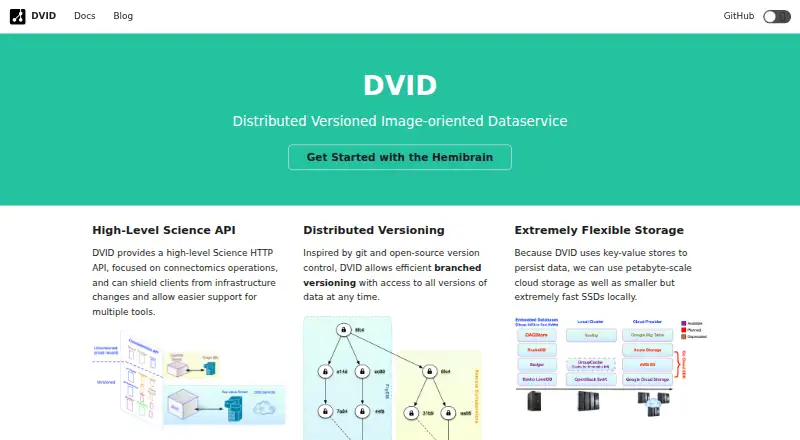
DVID is an open-source, self-hosted distributed dataservice for research teams and institutions managing large image-oriented datasets. Developed for connectomics research at HHMI Janelia, it versions and serves image volumes, labels, annotations, regions of interest, JSON, and other data types through an extensible datatype framework. Its audience is scientific groups that need repository history and data access around neuroscience or other 3D imaging workloads, rather than a general-purpose file versioning service.
DVID’s core distinction is the structure of its repository model. Versions form a directed acyclic graph, enabling branched versioning, commits, and immutable locked nodes. The system supports image and 64-bit label 3D volumes, point annotations, label graphs, and regions of interest, giving teams a way to organize related spatial data alongside its version history. Local embedded databases and cloud storage backends are supported, while pluggable storage and repository push and pull between DVID servers provide options for deployment and synchronization. As open-source server software, DVID is not presented as a hosted subscription product with paid tiers; teams should plan around self-hosted operation and their own infrastructure.
The ecosystem includes Google Cloud Storage, Google BrainMaps, OpenConnectome, Kafka, and Google Neuroglancer, and access is available through REST HTTP and RPC APIs. Those interfaces suit research pipelines and custom applications, while macOS, Linux, API, and self-hosted deployment options cover the environments identified for the project. DVID is a strong fit when 3D scientific data, annotations, branching, and repository-level versioning are central requirements. Teams seeking broad platform coverage or a general data version control tool for ordinary files should consider a more general alternative.
Your product? Our editors can test DVID in depth and publish a review, labelled as paid · from $149/mo →
DVID pricing
DVID fact sheet
| Free plan | Not verified |
|---|---|
| Paid from | Free |
| Data scope | Files |
| Dataset branching | Yes |
| Point-in-time rollback | Not verified |
| Snapshot granularity | File |
| Storage backend | Both |
| Deployment model | Self_hosted |
| Deployment | Self-hosted |
| Platforms | macOS, Linux |
| Support | Docs |
| Built for | Mid-market, Enterprise (editorial estimate) |
| Integrations | 5 integrations: Google Cloud Storage, Google BrainMaps, OpenConnectome, Kafka, Google Neuroglancer |
| Pricing | Open source |
| Website | dvid.io |
| Facts checked | 22 Sep 2026 |
DVID integrations
DVID lists 5 integrations on its own site.
- Google Cloud Storage
- Google BrainMaps
- OpenConnectome
- Kafka
- Google Neuroglancer
Alternatives to DVID
- lakeFSOpen-source, Git-like version control for governed data on object storage.9.4
- DoltGit-style table versioning with MySQL compatibility and open-source deployment.9.2
- DataLadA free, technical toolkit for versioning, reproducing, and synchronizing large file datasets.9.0


Used DVID? Be the first to review it
The editor score above is our own research. What this page doesn't have yet is a reader's view — what you used DVID for, what worked and what didn't. No stars are seeded and no review is paid for; an editor reads every one before it appears.
Write a reviewTwo minutes · verified accounts only · read by an editor before it appears
Featured on iTechGuides

DVID is listed in our Data Version Control Tools directory. Add the badge to your site — it links back to this page.
<a href="https://www.itechguides.com/products/dvid/"><img src="https://www.itechguides.com/best/badge/dvid.svg" alt="Featured on iTechGuides" width="230" height="46"></a>
Reviewed by iTechGuides Editors · Editorial team · Updated Oct 2026
Advertiser disclosure: iTechGuides is reader-supported. Vendors can pay for top positions in our rankings and for a place on other products' pages, and we may earn a commission when you click some links. Bought places stand at the number bought; this page and our disclosure say so. Paying vendors may get a fuller, more detailed review from our editors, and that review can change their score. How we rank.
Last updated · How we research and update