Duc
Duc: A scriptable, indexed disk analyzer with command-line, desktop, terminal, and web interfaces. Ranked #63 of 104 in Disk Space Analyzers by our editors (3.0/10); pricing: Free plan; best for scriptable indexed Linux or Windows analysis.
At a glance
- Editor score3.0 / 10
- PricingFree plan
- Best forScriptable indexed Linux or Windows analysis
- Free planYes
- Paid fromFree
- Desktop platformsLinux
- Facts checked23 Sep 2026
Where it wins
- Searchable database for indexed files and directories
- Command-line, ncurses, X11, and CGI web interfaces
- XML, JSON, PNG, SVG, PDF, and HTML output
Where it doesn't
- Visualizations focus on sunburst graphs, not treemaps
- No application-size or file-type reporting
- Linux-oriented installation documentation
Our verdict on Duc
Duc is an open-source collection of tools for indexing, querying, and visualizing filesystem usage. It builds a database of directory and file sizes, then lets users inspect selected filesystem paths through command-line queries, an interactive ncurses interface, a graphical X11 interface, or a CGI web interface. Linux and Windows are supported, making Duc a fit for technical users who want scriptable disk analysis rather than a single desktop-only application.
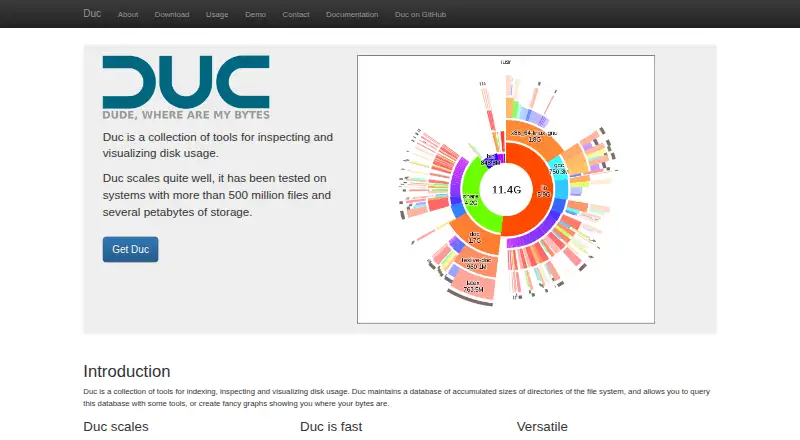
Its strongest capability is the indexed workflow. After filesystem data is placed in a searchable disk-usage database, command-line tools can query files and directories without relying only on a visual interface. Include and exclude controls help define which filesystem types are indexed. Duc also supports sunburst disk-usage graphs, including clickable web graphs, and can produce XML, JSON, PNG, SVG, PDF, and HTML output. This combination suits scheduled analysis, terminal-based inspection, and workflows that need structured or rendered results.
Duc is narrower than analyzers built around visual file exploration or application inventories. Its documented graph model centers on sunburst views, while application-size and file-type reporting are outside its stated capabilities. The project also has Linux-oriented installation documentation, which may make deployment more involved for Windows users. Choose Duc when open-source licensing, indexed queries, multiple interfaces, and exportable results matter most. Choose another analyzer if treemaps, application-size views, or file-type breakdowns are central requirements.
Your product? Our editors can test Duc in depth and publish a review, labelled as paid · from $149/mo →
Duc pricing
Duc fact sheet
| Free plan | Yes |
|---|---|
| Paid from | Free |
| Desktop platforms | Linux |
| Treemap view | No |
| Application sizes | No |
| File-type breakdown | No |
| External drive scans | Not verified |
| Exportable reports | Yes |
| Scan scope | Files_folders |
| Deployment | Self-hosted |
| Platforms | Linux, Web |
| Support | Community |
| Built for | Solo, Small business (editorial estimate) |
| Pricing | Free plan |
| Website | duc.zevv.nl |
| Facts checked | 23 Sep 2026 |
Alternatives to Duc
- TreeSizeA broad Windows analyzer with strong free features and tiered automation tools.9.3
- WinDirStatA classic Windows analyzer with treemaps, file breakdowns, duplicate detection, and CSV export.9.1
- FilelightA free, open-source disk analyzer with strong KDE integrations and ring-based visuals.9.0



Used Duc? Be the first to review it
The editor score above is our own research. What this page doesn't have yet is a reader's view — what you used Duc for, what worked and what didn't. No stars are seeded and no review is paid for; an editor reads every one before it appears.
Write a reviewTwo minutes · verified accounts only · read by an editor before it appears
Featured on iTechGuides

Duc is listed in our Disk Space Analyzers directory. Add the badge to your site — it links back to this page.
<a href="https://www.itechguides.com/products/duc/"><img src="https://www.itechguides.com/best/badge/duc.svg" alt="Featured on iTechGuides" width="230" height="46"></a>
Reviewed by iTechGuides Editors · Editorial team · Updated Oct 2026
Advertiser disclosure: iTechGuides is reader-supported. Vendors can pay for top positions in our rankings and for a place on other products' pages, and we may earn a commission when you click some links. Bought places stand at the number bought; this page and our disclosure say so. Paying vendors may get a fuller, more detailed review from our editors, and that review can change their score. How we rank.
Last updated · How we research and update