
dsync
dsync: A self-hosted, open-source choice for one-way synchronization across many data stores. Ranked #13 of 30 in Database Replication Software by our editors (7.8/10); pricing: Free plan; best for open-source multi-database synchronization.
At a glance
- Editor score7.8 / 10
- PricingFree plan
- Best forOpen-source multi-database synchronization
- Free planYes
- Paid fromFree
- Change data captureYes
- Facts checked20 Sep 2026
Where it wins
- Initial sync can continue with CDC replication
- Integrity checks, resumability, filtering, and rate limiting
- Connectors cover relational, NoSQL, vector, and storage systems
Where it doesn't
- Self-hosted deployment requires engineering ownership
- One-way replication is the current operating model
- Enterprise customization and roadmap prioritization require a paid tier
Our verdict on dsync
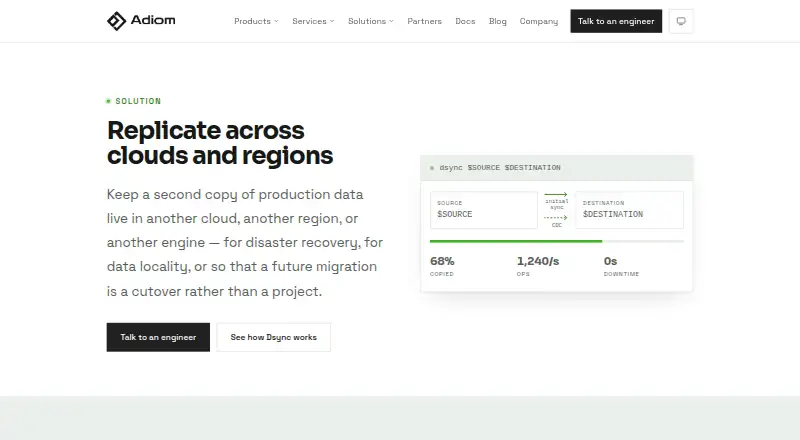
dsync is Adiom’s open-source database migration and replication tool for engineers and DevOps teams. It performs an initial synchronization between supported relational, NoSQL, vector, and storage systems, then can continuously capture source changes and apply them to a destination. The software is available for web, macOS, and Linux, with deployment options including a binary, Docker container, VM workload, or multi-worker system. It is best suited to teams that want to manage synchronization infrastructure themselves across varied data platforms.
Its strongest technical fit is the combination of migration controls and ongoing replication. Namespace filtering and remapping help target specific data areas, while fast count and hash-based checks support integrity verification. Initial synchronization and CDC can resume after interruption, and CLI or web-based progress reporting provides operational visibility. Write-rate limiting and configurable load levels help teams control destination pressure. A reverse option supports reverse replication flow, although the current operating model is one-way by default. gRPC-based connector and transformation interfaces also provide a path for custom integration work.
The integration range is a major consideration: dsync supports systems including MongoDB, Azure Cosmos DB, DynamoDB, HBase, Cassandra, CouchDB, PostgreSQL, SQL Server, Oracle, DB2, Weaviate, Qdrant, S3 Vector Index, S3 Storage, and File. The Open Source plan is positioned for small projects and testing, with best-effort support and a commercial support add-on. Enterprise adds commercial support, roadmap prioritization, and customization. Choose dsync if self-hosting, open-source access, CDC, and multi-database coverage matter more than a managed service experience. Teams seeking built-in bidirectional replication or minimal infrastructure ownership should consider alternatives.
Your product? Our editors can test dsync in depth and publish a review, labelled as paid · from $149/mo →
dsync pricing
All 2 dsync plans and prices →
dsync fact sheet
| Free plan | Yes |
|---|---|
| Paid from | Free |
| Change data capture | Yes |
| Replication direction | One-way |
| Deployment options | Self-hosted |
| Supported databases | MongoDB; Cosmos DB RU (MongoDB API); Azure Document DB; Cosmos DB NoSQL; DynamoDB; HBase; AWS DocumentDB; AstraDB; Cassandra; CouchDB/IBM Cloudant; Firestore; PostgreSQL; SQL Server; Oracle; DB2; Weaviate; Qdrant; S3 Vector Index; S3 Storage; File |
| Cross-region replication | Not verified |
| Data transformations | Yes |
| Deployment | Self-hosted |
| Platforms | Web, macOS, Linux |
| Support | Email, Community, Docs |
| Built for | Small business, Mid-market, Enterprise (editorial estimate) |
| Integrations | 19 integrations: MongoDB, Azure Cosmos DB, Azure Document DB, AWS DynamoDB, AWS DocumentDB, HBase … See all → |
| Pricing | Free plan (source) |
| Website | adiom.io |
| Facts checked | 20 Sep 2026 |
dsync integrations
dsync lists 19 integrations on its own site.
- MongoDB
- Azure Cosmos DB
- Azure Document DB
- AWS DynamoDB
- AWS DocumentDB
- HBase
- AstraDB
- Cassandra
- CouchDB
- IBM Cloudant
- PostgreSQL
- SQL Server
- Oracle
- DB2
- Weaviate
- Qdrant
- S3 Vector Index
- Amazon S3
- CSV files
Alternatives to dsync
- Oracle GoldenGateA broad enterprise replication platform with free, managed OCI, and BYOL options.9.4
- SymmetricDSA flexible replication platform for multi-primary synchronization across many database environments.9.2
- StriimA broad replication platform with visual pipelines, continuous CDC, and a free developer tier.9.0



Used dsync? Be the first to review it
The editor score above is our own research. What this page doesn't have yet is a reader's view — what you used dsync for, what worked and what didn't. No stars are seeded and no review is paid for; an editor reads every one before it appears.
Write a reviewTwo minutes · verified accounts only · read by an editor before it appears
Featured on iTechGuides

dsync is listed in our Database Replication Software directory. Add the badge to your site — it links back to this page.
<a href="https://www.itechguides.com/products/dsync/"><img src="https://www.itechguides.com/best/badge/dsync.svg" alt="Featured on iTechGuides" width="230" height="46"></a>
Reviewed by iTechGuides Editors · Editorial team · Updated Oct 2026
Advertiser disclosure: iTechGuides is reader-supported. Vendors can pay for top positions in our rankings and for a place on other products' pages, and we may earn a commission when you click some links. Bought places stand at the number bought; this page and our disclosure say so. Paying vendors may get a fuller, more detailed review from our editors, and that review can change their score. How we rank.
Last updated · How we research and update