dcd
dcd: A focused, self-hosted option for fuzzy duplicate checks in CI. Ranked #13 of 23 in Code Clone Detection Tools by our editors (7.9/10); pricing: Free plan; best for lightweight fuzzy duplicate checks in CI.
At a glance
- Editor score7.9 / 10
- PricingFree plan
- Best forLightweight fuzzy duplicate checks in CI
- Free planYes
- Paid fromFree
- Clone detection methodText
- Facts checked20 Sep 2026
Where it wins
- Simhash matching tolerates inserted, deleted, and modified lines
- JSON, HTML, text, and PBM outputs support varied reporting needs
- Duplicate-threshold exit codes fit continuous integration workflows
Where it doesn't
- Text-based detection is narrower than broader clone-analysis methods
- No IDE integration is provided
- Supported platforms are macOS and Linux
Our verdict on dcd
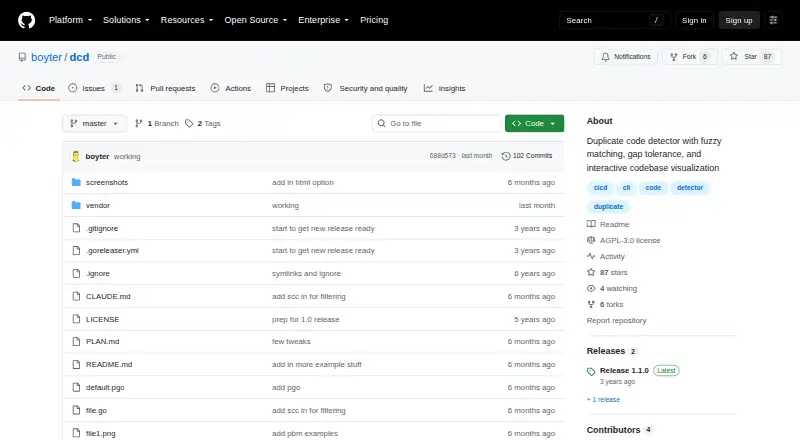
dcd is an open-source command-line tool for finding repeated and near-duplicate code in software projects. It is aimed at developers and teams that want a lightweight, self-hosted check for repositories, particularly in continuous integration workflows. The tool can compare a single file with a codebase, detect duplicates within the same file, and report matches in text, JSON, HTML, or PBM formats.
Its main strength is configurable fuzzy matching. dcd uses simhash distance and can tolerate gaps caused by inserted or deleted lines, as well as holes created by modified lines. Configurable ignored blocks and ignore files help exclude selected content from scans. For CI, a duplicate-threshold exit code provides a direct way to make detection part of an automated check. These capabilities make dcd more useful than a strict line-for-line duplicate scanner when similar code has been lightly edited or rearranged.
The project is free, open source, and self-hosted, with native binaries and source installation instructions for macOS and Linux. Its repository scan scope and command-line workflow suit teams comfortable integrating tools into scripts and build pipelines. The trade-off is focus: dcd uses a text-based clone method, has no IDE integration, and does not provide AI features. Windows support was removed in the latest 1.1.0 release, despite older Windows build examples remaining in the README. Choose dcd when simple fuzzy repository checks, configurable tolerances, and CI exit codes are the priority; consider an alternative when IDE workflows, Windows support, or broader analysis capabilities matter more.
Your product? Our editors can test dcd in depth and publish a review, labelled as paid · from $149/mo →
dcd pricing
dcd fact sheet
| Free plan | Yes |
|---|---|
| Paid from | Free |
| Clone detection method | Text |
| Scan scope | Repository |
| CI integration | Yes |
| IDE integration | No |
| Self-hosted option | Yes |
| Supported languages | Not verified |
| Deployment | Self-hosted |
| Platforms | macOS, Linux |
| Support | |
| Built for | Solo, Small business, Mid-market, Enterprise (editorial estimate) |
| Pricing | Free plan |
| Website | github.com |
| Facts checked | 20 Sep 2026 |
Alternatives to dcd
- jscpdA broad, self-hosted clone detector with strong CI, reporting, and history analysis.9.4
- art-duplA focused, self-hosted clone analyzer for Go teams building duplication checks into CI.9.2
- PMDA strong open-source choice for teams pairing clone detection with broad static analysis.9.0


Also Ranked In
dcd is ranked in 2 of our directories.
Used dcd? Be the first to review it
The editor score above is our own research. What this page doesn't have yet is a reader's view — what you used dcd for, what worked and what didn't. No stars are seeded and no review is paid for; an editor reads every one before it appears.
Write a reviewTwo minutes · verified accounts only · read by an editor before it appears
Featured on iTechGuides

dcd is listed in our Code Clone Detection Tools directory. Add the badge to your site — it links back to this page.
<a href="https://www.itechguides.com/products/dcd/"><img src="https://www.itechguides.com/best/badge/dcd.svg" alt="Featured on iTechGuides" width="230" height="46"></a>
Reviewed by iTechGuides Editors · Editorial team · Updated Oct 2026
Advertiser disclosure: iTechGuides is reader-supported. Vendors can pay for top positions in our rankings and for a place on other products' pages, and we may earn a commission when you click some links. Bought places stand at the number bought; this page and our disclosure say so. Paying vendors may get a fuller, more detailed review from our editors, and that review can change their score. How we rank.
Last updated · How we research and update