
dbplyr
dbplyr: A focused, open-source R layer for translating dplyr workflows into SQL. Ranked #17 of 36 in Data Transformation Tools by our editors (7.6/10); pricing: Free plan; best for R-based transformations on remote databases.
At a glance
- Editor score7.6 / 10
- PricingFree plan
- Best forR-based transformations on remote databases
- Free planYes
- Paid fromFree
- Facts checked22 Sep 2026
Where it wins
- Translates dplyr workflows into database-specific SQL
- Works with lazy remote tables and query plans
- Supports major databases including PostgreSQL and Snowflake
Where it doesn't
- Focused on database transformation rather than complete pipelines
- Requires an R and dplyr-based workflow
- SQL is the supported transformation format
Our verdict on dbplyr
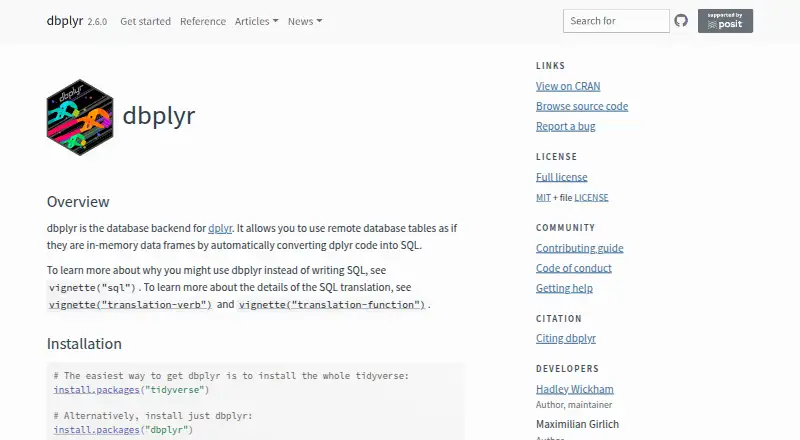
dbplyr is an open-source R package for transforming data in remote relational databases. It connects dplyr workflows to database-backed tables, treating them as lazy data frames while translating dplyr expressions and verbs into SQL. The package is intended for R users who need to filter, join, aggregate, mutate, or apply window functions without first bringing the full dataset into local memory. It is a focused transformation layer rather than a hosted data pipeline product.
Its platform fit is broad for a database-oriented R workflow. dbplyr supports DBI-backed databases and database-specific SQL dialects across PostgreSQL, MySQL, MariaDB, SQLite, Microsoft SQL Server, Oracle, Snowflake, Amazon Redshift, Apache Spark, and Teradata. Users can inspect generated SQL and query plans, copy local data frames to remote databases, collect query results into local data frames, or compute results into new remote tables. That combination keeps the interface in dplyr while allowing execution to remain with the connected database.
The standout capability is the translation layer: familiar dplyr code can express database operations while dbplyr generates SQL for the target system. This makes it a strong choice for teams already working in R and dplyr who need remote-table operations and visibility into the resulting queries. It is less suitable for buyers seeking a complete pipeline tool, a hosted interface, or a broader transformation environment beyond code-based SQL-backed workflows. Choose dbplyr when the priority is R-based database transformation; choose another category tool when orchestration or a complete pipeline product is required.
Your product? Our editors can test dbplyr in depth and publish a review, labelled as paid · from $149/mo →
dbplyr pricing
dbplyr fact sheet
| Free plan | Yes |
|---|---|
| Paid from | Free |
| Deployment model | Not verified |
| Transformation interface | Code |
| Supported data formats | SQL |
| Version control | Not verified |
| Workflow orchestration | Not verified |
| Data quality checks | Not verified |
| Deployment | Self-hosted |
| Support | Docs, Community |
| Built for | Solo, Small business, Mid-market, Enterprise (editorial estimate) |
| Integrations | 10 integrations: PostgreSQL, MySQL, MariaDB, SQLite, Microsoft SQL Server, Oracle … |
| Pricing | Free plan |
| Website | dbplyr.tidyverse.org |
| Facts checked | 22 Sep 2026 |
dbplyr integrations
dbplyr lists 10 integrations on its own site.
- PostgreSQL
- MySQL
- MariaDB
- SQLite
- Microsoft SQL Server
- Oracle
- Snowflake
- Amazon Redshift
- Apache Spark
- Teradata
Alternatives to dbplyr
- DataformA free, managed workflow service for SQL transformation and testing in BigQuery.9.2
- Alteryx DesignerA broad visual toolkit for enterprise analysts working across complex data environments.9.1
- Apache BeamA broad, portable framework for engineering teams building code-driven data pipelines.9.0



Used dbplyr? Be the first to review it
The editor score above is our own research. What this page doesn't have yet is a reader's view — what you used dbplyr for, what worked and what didn't. No stars are seeded and no review is paid for; an editor reads every one before it appears.
Write a reviewTwo minutes · verified accounts only · read by an editor before it appears
Featured on iTechGuides

dbplyr is listed in our Data Transformation Tools directory. Add the badge to your site — it links back to this page.
<a href="https://www.itechguides.com/products/dbplyr/"><img src="https://www.itechguides.com/best/badge/dbplyr.svg" alt="Featured on iTechGuides" width="230" height="46"></a>
Reviewed by iTechGuides Editors · Editorial team · Updated Oct 2026
Advertiser disclosure: iTechGuides is reader-supported. Vendors can pay for top positions in our rankings and for a place on other products' pages, and we may earn a commission when you click some links. Bought places stand at the number bought; this page and our disclosure say so. Paying vendors may get a fuller, more detailed review from our editors, and that review can change their score. How we rank.
Last updated · How we research and update