
Datacyclic
Datacyclic: A broad database archiving platform for teams planning modern cloud-based retention. Ranked #18 of 29 in Data Archiving Software by our editors (7.4/10); pricing: Pricing on request; best for database teams needing modern cloud archive formats.
At a glance
- Editor score7.4 / 10
- PricingPricing on request
- Best forDatabase teams needing modern cloud archive formats
- Founded2025
- Facts checked20 Sep 2026
Where it wins
- Parquet-based storage with database-to-database archiving
- Retention, legal holds, purge, search, restore, and audit history
- Cloud, on-premises, and hybrid deployment with broad connections
Where it doesn't
- Pricing requires a contact-sales engagement
- Founded in 2025, with limited maturity evidence
- Enterprise scope may require planning across policies, storage, and access
Our verdict on Datacyclic
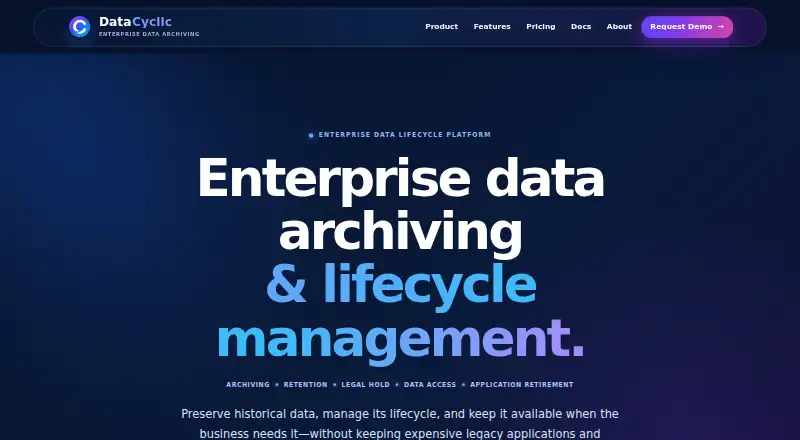
Datacyclic is an enterprise data archiving platform for organizations retiring legacy applications, reducing active-system storage, and preserving historical information. It moves eligible data into customer-controlled archive storage while retaining metadata, schema, lineage, retention rules, legal holds, and audit history. Database teams can use it across Oracle, SQL Server, PostgreSQL, MySQL, JDBC sources, files, object stores, and SaaS exports. Deployment options include cloud, on-premises, and hybrid environments, making it suitable for organizations with varied infrastructure requirements.
The platform’s strongest area is lifecycle control. Retention policies and lifecycle management govern archived information, while legal holds can preserve data that should not be purged. Policy-driven purge supports controlled removal, and archived-data browsing and search help teams locate historical records. Selective and full dataset restore provide two recovery paths, while audit history and logging support traceability. SSO and role-based access control add administrative controls for teams managing sensitive archives.
Datacyclic also fits teams evaluating modern archive formats and customer-controlled storage. Parquet-based archive storage is paired with connections to AWS Glue, AWS S3, Azure Blob, and Google Cloud Storage, alongside database and file-based sources. Pricing is handled through contact sales, with the engagement described as depending on data volume, application scale, deployment, usage, and services, so buyers should expect a scoped commercial process rather than a published plan comparison. Founded in 2025, Datacyclic has limited maturity evidence; organizations prioritizing an established operating history may prefer an alternative. It is a strong candidate for database teams planning application retirement, retention, and restore workflows, but less suited to buyers seeking simple, self-serve archiving.
Your product? Our editors can test Datacyclic in depth and publish a review, labelled as paid · from $149/mo →
Datacyclic pricing
Datacyclic fact sheet
| Free plan | Not verified |
|---|---|
| Paid from | Not verified |
| Deployment | Not verified |
| Retention policies | Yes |
| Legal hold | Yes |
| Immutable archive | Yes |
| Deduplication | Not verified |
| Search and restore | Yes |
| Supported data sources | Oracle, SQL Server, PostgreSQL, MySQL, JDBC, files, object stores, SaaS exports |
| Deployment | Cloud, Self-hosted |
| Compliance & security | 2FA |
| Support | |
| Built for | Mid-market, Enterprise (editorial estimate) |
| Integrations | 12 integrations: Oracle, SQL Server, PostgreSQL, MySQL, JDBC, AWS Glue … See all → |
| Pricing | Pricing on request (source) |
| Website | datacyclic.com |
| Facts checked | 20 Sep 2026 |
Datacyclic integrations
Datacyclic lists 12 integrations on its own site.
- Oracle
- SQL Server
- PostgreSQL
- MySQL
- JDBC
- AWS Glue
- AWS S3
- Azure Blob
- Google Cloud Storage
- Files
- Object storage
- SaaS exports
See all Datacyclic integrations →
Alternatives to Datacyclic
- Archon Data StoreA broad hybrid archive for regulated enterprises retiring legacy systems.9.4
- Infobelt Enterprise Information ArchivingBroad archive coverage, governance controls, and AI search for complex enterprise environments.9.3
- PreservicaA broad preservation and archiving platform with a free entry plan and hybrid deployment.9.1



See all Datacyclic alternatives →
Used Datacyclic? Be the first to review it
The editor score above is our own research. What this page doesn't have yet is a reader's view — what you used Datacyclic for, what worked and what didn't. No stars are seeded and no review is paid for; an editor reads every one before it appears.
Write a reviewTwo minutes · verified accounts only · read by an editor before it appears
Featured on iTechGuides

Datacyclic is listed in our Data Archiving Software directory. Add the badge to your site — it links back to this page.
<a href="https://www.itechguides.com/products/datacyclic/"><img src="https://www.itechguides.com/best/badge/datacyclic.svg" alt="Featured on iTechGuides" width="230" height="46"></a>
Reviewed by iTechGuides Editors · Editorial team · Updated Oct 2026
Advertiser disclosure: iTechGuides is reader-supported. Vendors can pay for top positions in our rankings and for a place on other products' pages, and we may earn a commission when you click some links. Bought places stand at the number bought; this page and our disclosure say so. Paying vendors may get a fuller, more detailed review from our editors, and that review can change their score. How we rank.
Last updated · How we research and update