Common Open Research Emulator (CORE)
Common Open Research Emulator (CORE): A flexible Linux emulator for topology design, protocol research, and hardware-in-the-loop work. Ranked #8 of 30 in Network Simulation Software by our editors (8.5/10); pricing: Open source; best for linux-based real-time network emulation.
At a glance
- Editor score8.5 / 10
- PricingOpen source
- Best forLinux-based real-time network emulation
- Paid fromFree
- Real-time emulationYes
- Facts checked20 Sep 2026
Where it wins
- Real-time emulation with lightweight virtual nodes and Linux namespaces
- Connects physical networks and hardware through physical interfaces
- Python and gRPC APIs support programmable automation and distributed execution
Where it doesn't
- Linux-only platform coverage
- Self-hosted deployment requires managing the software environment
- Emulation-focused design may not fit users seeking other simulation models
Our verdict on Common Open Research Emulator (CORE)
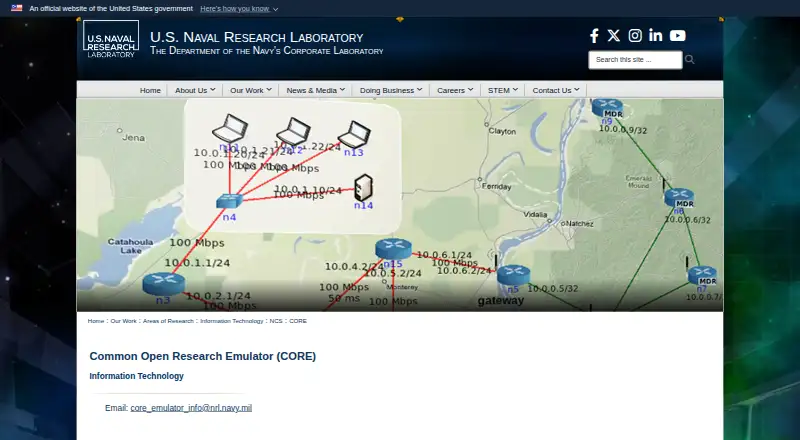
Common Open Research Emulator (CORE) is free, open-source software for building and running emulated computer networks on Linux. It is aimed at network and protocol researchers, application testers, security teams, educators, and users demonstrating network behavior. A graphical canvas supports topology creation, while lightweight virtual nodes and Linux namespaces provide the environment for running real applications and protocols. CORE also covers wireless scenarios, routing, security, SDN, and utility services.
Its standout capability is the connection between virtual and physical networking. CORE supports physical network and router connections, plus hardware-in-the-loop work through physical interfaces. Distributed emulation can run across multiple CORE machines, extending the environment beyond a single host. Python scripting and a gRPC client/server API add programmatic control for repeatable workflows, automation, and integration with external tooling. These capabilities make CORE a strong fit when a project needs live network behavior alongside physical equipment or hardware.
The main trade-off is platform scope: CORE is Linux-only and self-hosted. That focus suits teams already working with Linux namespaces and local or distributed infrastructure, but it narrows the audience compared with tools designed for broader operating-system coverage or hosted access. CORE is also specifically an emulation product, so it is better suited to running real applications and protocols in a controlled network environment than to projects centered on a different simulation model. Choose CORE for open-source, real-time Linux emulation with physical connectivity and APIs; consider an alternative when cross-platform access or a non-emulation approach is the priority.
Your product? Our editors can test Common Open Research Emulator (CORE) in depth and publish a review, labelled as paid · from $149/mo →
Common Open Research Emulator (CORE) pricing
Common Open Research Emulator (CORE) fact sheet
| Free plan | Not verified |
|---|---|
| Paid from | Free |
| Simulation model | Emulation |
| Real-time emulation | Yes |
| Hardware-in-the-loop | Yes |
| Deployment options | Not verified |
| Documented node limit | Not verified |
| Automation API | Yes |
| Deployment | Self-hosted |
| Platforms | Linux |
| Support | Community, Docs |
| Pricing | Open source |
| Website | nrl.navy.mil |
| Facts checked | 20 Sep 2026 |
Alternatives to Common Open Research Emulator (CORE)
- GNS3A free, broad multivendor lab for simulating, emulating, and connecting real networks.9.4
- Cisco Modeling LabsA Cisco-focused virtual lab with broad automation, integration, and deployment options.9.2
- EVE-NGA broad emulation platform for large, collaborative multivendor network labs.9.0

See all Common Open Research Emulator (CORE) alternatives →
Common Open Research Emulator (CORE) vs the competition
- Common Open Research Emulator (CORE) vs GNS3
- Common Open Research Emulator (CORE) vs Cisco Modeling Labs
- Common Open Research Emulator (CORE) vs EVE-NG
- Common Open Research Emulator (CORE) vs NetSim by Tetcos
- Common Open Research Emulator (CORE) vs OMNeT++
- Common Open Research Emulator (CORE) vs ns-3

Compare Common Open Research Emulator (CORE) with any tool side by side →
Used Common Open Research Emulator (CORE)? Be the first to review it
The editor score above is our own research. What this page doesn't have yet is a reader's view — what you used Common Open Research Emulator (CORE) for, what worked and what didn't. No stars are seeded and no review is paid for; an editor reads every one before it appears.
Write a reviewTwo minutes · verified accounts only · read by an editor before it appears
Featured on iTechGuides

Common Open Research Emulator (CORE) is listed in our Network Simulation Software directory. Add the badge to your site — it links back to this page.
<a href="https://www.itechguides.com/products/common-open-research-emulator-core/"><img src="https://www.itechguides.com/best/badge/common-open-research-emulator-core.svg" alt="Featured on iTechGuides" width="230" height="46"></a>
Reviewed by iTechGuides Editors · Editorial team · Updated Oct 2026
Advertiser disclosure: iTechGuides is reader-supported. Vendors can pay for top positions in our rankings and for a place on other products' pages, and we may earn a commission when you click some links. Bought places stand at the number bought; this page and our disclosure say so. Paying vendors may get a fuller, more detailed review from our editors, and that review can change their score. How we rank.
Last updated · How we research and update