
Chaos Toolkit
Chaos Toolkit: Broad, low-cost multi-cloud chaos testing with declarative experiments and safeguards. Ranked #1 of 25 in Chaos Engineering Platforms by our editors (9.3/10); pricing: Free plan; best for broad, low-cost multi-cloud chaos testing.
At a glance
- Editor score9.3 / 10
- PricingFree plan
- Best forBroad, low-cost multi-cloud chaos testing
- Free planYes
- Paid fromFree
- Kubernetes supportYes
- Facts checked20 Sep 2026
Where it wins
- Supports Kubernetes, AWS, Azure, and Google Cloud experiments
- Includes safeguards, controls, rollbacks, and steady-state hypotheses
- Offers 300+ actions and probes plus custom extensions
Where it doesn't
- The standalone interface is a command-line toolkit
- Scheduling uses Kubernetes CronJobs or external automation
- Custom extensions require Python, HTTP, or process providers
Our verdict on Chaos Toolkit
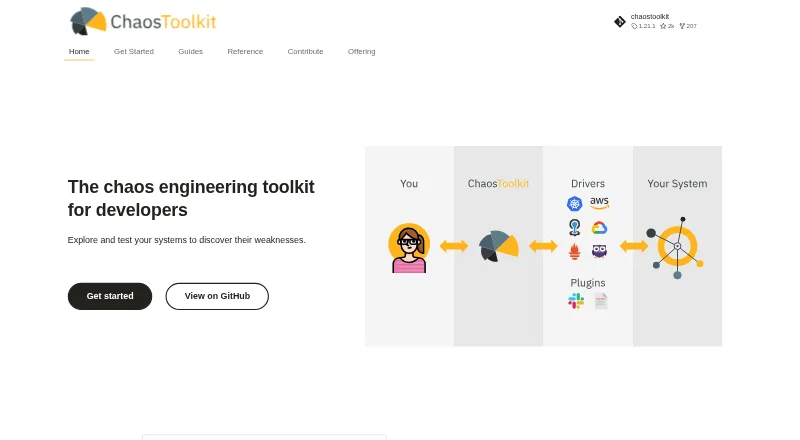
Chaos Toolkit is an open-source, Python-based toolkit for developers defining and running chaos engineering experiments. Experiments are written in JSON or YAML and executed through a standalone command-line interface. The toolkit covers Kubernetes actions for pods, statefulsets, nodes, and services, along with AWS infrastructure and Lambda fault injection, Azure resource operations, and Google Cloud experiments. It can run locally, in containers, CI/CD workflows, or through a Kubernetes operator, making it suited to teams that want self-hosted chaos testing across several environments.
The published plan is straightforward: Chaos Toolkit is open source and free, with a standalone CLI and more than 300 actions and probes. Its workflow includes commands for discovery, validation, initialization, execution, and reporting. Experiments can use probes, actions, steady-state hypotheses, rollbacks, controls, and safeguards that bypass activities or terminate experiments when conditions become unsafe. Scheduling is handled through Kubernetes CronJobs or external automation rather than the core CLI, which fits teams already operating Kubernetes or CI/CD systems.
Its ecosystem coverage is a central strength. Integrations include Kubernetes, AWS, Azure, Google Cloud Platform, ToxiProxy, Istio, WireMock, GitHub Actions, GitLab, Slack, OpenTelemetry, and Prometheus. Custom extensions can use Python, HTTP, or process providers, while the declarative workflow supports tailored experiments. Chaos Toolkit is a strong choice for teams seeking broad, low-cost, self-hosted testing across cloud and Kubernetes infrastructure. Teams wanting a primarily graphical experience, built-in scheduling in the core CLI, or a separate commercial operating layer should consider a different platform.
Questions about Chaos Toolkit
Does Chaos Toolkit have a free plan? Yes: the Chaos Toolkit plan is free.
What does Chaos Toolkit run on? Web, Windows, macOS and Linux. It runs self-hosted, as a desktop app and as a browser extension.
What does Chaos Toolkit integrate with? 12 integrations, including Kubernetes, AWS, Azure, Google Cloud Platform and ToxiProxy.
Who is Chaos Toolkit built for? Solo users, small businesses, mid-market companies and enterprises (our editorial estimate).
Your product? Our editors can test Chaos Toolkit in depth and publish a review, labelled as paid · from $149/mo →
Chaos Toolkit pricing
All 1 Chaos Toolkit plans and prices →
Chaos Toolkit fact sheet
| Free plan | Yes |
|---|---|
| Paid from | Free |
| Kubernetes support | Yes |
| Cloud fault injection | Yes |
| Network fault injection | Yes |
| Experiment scheduling | Yes |
| Deployment model | Self_hosted |
| Blast-radius controls | Yes |
| Deployment | Self-hosted, Desktop, Browser extension |
| Platforms | Web, Windows, macOS, Linux |
| Support | Docs |
| Built for | Solo, Small business, Mid-market, Enterprise (editorial estimate) |
| Integrations | 12 integrations: Kubernetes, AWS, Azure, Google Cloud Platform, ToxiProxy, Istio … |
| Pricing | Free plan (source) |
| Website | chaostoolkit.org |
| Facts checked | 20 Sep 2026 |
Chaos Toolkit integrations
Chaos Toolkit lists 12 integrations on its own site.
- Kubernetes
- AWS
- Azure
- Google Cloud Platform
- ToxiProxy
- Istio
- WireMock
- GitHub Actions
- GitLab
- Slack
- OpenTelemetry
- Prometheus
Alternatives to Chaos Toolkit
- Chaos MeshA broad, self-hosted toolkit for controlled Kubernetes fault injection.9.1
- Harness Chaos EngineeringA free hybrid-cloud option with strong experiment controls and broad infrastructure coverage.9.0
- GremlinA broad managed chaos platform for controlled failure testing across modern infrastructure.8.9



See all Chaos Toolkit alternatives →
Chaos Toolkit vs the competition
- Chaos Toolkit vs Chaos Mesh
- Chaos Toolkit vs Harness Chaos Engineering
- Chaos Toolkit vs Gremlin
- Chaos Toolkit vs Steadybit
- Chaos Toolkit vs Reliably
- Chaos Toolkit vs LitmusChaos


Compare Chaos Toolkit with any tool side by side →
Used Chaos Toolkit? Be the first to review it
The editor score above is our own research. What this page doesn't have yet is a reader's view — what you used Chaos Toolkit for, what worked and what didn't. No stars are seeded and no review is paid for; an editor reads every one before it appears.
Write a reviewTwo minutes · verified accounts only · read by an editor before it appears
Featured on iTechGuides

Chaos Toolkit is listed in our Chaos Engineering Platforms directory. Add the badge to your site — it links back to this page.
<a href="https://www.itechguides.com/products/chaos-toolkit/"><img src="https://www.itechguides.com/best/badge/chaos-toolkit.svg" alt="Featured on iTechGuides" width="230" height="46"></a>
Reviewed by iTechGuides Editors · Editorial team · Updated Nov 2026
Advertiser disclosure: iTechGuides is reader-supported. Vendors can pay for top positions in our rankings and for a place on other products' pages, and we may earn a commission when you click some links. Bought places stand at the number bought; this page and our disclosure say so. Paying vendors may get a fuller, more detailed review from our editors, and that review can change their score. How we rank.
Last updated · How we research and update