cargo-dist
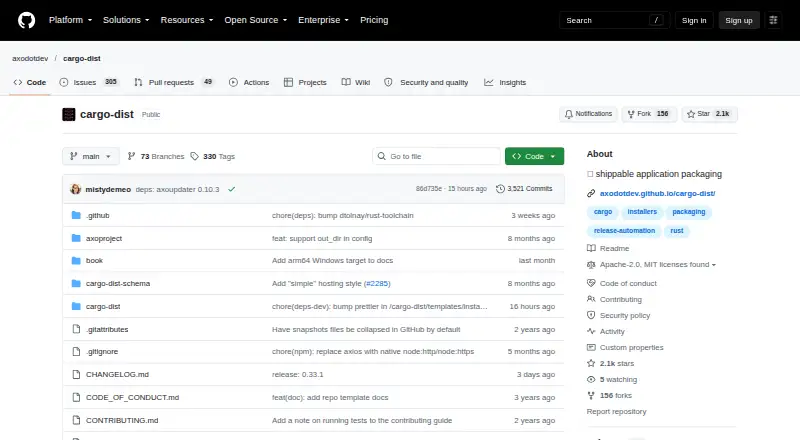
cargo-dist: Open-source packaging and release automation for Rust applications distributing binaries and installers. Ranked #12 of 29 in Release Automation Tools by our editors (7.6/10); pricing: Free plan; best for rust applications distributing binaries and installers.
At a glance
- Editor score7.6 / 10
- PricingFree plan
- Best forRust applications distributing binaries and installers
- Free planYes
- Paid fromFree
- Semantic versioningNo
- Facts checked5 Oct 2026
Where it wins
- Generates CI workflows to build and publish releases from Git tags.
- Creates archives, installers, and machine-readable release manifests.
- Supports GitHub Releases and package channels including Homebrew and npm.
Where it doesn't
- Focuses on packaging and distribution, not semantic-version calculation.
- Does not generate changelogs; release notes come from project files.
- Documented release flow is GitHub-based and self-hosted.
Our verdict on cargo-dist
cargo-dist, now referred to as dist, is an open-source release packaging and distribution tool aimed particularly at application developers using Rust and Cargo. It suits solo developers and teams that want to turn Git-tagged versions into application binaries, archives, installers, and release announcements. Workspace-aware planning can select packages to announce, making it relevant to Cargo workspaces as well as individual applications.
The release workflow covers packaging through publication: it generates CI release workflows, builds binaries for configured platforms, creates tarballs and shell or PowerShell installers, and produces machine-readable release manifests. It can upload artifacts and create or edit GitHub Releases, with release notes drawn from a project’s RELEASES or CHANGELOG file. Package-manager publishing extends the output to Homebrew, npm, Apt, and Chocolatey; supported artifact types also include a Windows MSI. This breadth is useful when a project ships across several distribution channels, while the central workflow remains oriented around GitHub.
There is no purchase tier to compare: cargo-dist is open source and has a free plan, with self-hosted deployment and documentation and community support. Its scope is packaging and distribution, not deciding semantic version increments or generating changelogs. Projects seeking automated version calculation or changelog authoring should look elsewhere; teams that already manage those inputs and want CI to build, package, and publish tagged releases are a better fit. The project’s current name is dist, though cargo-dist remains in its repository and installer names.
Your product? Our editors can test cargo-dist in depth and publish a review, labelled as paid · from $149/mo →
cargo-dist pricing
cargo-dist fact sheet
| Free plan | Yes |
|---|---|
| Paid from | Free |
| Semantic versioning | No |
| Changelog generation | No |
| Release note automation | Yes |
| Release artifacts | tarballs, binaries, shell and PowerShell installers, npm package, Homebrew formula, Windows MSI |
| Source platforms | GitHub |
| Package registries | Homebrew, npm, Apt, Chocolatey |
| Deployment | Self-hosted |
| Platforms | Windows, macOS, Linux |
| Support | Docs, Community |
| Built for | Solo, Small business, Mid-market (editorial estimate) |
| Integrations | 6 integrations: GitHub Actions, GitHub Releases, Homebrew, npm, Apt, Chocolatey |
| Pricing | Free plan |
| Website | github.com |
| Facts checked | 5 Oct 2026 |
cargo-dist integrations
cargo-dist lists 6 integrations on its own site.
- GitHub Actions
- GitHub Releases
- Homebrew
- npm
- Apt
- Chocolatey
Alternatives to cargo-dist
- semantic-releaseAn open-source CI release tool that turns commit history into versions, notes, and published releases.9.1
- LernaLerna combines monorepo task orchestration with npm package versioning and publishing.8.1
- release-itA flexible release CLI that handles Git workflows, release notes and npm publishing.7.9


See all cargo-dist alternatives →
Used cargo-dist? Be the first to review it
The editor score above is our own research. What this page doesn't have yet is a reader's view — what you used cargo-dist for, what worked and what didn't. No stars are seeded and no review is paid for; an editor reads every one before it appears.
Write a reviewTwo minutes · verified accounts only · read by an editor before it appears
Featured on iTechGuides

cargo-dist is listed in our Release Automation Tools directory. Add the badge to your site — it links back to this page.
<a href="https://www.itechguides.com/products/cargo-dist/"><img src="https://www.itechguides.com/best/badge/cargo-dist.svg" alt="Featured on iTechGuides" width="230" height="46"></a>
Reviewed by iTechGuides Editors · Editorial team · Updated Oct 2026
Advertiser disclosure: iTechGuides is reader-supported. Vendors can pay for top positions in our rankings and for a place on other products' pages, and we may earn a commission when you click some links. Bought places stand at the number bought; this page and our disclosure say so. Paying vendors may get a fuller, more detailed review from our editors, and that review can change their score. How we rank.
Last updated · How we research and update