
Bonobo
Bonobo: A free, code-first ETL framework for lightweight, self-hosted Python data jobs. Ranked #33 of 36 in Data Transformation Tools by our editors (6.0/10); pricing: Open source; best for python developers building lightweight ETL graphs.
At a glance
- Editor score6.0 / 10
- PricingOpen source
- Best forPython developers building lightweight ETL graphs
- Paid fromFree
- Deployment modelSelf_hosted
- Facts checked22 Sep 2026
Where it wins
- Python callables and iterables make transformations code-first
- Streaming, parallel graph execution, and DAG-based pipeline design
- Built-in CSV, JSON, XML, and XLS readers and writers
Where it doesn't
- Self-hosted operation requires your own runtime and deployment setup
- The published project is described as alpha on its 0.6.x release line
- Narrower feature and integration breadth than larger pipeline platforms
Our verdict on Bonobo
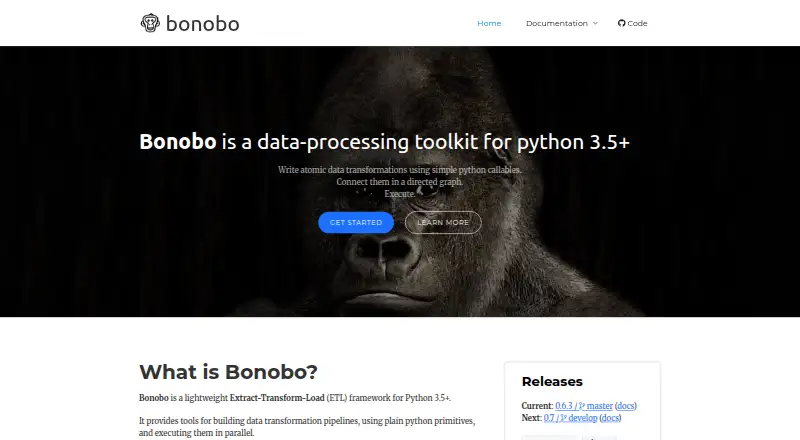
Bonobo is an open-source Extract-Transform-Load framework for Python developers and data engineers who prefer code-defined, locally run jobs over a hosted visual platform. Transformations can be expressed as Python callables or iterables, then connected into directed acyclic graphs. The framework supports Windows, macOS, Linux, and API-based use, with a self-hosted deployment model and code as its transformation interface. It fits teams building focused ETL workflows around files, databases, HTTP endpoints, and external services.
Its strongest technical distinction is the combination of row-by-row streaming and graph-based execution. Jobs can process data incrementally rather than requiring an entire dataset to be handled at once, while graph nodes can run in parallel. Bonobo also includes command-line operations for initializing and running ETL jobs, plus graph inspection and Graphviz visualization. Built-in readers and writers cover CSV, JSON, XML, XLS, and Excel workflows, with Pickle listed among the supported formats. These capabilities give Python developers a direct way to compose and inspect lightweight transformation graphs.
Bonobo is free to use as open-source software, rather than being organized around commercial hosted tiers. Its ecosystem includes Docker and SQLAlchemy integrations, along with filesystem, HTTP, and external service connections. The published project materials describe an older 0.6.x release line and characterize the project as alpha, which matters when evaluating long-term fit and operational expectations. Choose Bonobo when Python control, local execution, streaming, and a narrow ETL scope are priorities. A larger pipeline platform is a better fit for teams that need broader verified integrations, a hosted visual workspace, or a more extensive platform ecosystem.
Your product? Our editors can test Bonobo in depth and publish a review, labelled as paid · from $149/mo →
Bonobo pricing
Bonobo fact sheet
| Free plan | Not verified |
|---|---|
| Paid from | Free |
| Deployment model | Self_hosted |
| Transformation interface | Code |
| Supported data formats | CSV, JSON, XML, XLS, Excel, Pickle |
| Version control | Not verified |
| Workflow orchestration | Not verified |
| Data quality checks | Not verified |
| Deployment | Self-hosted |
| Platforms | Windows, macOS, Linux |
| Support | Community, Docs |
| Built for | Solo, Small business (editorial estimate) |
| Integrations | 2 integrations: Docker, SQLAlchemy See all → |
| Pricing | Open source |
| Website | bonobo-project.org |
| Facts checked | 22 Sep 2026 |
Bonobo integrations
Bonobo lists 2 integrations on its own site.
- Docker
- SQLAlchemy
Alternatives to Bonobo
- DataformA free, managed workflow service for SQL transformation and testing in BigQuery.9.2
- Alteryx DesignerA broad visual toolkit for enterprise analysts working across complex data environments.9.1
- Apache BeamA broad, portable framework for engineering teams building code-driven data pipelines.9.0



Used Bonobo? Be the first to review it
The editor score above is our own research. What this page doesn't have yet is a reader's view — what you used Bonobo for, what worked and what didn't. No stars are seeded and no review is paid for; an editor reads every one before it appears.
Write a reviewTwo minutes · verified accounts only · read by an editor before it appears
Featured on iTechGuides

Bonobo is listed in our Data Transformation Tools directory. Add the badge to your site — it links back to this page.
<a href="https://www.itechguides.com/products/bonobo/"><img src="https://www.itechguides.com/best/badge/bonobo.svg" alt="Featured on iTechGuides" width="230" height="46"></a>
Reviewed by iTechGuides Editors · Editorial team · Updated Oct 2026
Advertiser disclosure: iTechGuides is reader-supported. Vendors can pay for top positions in our rankings and for a place on other products' pages, and we may earn a commission when you click some links. Bought places stand at the number bought; this page and our disclosure say so. Paying vendors may get a fuller, more detailed review from our editors, and that review can change their score. How we rank.
Last updated · How we research and update