
BinderHub
BinderHub: A strong choice for repository-backed environments, not a complete notebook authoring product. Ranked #23 of 25 in Notebook Software by our editors (6.8/10); pricing: Open source; best for launching reproducible repository environments.
At a glance
- Editor score6.8 / 10
- PricingOpen source
- Best forLaunching reproducible repository environments
- Paid fromFree
- Execution modelHosted
- Facts checked20 Sep 2026
Where it wins
- Builds Docker images from Git repositories with repo2docker
- Runs temporary notebook environments in Kubernetes pods
- Supports GitHub, GitLab, Zenodo, Dataverse and other providers
Where it doesn't
- Requires self-hosted deployment and operator-managed infrastructure
- Cloud or hardware costs depend on the deploying organization
- Focuses on environment delivery rather than notebook authoring
Our verdict on BinderHub
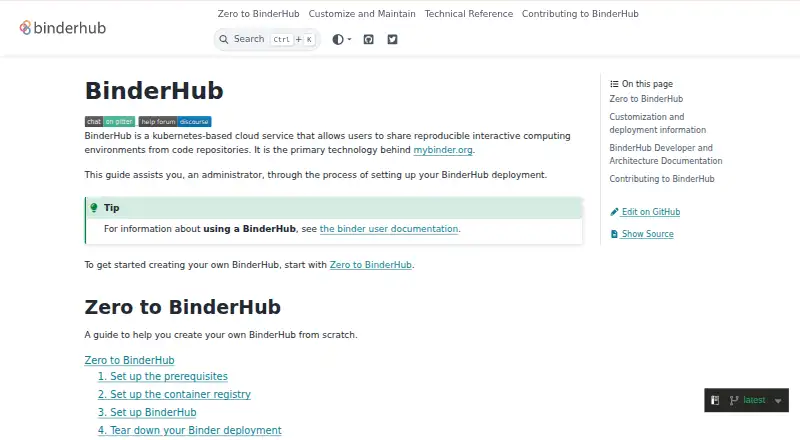
BinderHub is open-source, Kubernetes-based infrastructure for building and serving reproducible interactive computing environments from code repositories. It is intended for organizations, educators, researchers and platform operators who want users to open repository-backed notebook sessions through the web. BinderHub uses repo2docker to build Docker images, stores those images in a container registry, and launches temporary user servers through JupyterHub. Supported notebook work can include Python, R, Julia, Octave, Rust, Fortran, C and Cython, with Jupyter Notebook files as the supported format.
Its main strength is the connection between a repository reference and a runnable environment. Administrators can use a branch, commit or tag, while BinderHub builds the corresponding image and runs the user environment in a Kubernetes pod. The system supports multiple repository and data providers, including GitHub, GitLab, Zenodo, Figshare, HydroShare, Dataverse and CKAN. Optional JupyterHub authentication is available, while temporary users and default inactive-server culling support short-lived access patterns. The surrounding ecosystem includes Docker, Docker registries, Helm, Kubernetes, JupyterHub and repo2docker, making it a fit for teams already operating these components.
BinderHub is free to deploy as open source, but it is deployment software rather than a vendor-hosted notebook subscription. Hosting and infrastructure costs depend on the operator's cloud or hardware, and the organization must manage the Kubernetes-based service and its connected components. That makes it a strong pick for teams that need reproducible, repository-defined environments and have the platform capacity to run them. Users seeking a ready-made notebook workspace or a product centered on authoring rather than deployment should choose a different type of tool.
Your product? Our editors can test BinderHub in depth and publish a review, labelled as paid · from $149/mo →
BinderHub pricing
BinderHub fact sheet
| Free plan | Not verified |
|---|---|
| Paid from | Free |
| Execution model | Hosted |
| Real-time collaboration | Not verified |
| Version history | Not verified |
| GPU compute | Not verified |
| Supported languages | Python, R, Julia, Octave, Rust, Fortran, C, Cython |
| Notebook formats | Jupyter Notebook (.ipynb) |
| Deployment | Cloud, Self-hosted |
| Platforms | Web |
| Support | Community, Docs |
| Built for | Small business, Mid-market, Enterprise (editorial estimate) |
| Integrations | 13 integrations: JupyterHub, repo2docker, Kubernetes, Helm, Docker, Docker registries … |
| Pricing | Open source |
| Website | binderhub.readthedocs.io |
| Facts checked | 20 Sep 2026 |
BinderHub integrations
BinderHub lists 13 integrations on its own site.
- JupyterHub
- repo2docker
- Kubernetes
- Helm
- Docker
- Docker registries
- GitHub
- GitLab
- Zenodo
- Figshare
- HydroShare
- Dataverse
- CKAN
Alternatives to BinderHub
- Google ColabA capable browser notebook with free compute and paid access to more resources.9.4
- Jupyter NotebookA flexible, free notebook environment for code, narrative, visualizations, and data-science work.9.2
- JupyterLabA free, open-source notebook IDE with kernels, terminals, debugging, and extensions.9.1



See all BinderHub alternatives →
Used BinderHub? Be the first to review it
The editor score above is our own research. What this page doesn't have yet is a reader's view — what you used BinderHub for, what worked and what didn't. No stars are seeded and no review is paid for; an editor reads every one before it appears.
Write a reviewTwo minutes · verified accounts only · read by an editor before it appears
Featured on iTechGuides

BinderHub is listed in our Notebook Software directory. Add the badge to your site — it links back to this page.
<a href="https://www.itechguides.com/products/binderhub/"><img src="https://www.itechguides.com/best/badge/binderhub.svg" alt="Featured on iTechGuides" width="230" height="46"></a>
Reviewed by iTechGuides Editors · Editorial team · Updated Oct 2026
Advertiser disclosure: iTechGuides is reader-supported. Vendors can pay for top positions in our rankings and for a place on other products' pages, and we may earn a commission when you click some links. Bought places stand at the number bought; this page and our disclosure say so. Paying vendors may get a fuller, more detailed review from our editors, and that review can change their score. How we rank.
Last updated · How we research and update