Asynq
Asynq: A focused, self-hosted Redis queue for Go teams needing task administration. Ranked #18 of 36 in Task Queue Software by our editors (7.5/10); pricing: Open source; best for redis-backed Go queues with administration.
At a glance
- Editor score7.5 / 10
- PricingOpen source
- Best forRedis-backed Go queues with administration
- Paid fromFree
- Deployment modelSelf_hosted
- Facts checked20 Sep 2026
Where it wins
- Scheduling, periodic tasks, retries, priorities, and retry delays
- Crash recovery, deduplication, timeouts, and task deadlines
- Web administration, CLI controls, and Prometheus queue metrics
Where it doesn't
- Requires Redis as the task broker
- Self-hosted deployment requires infrastructure ownership
- Official SDK coverage is focused on Go
Our verdict on Asynq
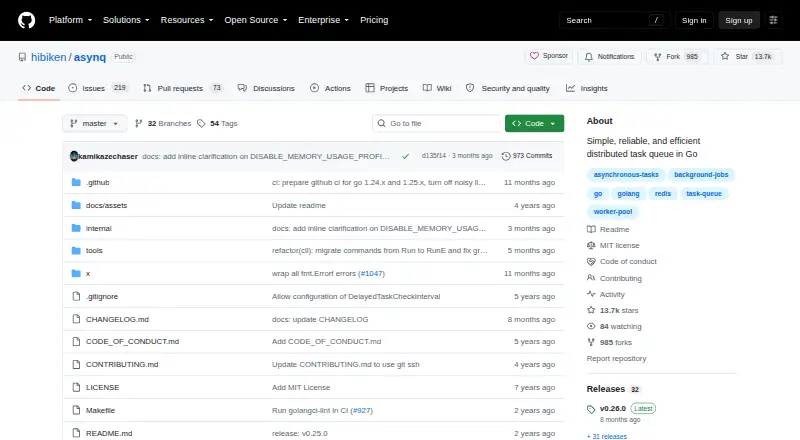
Asynq is an open-source library for queuing and asynchronously processing background tasks with workers. It is designed for developers and teams building background-job systems in Go, with applications running workers in their own infrastructure. Redis serves as the broker, while the queue supports scheduled and periodic tasks, configurable retries, weighted and strict-priority queues, automatic recovery after worker crashes, task deduplication, per-task timeouts, and deadlines. This makes Asynq a focused option for Go applications that need more control than a basic in-process job runner.
Its standout feature set centers on task lifecycle and queue administration. Teams can configure retry policies and delays, schedule work, assign queue priorities, prevent duplicate tasks with unique options, and recover tasks after worker crashes. The web administration UI provides queue and task management, while the command-line tool adds another route for operational control. Prometheus integration supplies queue metrics for monitoring workflows. These capabilities give Asynq useful depth for background processing without broadening the product into a general-purpose workflow platform.
The main trade-off is its self-hosted model. Running Asynq means operating the application workers and Redis infrastructure within your own environment, rather than adopting a hosted service. Its ecosystem fit is also deliberate: Redis and Prometheus are the verified integrations, and the official SDK is Go. Choose Asynq when your application is built in Go, Redis is an acceptable dependency, and your team wants direct control over queues and administration. Consider an alternative if you need a hosted SaaS experience, a different primary programming language, or a wider integration ecosystem.
Your product? Our editors can test Asynq in depth and publish a review, labelled as paid · from $149/mo →
Asynq pricing
Asynq fact sheet
| Free plan | Not verified |
|---|---|
| Paid from | Free |
| Deployment model | Self_hosted |
| Custom retry policy | Yes |
| Scheduled jobs | Yes |
| Dead-letter queue | Not verified |
| Maximum payload size | Not verified |
| Official SDK languages | Go |
| Deployment | Self-hosted |
| Support | Community, Docs |
| Built for | Small business, Mid-market, Enterprise (editorial estimate) |
| Integrations | 2 integrations: Redis, Prometheus |
| Pricing | Open source |
| Website | github.com |
| Facts checked | 20 Sep 2026 |
Asynq integrations
Asynq lists 2 integrations on its own site.
- Redis
- Prometheus
Alternatives to Asynq
- HatchetA code-first queue for durable execution, observable workflows, and AI task orchestration.9.4
- Trigger.devA strong fit for durable TypeScript tasks, queues, retries, and preview environments.9.2
- InngestA flexible task engine for serverless teams that need durable, observable execution.9.0



Used Asynq? Be the first to review it
The editor score above is our own research. What this page doesn't have yet is a reader's view — what you used Asynq for, what worked and what didn't. No stars are seeded and no review is paid for; an editor reads every one before it appears.
Write a reviewTwo minutes · verified accounts only · read by an editor before it appears
Featured on iTechGuides

Asynq is listed in our Task Queue Software directory. Add the badge to your site — it links back to this page.
<a href="https://www.itechguides.com/products/asynq/"><img src="https://www.itechguides.com/best/badge/asynq.svg" alt="Featured on iTechGuides" width="230" height="46"></a>
Reviewed by iTechGuides Editors · Editorial team · Updated Oct 2026
Advertiser disclosure: iTechGuides is reader-supported. Vendors can pay for top positions in our rankings and for a place on other products' pages, and we may earn a commission when you click some links. Bought places stand at the number bought; this page and our disclosure say so. Paying vendors may get a fuller, more detailed review from our editors, and that review can change their score. How we rank.
Last updated · How we research and update