
Apica Synthetic Monitoring
Apica Synthetic Monitoring: A broad synthetic monitoring platform with a free plan and private-agent support. Ranked #12 of 42 in Synthetic Monitoring by our editors (8.1/10); pricing: Free plan; best for free synthetic monitoring with private agents.
At a glance
- Editor score8.1 / 10
- PricingFree plan
- Best forFree synthetic monitoring with private agents
- Free planYes
- Facts checked20 Sep 2026
Where it wins
- Free plan covers four basic synthetic check types
- Private agents monitor internal and restricted environments
- Alerts connect with PagerDuty, Slack, SMS, and webhooks
Where it doesn't
- Available check types and minimum frequencies vary by account
- API Tools checks require a private agent
- Its broad scope may exceed simple uptime monitoring needs
Our verdict on Apica Synthetic Monitoring
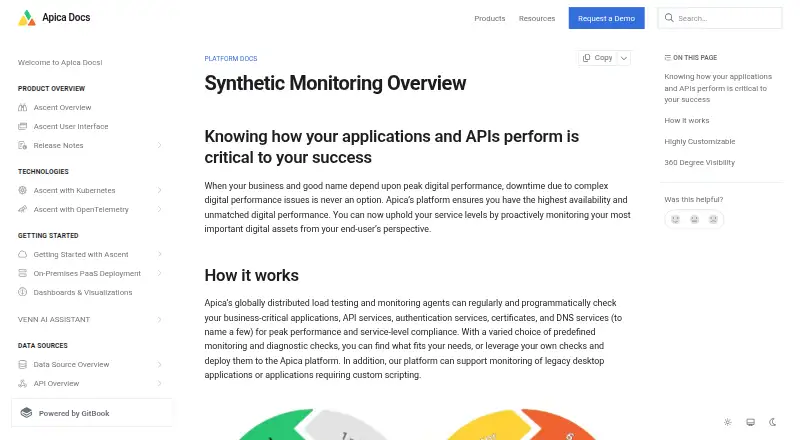
Apica Synthetic Monitoring checks websites, applications, APIs, authentication services, certificates, DNS services, and other digital assets from distributed monitoring locations. It is aimed at organizations that need availability, performance, service-level, and end-to-end workflow visibility across public, private, hybrid, and on-premises environments. The platform supports web, API, and self-hosted use cases, including browser checks, Postman-based API collections, scripted checks, and multi-step user scenarios.
Its ecosystem coverage is a practical strength for operations teams. Alert delivery includes email, SMS, PagerDuty, and webhooks, while listed integrations include AppDynamics, Microsoft Azure, Akamai, Google Analytics, OpsGenie, Splunk, Dynatrace, ServiceNow, and Slack. Reporting, dashboards, metrics analysis, subscriptions, and a REST API support ongoing monitoring management and result retrieval. Private agents extend monitoring to internal applications and restricted environments, and API Tools checks can run through a private agent.
The product’s breadth makes it suitable for teams monitoring more than basic uptime: browser journeys, API behavior, network services, certificates, security checks, and scripted workflows are all part of its scope. The published freemium offer includes four basic synthetic check types, while available check types and minimum frequencies vary by account. Teams seeking a free starting point with private-agent coverage should consider Apica. Organizations that need only a narrow, simple uptime checker may prefer a more focused tool, while teams should also account for the private-agent requirement on applicable API Tools checks.
Your product? Our editors can test Apica Synthetic Monitoring in depth and publish a review, labelled as paid · from $149/mo →
Apica Synthetic Monitoring pricing
Apica Synthetic Monitoring fact sheet
| Free plan | Yes |
|---|---|
| Paid from | Not verified |
| Locations | Not verified |
| Fastest schedule | Not verified |
| Browser checks | Yes |
| API checks | Yes |
| Transaction checks | Yes |
| Journey checks | Yes |
| Deployment | Cloud, Self-hosted |
| Platforms | Web |
| Compliance & security | SOC 2, ISO 27001, GDPR, PCI DSS |
| Support | Email, Phone, Docs |
| Built for | Mid-market, Enterprise (editorial estimate) |
| Integrations | 15 integrations: AppDynamics, Microsoft Azure, Akamai, Google Analytics, PagerDuty, OpsGenie … See all → |
| Pricing | Free plan |
| Website | docs.apica.io |
| Facts checked | 20 Sep 2026 |
Apica Synthetic Monitoring integrations
Apica Synthetic Monitoring lists 15 integrations on its own site.
- AppDynamics
- Microsoft Azure
- Akamai
- Google Analytics
- PagerDuty
- OpsGenie
- Centrify
- Splunk
- Dynatrace
- Google PageSpeed Insights
- ServiceNow
- Slack
- SMS
- Custom webhooks
See all Apica Synthetic Monitoring integrations →
Alternatives to Apica Synthetic Monitoring
- ChecklyBroad synthetic monitoring coverage with a free plan and paid features for growing teams.9.4
- Testable Synthetic MonitoringEvidence-rich synthetic monitoring with browser, API, infrastructure, and private-network coverage.9.2
- Site24x7 Synthetic MonitoringBroad synthetic monitoring with browser, API, private-location, and one-minute coverage.9.0



See all Apica Synthetic Monitoring alternatives →
Used Apica Synthetic Monitoring? Be the first to review it
The editor score above is our own research. What this page doesn't have yet is a reader's view — what you used Apica Synthetic Monitoring for, what worked and what didn't. No stars are seeded and no review is paid for; an editor reads every one before it appears.
Write a reviewTwo minutes · verified accounts only · read by an editor before it appears
Featured on iTechGuides

Apica Synthetic Monitoring is listed in our Synthetic Monitoring directory. Add the badge to your site — it links back to this page.
<a href="https://www.itechguides.com/products/apica-synthetic-monitoring/"><img src="https://www.itechguides.com/best/badge/apica-synthetic-monitoring.svg" alt="Featured on iTechGuides" width="230" height="46"></a>
Reviewed by iTechGuides Editors · Editorial team · Updated Oct 2026
Advertiser disclosure: iTechGuides is reader-supported. Vendors can pay for top positions in our rankings and for a place on other products' pages, and we may earn a commission when you click some links. Bought places stand at the number bought; this page and our disclosure say so. Paying vendors may get a fuller, more detailed review from our editors, and that review can change their score. How we rank.
Last updated · How we research and update