
Apache IoTDB
Apache IoTDB: A focused open-source choice for high-volume IoT ingestion, SQL, retention, and scaling. Ranked #1 of 36 in Time-Series Databases by our editors (9.3/10); pricing: Open source; best for ioT data with SQL and many ingestion options.
At a glance
- Editor score9.3 / 10
- PricingOpen source
- Best forIoT data with SQL and many ingestion options
- Paid fromFree
- DeploymentBoth
- Facts checked22 Sep 2026
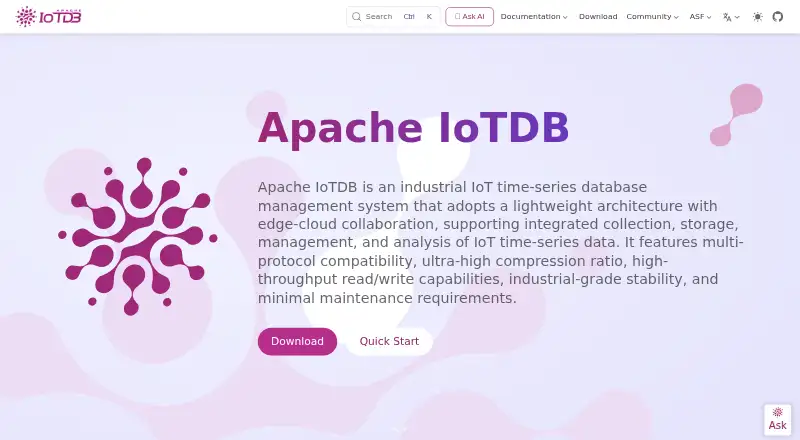
Where it wins
- High-throughput real-time and batch ingestion across multiple interfaces
- SQL with tree and table models, filtering, aggregation, and grouping
- TTL retention, cluster scaling, and broad analytics integrations
Where it doesn't
- Self-managed deployment places operations and maintenance on the organization
- Uses IoTDB SQL dialects rather than a single conventional SQL model
- Its broad ingestion and integration surface may exceed smaller IoT projects
Our verdict on Apache IoTDB
Apache IoTDB is an open-source, IoT-native time-series database for organizations managing large volumes of device and sensor data. It suits industrial use cases across energy, transportation, aerospace, manufacturing, and general IoT platforms. Data can be organized with tree-model or table-model structures, while SQL supports filtering, aggregation, grouping, ordering, limits, and alignment. Deployment can run as a standalone instance or cluster on Linux, Windows, and macOS, including self-hosted environments and API-based workflows.
Its strongest fit is ingestion flexibility. IoTDB accepts INSERT SQL, native Java, Python, C++, and Go API calls, REST API writes, MQTT data, CSV files, and TsFile batch imports. Schema-less writing can create metadata automatically, which supports device and sensor pipelines with changing structures. Configurable database- and device-level TTL retention helps manage data lifecycles. For larger deployments, DataNode-based horizontal scaling provides a cluster path, while compression and high-throughput real-time and batch ingestion address the volume patterns common in IoT systems.
The ecosystem covers Grafana, Kafka, Flink, Spark, Telegraf, Apache NiFi, DBeaver, Hadoop, Zeppelin, ThingsBoard, and DataEase. That range makes IoTDB a practical choice when telemetry must feed dashboards, stream processing, analytics, or data-management tools. The tradeoff is ownership: as open-source software with self-hosted deployment options, organizations must handle the database environment and its operational requirements. Teams seeking direct control, multiple ingestion paths, SQL access, retention policies, and cluster scaling should consider Apache IoTDB. Smaller projects with simple collection needs, or teams seeking a narrowly managed service, may prefer a less operationally involved alternative.
Your product? Our editors can test Apache IoTDB in depth and publish a review, labelled as paid · from $149/mo →
Apache IoTDB pricing
Apache IoTDB fact sheet
| Free plan | Not verified |
|---|---|
| Paid from | Free |
| Deployment | Both |
| SQL support | Yes |
| Retention policies | Yes |
| Horizontal scaling | Yes |
| Query languages | IoTDB-SQL; Tree Mode SQL; Table Mode SQL |
| Ingestion methods | INSERT SQL; Java JDBC; Java, C++, Python, and Go native APIs; REST API; MQTT; CSV; TsFile |
| Deployment | Cloud, Self-hosted, Desktop |
| Platforms | Web, Windows, Linux |
| Support | Community, Docs |
| Built for | Small business, Mid-market, Enterprise (editorial estimate) |
| Integrations | 4 integrations: Hadoop, Spark, Flink, Grafana |
| Pricing | Open source |
| Website | iotdb.apache.org |
| Facts checked | 22 Sep 2026 |
Apache IoTDB integrations
Apache IoTDB lists 4 integrations on its own site.
- Hadoop
- Spark
- Flink
- Grafana
Alternatives to Apache IoTDB
- Amazon TimestreamA managed AWS option with flexible ingestion, retention, SQL, and InfluxDB support.9.1
- LindormTSDBA broad compatibility layer for teams managing scalable telemetry and metrics workloads.9.0
- kdb+A specialized, self-hosted engine for real-time and historical financial analytics.8.9



See all Apache IoTDB alternatives →
Apache IoTDB vs the competition
- Apache IoTDB vs Amazon Timestream
- Apache IoTDB vs LindormTSDB
- Apache IoTDB vs kdb+
- Apache IoTDB vs Prometheus
- Apache IoTDB vs Grafana Mimir
- Apache IoTDB vs InfluxDB



Compare Apache IoTDB with any tool side by side →
Also Ranked In
Apache IoTDB is ranked in 3 of our directories.
Used Apache IoTDB? Be the first to review it
The editor score above is our own research. What this page doesn't have yet is a reader's view — what you used Apache IoTDB for, what worked and what didn't. No stars are seeded and no review is paid for; an editor reads every one before it appears.
Write a reviewTwo minutes · verified accounts only · read by an editor before it appears
Featured on iTechGuides

Apache IoTDB is listed in our Time-Series Databases directory. Add the badge to your site — it links back to this page.
<a href="https://www.itechguides.com/products/apache-iotdb/"><img src="https://www.itechguides.com/best/badge/apache-iotdb.svg" alt="Featured on iTechGuides" width="230" height="46"></a>
Reviewed by iTechGuides Editors · Editorial team · Updated Oct 2026
Advertiser disclosure: iTechGuides is reader-supported. Vendors can pay for top positions in our rankings and for a place on other products' pages, and we may earn a commission when you click some links. Bought places stand at the number bought; this page and our disclosure say so. Paying vendors may get a fuller, more detailed review from our editors, and that review can change their score. How we rank.
Last updated · How we research and update