
Apache CloudStack
Apache CloudStack: A capable self-hosted choice for organizations managing varied virtualized environments. Ranked #1 of 33 in Virtualization Management Software by our editors (9.3/10); pricing: Free plan; best for open-source multi-hypervisor cloud management.
At a glance
- Editor score9.3 / 10
- PricingFree plan
- Best forOpen-source multi-hypervisor cloud management
- Free planYes
- Paid fromFree
- Deployment modelSelf-hosted
- Founded2008
- Facts checked20 Sep 2026
Where it wins
- Supports BareMetal, Hyper-V, KVM, LXC, vSphere, and Xen environments
- Combines HA, live migration, orchestration, and recovery workflows
- Offers REST-like, AWS-compatible, Terraform, and Ansible integrations
Where it doesn't
- Self-hosted deployment leaves infrastructure operations with the adopter
- Its broad infrastructure scope may exceed smaller virtualization needs
- Administration spans compute, network, storage, tenancy, and recovery
Our verdict on Apache CloudStack
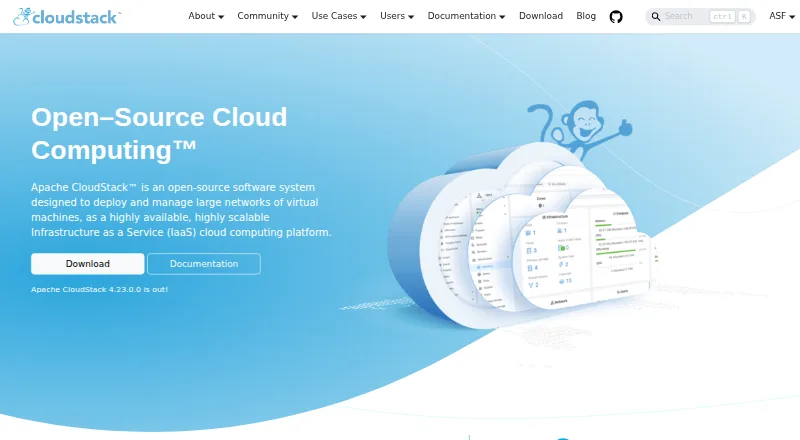
Apache CloudStack is an open-source Infrastructure-as-a-Service platform for deploying and managing public, private, and hybrid clouds. It is designed for cloud providers, managed service providers, telecommunications companies, and enterprises operating large-scale virtualized environments. Web-based administrator and end-user interfaces, command-line tools, and APIs cover compute, networking, storage, virtual machines, and related infrastructure. The deployment model is self-hosted, and the software is available as an open-source product rather than a vendor-hosted subscription service.
Its strongest differentiator is multi-hypervisor management. CloudStack supports BareMetal, Hyper-V, KVM, LXC, vSphere through vCenter, XenServer, and Xen Project. That coverage is paired with VM high availability and automatic restart, host maintenance with live migration, and orchestration across compute, network, and storage resources. Snapshots, templates, ISO images, and backup and recovery workflows extend the platform beyond basic VM provisioning. Multi-tenancy, accounts, domains, delegated administration, usage metering, alerts, audit logs, and webhooks also support shared infrastructure operations.
CloudStack fits teams that want open-source control over a broad virtualized environment and have the operational capacity to run self-hosted infrastructure. Its REST-like native API and AWS EC2/S3-compatible APIs support custom tooling, while Terraform, Ansible, Cluster API, and Packer integrations connect it to infrastructure automation workflows. The tradeoff is scope: organizations seeking a narrowly focused virtualization tool or a vendor-hosted service may find CloudStack’s infrastructure breadth and administrative model unnecessary. Teams managing varied hypervisors, lifecycle operations, tenancy, availability, and recovery should find its feature set more aligned with their needs.
Your product? Our editors can test Apache CloudStack in depth and publish a review, labelled as paid · from $149/mo →
Apache CloudStack pricing
Apache CloudStack fact sheet
| Free plan | Yes |
|---|---|
| Paid from | Free |
| Deployment model | Self-hosted |
| Supported hypervisors | BareMetal, Hyper-V, KVM, LXC, vSphere via vCenter, XenServer, Xen Project |
| Managed host limit | Not verified |
| Live migration | Yes |
| High availability | Yes |
| Disaster recovery | Yes |
| API access | Yes |
| Deployment | Self-hosted, Browser extension |
| Platforms | Web, Linux |
| Compliance & security | SSO/SAML, 2FA |
| Support | Community, Docs |
| Built for | Small business, Mid-market, Enterprise (editorial estimate) |
| Integrations | 4 integrations: Terraform, Ansible, Cluster API, Packer See all → |
| Pricing | Free plan |
| Website | cloudstack.apache.org |
| Facts checked | 20 Sep 2026 |
Apache CloudStack integrations
Apache CloudStack lists 4 integrations on its own site.
- Terraform
- Ansible
- Cluster API
- Packer
See all Apache CloudStack integrations →
Alternatives to Apache CloudStack
- Proxmox VEA capable self-hosted KVM/LXC manager with broad infrastructure features and optional paid support.9.2
- Nutanix Prism CentralA centralized control plane for managing enterprise Nutanix clusters, workloads, and operations.8.9
- VMware Cloud DirectorA broad VMware platform for providers managing tenants, infrastructure, automation, and recovery.8.8



See all Apache CloudStack alternatives →
Apache CloudStack vs the competition
- Apache CloudStack vs Proxmox VE
- Apache CloudStack vs Nutanix Prism Central
- Apache CloudStack vs VMware Cloud Director
- Apache CloudStack vs Microsoft System Center Virtual Machine Manager
- Apache CloudStack vs Virtuozzo Infrastructure
- Apache CloudStack vs VMmanager



Compare Apache CloudStack with any tool side by side →
Also Ranked In
Apache CloudStack is ranked in 12 of our directories; the 6 strongest besides Virtualization Management Software.
Used Apache CloudStack? Be the first to review it
The editor score above is our own research. What this page doesn't have yet is a reader's view — what you used Apache CloudStack for, what worked and what didn't. No stars are seeded and no review is paid for; an editor reads every one before it appears.
Write a reviewTwo minutes · verified accounts only · read by an editor before it appears
Featured on iTechGuides

Apache CloudStack is listed in our Virtualization Management Software directory. Add the badge to your site — it links back to this page.
<a href="https://www.itechguides.com/products/apache-cloudstack/"><img src="https://www.itechguides.com/best/badge/apache-cloudstack.svg" alt="Featured on iTechGuides" width="230" height="46"></a>
Reviewed by iTechGuides Editors · Editorial team · Updated Oct 2026
Advertiser disclosure: iTechGuides is reader-supported. Vendors can pay for top positions in our rankings and for a place on other products' pages, and we may earn a commission when you click some links. Bought places stand at the number bought; this page and our disclosure say so. Paying vendors may get a fuller, more detailed review from our editors, and that review can change their score. How we rank.
Last updated · How we research and update