
Amazon Neptune
Amazon Neptune: A managed AWS graph service with broad query, resilience, analytics, and AI connectivity. Ranked #2 of 39 in Graph Databases by our editors (9.2/10); pricing: 30-day trial; best for managed AWS graph deployments.
At a glance
- Editor score9.2 / 10
- Pricing30-day trial
- Best forManaged AWS graph deployments
- Free planNo
- DeploymentCloud
- Facts checked22 Sep 2026
Where it wins
- Supports Gremlin, openCypher, and SPARQL query languages
- Includes read replicas, Multi-AZ failover, and point-in-time recovery
- Adds graph algorithms and vector similarity search through Neptune Analytics
Where it doesn't
- Uses usage-based pricing rather than fixed subscription plans
- Requires AWS ecosystem fit for its integrations and access controls
- Neptune Analytics is separate from the core managed database service
Our verdict on Amazon Neptune
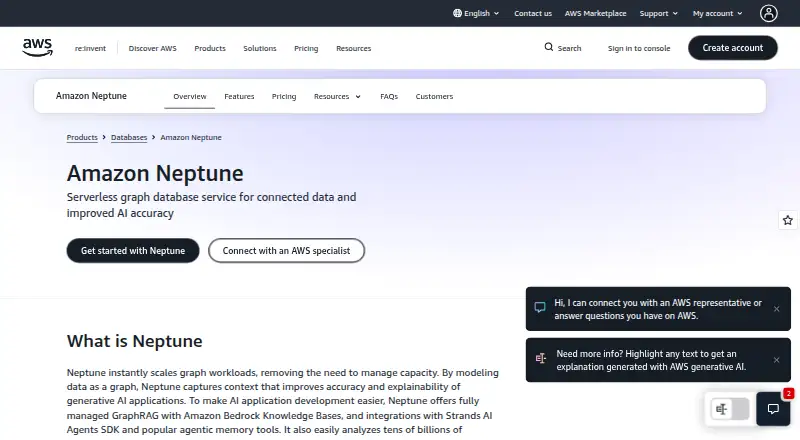
Amazon Neptune is a fully managed graph database service for applications built on highly connected datasets. It supports property graphs through Gremlin and openCypher, as well as RDF graphs through SPARQL. That makes it suitable for recommendation engines, fraud detection, knowledge graphs, drug discovery, network security, and generative AI applications. Its cloud deployment, transaction support, managed storage, encryption, and IAM-based access controls target teams that want graph capabilities within AWS rather than a self-managed database.
Pricing is usage-based instead of organized into fixed subscription plans. According to the vendor's pricing information, new Neptune Database users receive a 30-day free allowance, treated as a trial rather than a permanent free plan. The paid service combines managed database operations with read replicas, Multi-AZ failover, continuous backups, and point-in-time recovery. Buyers should therefore evaluate expected usage and AWS deployment requirements rather than compare a set of standard tiers. Neptune suits teams that value managed operations and resilience; organizations seeking a permanent free plan or simple fixed-plan budgeting should look elsewhere.
Its broader value comes from the AWS ecosystem and the companion Neptune Analytics service. Integrations include Amazon Bedrock, Amazon SageMaker, Amazon S3, LangChain, LlamaIndex, the AWS CLI, and AWS SDKs. Neptune Analytics adds in-memory graph analysis, built-in graph algorithms, and vector similarity search, extending the platform toward AI and analytical workloads. The result is a broad managed offering for AWS-centered applications, but it may be more than needed for projects requiring only a narrow graph database or a deployment outside the cloud ecosystem.
Your product? Our editors can test Amazon Neptune in depth and publish a review, labelled as paid · from $149/mo →
Amazon Neptune pricing
All 3 Amazon Neptune plans and prices →
Amazon Neptune fact sheet
| Free plan | No |
|---|---|
| Paid from | Not verified |
| Deployment | Cloud |
| Query languages | Gremlin, openCypher, SPARQL |
| ACID transactions | Yes |
| Graph algorithms | Yes |
| Vector search | Yes |
| Included storage | Not verified |
| Free trial | 30 days |
| Deployment | Cloud |
| Platforms | Web |
| Compliance & security | SOC 2, HIPAA |
| Support | Docs |
| Built for | Mid-market, Enterprise (editorial estimate) |
| Integrations | 8 integrations: Amazon Bedrock Knowledge Bases, AWS IAM, Amazon VPC, AWS Key Management Service, Amazon CloudWatch, Amazon S3 … |
| Pricing | 30-day trial (source) |
| Website | aws.amazon.com |
| Facts checked | 22 Sep 2026 |
Amazon Neptune integrations
Amazon Neptune lists 8 integrations on its own site.
- Amazon Bedrock Knowledge Bases
- AWS IAM
- Amazon VPC
- AWS Key Management Service
- Amazon CloudWatch
- Amazon S3
- Amazon SageMaker
- Strands AI Agents SDK
Alternatives to Amazon Neptune
- Neo4jA broad graph platform spanning managed cloud, self-managed deployments, analytics, and AI.9.4
- Apache HugeGraphA self-hosted graph platform combining transactional storage, analytics, and graph-AI tooling.9.0
- Aerospike GraphA Gremlin-based graph database for distributed enterprise workloads that need scale-out traversal.8.8



See all Amazon Neptune alternatives →
Amazon Neptune vs the competition
- Amazon Neptune vs Neo4j
- Amazon Neptune vs Apache HugeGraph
- Amazon Neptune vs Aerospike Graph
- Amazon Neptune vs TigerGraph
- Amazon Neptune vs GraphDB
- Amazon Neptune vs AllegroGraph


Compare Amazon Neptune with any tool side by side →
Also Ranked In
Amazon Neptune is ranked in 6 of our directories.
Used Amazon Neptune? Be the first to review it
The editor score above is our own research. What this page doesn't have yet is a reader's view — what you used Amazon Neptune for, what worked and what didn't. No stars are seeded and no review is paid for; an editor reads every one before it appears.
Write a reviewTwo minutes · verified accounts only · read by an editor before it appears
Featured on iTechGuides

Amazon Neptune is listed in our Graph Databases directory. Add the badge to your site — it links back to this page.
<a href="https://www.itechguides.com/products/amazon-neptune/"><img src="https://www.itechguides.com/best/badge/amazon-neptune.svg" alt="Featured on iTechGuides" width="230" height="46"></a>
Reviewed by iTechGuides Editors · Editorial team · Updated Oct 2026
Advertiser disclosure: iTechGuides is reader-supported. Vendors can pay for top positions in our rankings and for a place on other products' pages, and we may earn a commission when you click some links. Bought places stand at the number bought; this page and our disclosure say so. Paying vendors may get a fuller, more detailed review from our editors, and that review can change their score. How we rank.
Last updated · How we research and update