
Amazon Aurora
Amazon Aurora: A managed AWS database for scalable PostgreSQL, MySQL, and distributed SQL workloads. Ranked #5 of 37 in Relational Databases by our editors (9.0/10); pricing: Paid; best for scalable managed PostgreSQL or MySQL.
At a glance
- Editor score9.0 / 10
- PricingPaid
- Best forScalable managed PostgreSQL or MySQL
- Free planNo
- Deployment modelCloud
- Founded2006 · Seattle, Washington, United States
- Facts checked22 Sep 2026
Where it wins
- PostgreSQL- and MySQL-compatible engines with serverless options
- Automatic scaling, failover, backups, and point-in-time recovery
- Up to 15 read replicas plus multi-Region database support
Where it doesn't
- No permanent free plan
- Pricing varies by region, engine, capacity, storage, and I/O
- Cloud-based service with AWS ecosystem dependencies
Our verdict on Amazon Aurora
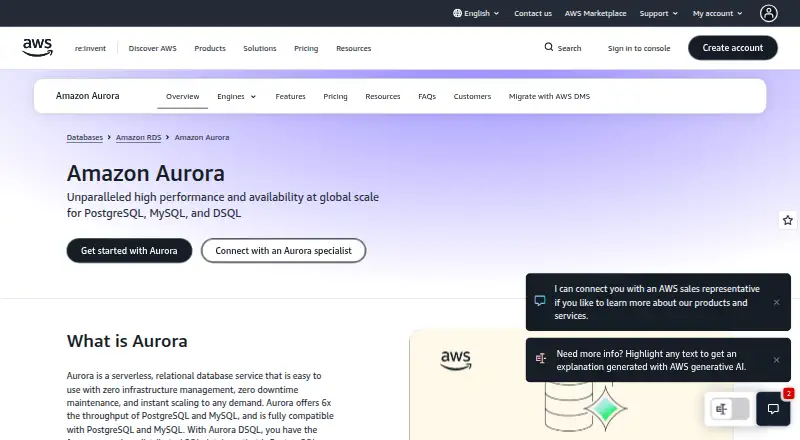
Amazon Aurora is a fully managed, cloud-based relational database service from Amazon Web Services. It supports PostgreSQL- and MySQL-compatible engines, along with Aurora DSQL, a distributed SQL engine. Provisioned and serverless deployment options make it suitable for enterprise applications, SaaS products, and globally distributed workloads that need managed provisioning, patching, backups, scaling, and failure handling.
Pricing is usage-based rather than organized around a simple fixed plan ladder. According to the published pricing structure, cost varies by AWS Region, database engine, instance or Aurora Capacity Unit capacity, storage, I/O, and optional features. Aurora is a paid service, while eligible new customers may access AWS credits for up to 12 months. The main deployment choice is between provisioned capacity and serverless capacity, with automatic scaling available for database capacity and storage. Teams should model expected workload, replicas, storage, and regional requirements before selecting a configuration.
Aurora’s strongest fit is for teams that want AWS-managed availability and scale without operating database infrastructure directly. Its features include distributed storage across Availability Zones, automatic failover to an Aurora Replica, continuous automated backups, point-in-time recovery, up to 15 Aurora read replicas, and Multi-Region Aurora Global Database. Native JSON and JSONB support extends its fit for applications that combine relational and document-style data. Integrations with Amazon S3, AWS Backup, Amazon Bedrock, and Amazon SageMaker add AWS ecosystem alignment. Teams seeking a permanent free tier, a self-managed deployment, or a non-AWS operating model should choose an alternative instead.
Your product? Our editors can test Amazon Aurora in depth and publish a review, labelled as paid · from $149/mo →
Amazon Aurora pricing
All 2 Amazon Aurora plans and prices →
Amazon Aurora fact sheet
| Free plan | No |
|---|---|
| Paid from | Not verified |
| Deployment model | Cloud |
| Managed service | Yes |
| High availability | Yes |
| Read replicas | Yes |
| Backup retention | Not verified |
| JSON data support | Yes |
| Maximum connections | Not verified |
| Deployment | Cloud |
| Platforms | Web |
| Compliance & security | SOC 2, HIPAA, PCI DSS |
| Support | Email, Live chat, Phone, Tickets, Community, Docs · 24/7 |
| Built for | Small business, Mid-market, Enterprise (editorial estimate) |
| Integrations | 9 integrations: AWS Lambda, Amazon S3, Amazon RDS Proxy, Amazon CloudWatch, Amazon Performance Insights, Amazon Aurora Auto Scaling … See all → |
| Pricing | Paid (source) |
| Website | aws.amazon.com |
| Facts checked | 22 Sep 2026 |
Amazon Aurora integrations
Amazon Aurora lists 9 integrations on its own site.
- AWS Lambda
- Amazon S3
- Amazon RDS Proxy
- Amazon CloudWatch
- Amazon Performance Insights
- Amazon Aurora Auto Scaling
- Amazon Redshift
- AWS IAM
- AWS Secrets Manager
See all Amazon Aurora integrations →
Alternatives to Amazon Aurora
- PostgreSQLA free, extensible relational database for production workloads and technical teams.9.4
- MySQLA versatile open-source SQL database with replication, JSON, connectors, and failover.9.3
- Oracle DatabaseA mature enterprise database with unusually broad data-model and availability capabilities.9.2



See all Amazon Aurora alternatives →
Amazon Aurora vs the competition
- Amazon Aurora vs PostgreSQL
- Amazon Aurora vs MySQL
- Amazon Aurora vs Oracle Database
- Amazon Aurora vs Microsoft SQL Server
- Amazon Aurora vs Azure SQL Database
- Amazon Aurora vs Google Cloud SQL



Compare Amazon Aurora with any tool side by side →
Also Ranked In
Amazon Aurora is ranked in 13 of our directories; the 6 strongest besides Relational Databases.
Used Amazon Aurora? Be the first to review it
The editor score above is our own research. What this page doesn't have yet is a reader's view — what you used Amazon Aurora for, what worked and what didn't. No stars are seeded and no review is paid for; an editor reads every one before it appears.
Write a reviewTwo minutes · verified accounts only · read by an editor before it appears
Featured on iTechGuides

Amazon Aurora is listed in our Relational Databases directory. Add the badge to your site — it links back to this page.
<a href="https://www.itechguides.com/products/amazon-aurora/"><img src="https://www.itechguides.com/best/badge/amazon-aurora.svg" alt="Featured on iTechGuides" width="230" height="46"></a>
Reviewed by iTechGuides Editors · Editorial team · Updated Oct 2026
Advertiser disclosure: iTechGuides is reader-supported. Vendors can pay for top positions in our rankings and for a place on other products' pages, and we may earn a commission when you click some links. Bought places stand at the number bought; this page and our disclosure say so. Paying vendors may get a fuller, more detailed review from our editors, and that review can change their score. How we rank.
Last updated · How we research and update