
Quick wins for a faster PC:
Fix the driver behind crashes, sound loss and screen glitchesFind Drivers →Clear out junk files and repair common Windows errorsFree Scan →Scan for outdated or missing drivers - takes under a minuteDriver Scan →A polymer additive helped researchers build perovskite solar cells tuned to the dim, spectrum-shifted light found underwater. The cells reached 34.71% efficiency under a laboratory simulation of illumination at 10 meters, while an outdoor seawater test produced 324 mWh in two hours at that depth from a 115 cm² module. Those figures point to a possible power source for underwater sensors, but they describe a research prototype—not a commercially available panel or a proven long-term marine system.
Can solar cells work underwater?
Yes. Sunlight penetrates water, although water both reduces its intensity and changes its spectral composition with depth. A solar cell designed for terrestrial sunlight may therefore be poorly matched to the light available underwater. In a study published online in Joule on 11 September 2026, a team led by Wen-Hua Zhang at Yunnan University designed perovskite cells around underwater illumination instead of ordinary full-spectrum terrestrial sunlight. The paper is titled “Submerged solar harvesting with wide-band-gap perovskites for autonomous underwater energy systems”. Simin Ma and Bing Cai are identified by Yunnan University as co-first authors. (Joule study)
How does the polymer additive change the cell?
The device uses a lead-halide perovskite absorber with an optical bandgap of about 1.96 eV. The researchers added polyhexamethylene guanidine hydrochloride (PHMG) during crystallization. According to the study, PHMG improved crystallinity and energy-level alignment, reduced defects and non-radiative recombination at interfaces, and suppressed halide-ion migration. The paper also describes a shift from p-type to n-type electronic behavior that supports electron extraction. (Joule study)
In practical terms, the additive is part of the researchers’ material recipe: it is intended to help the absorber form and move electrical charge more effectively under the conditions for which the cell was designed. PHMG is not a consumer treatment or a product recommendation.
Free tools Windows power users keep installed
One-click scans. No signup required.
#1 Best Overall

- Works Indoors & Outdoors - Generates power from ambient indoor lighting, window light, and sunlight
- Perovskite Solar Technology - Advanced photovoltaic material designed to capture more usable energy in low-light environments than traditional silicon panels.
- Built for Energy Harvesting - Ideal for powering or extending battery life in low-power electronics and IoT devices.
- Ultra-Thin & Lightweight - Compact form factor makes integration easy, even in space-constrained projects.
- Easy to Integrate - Simple wire output design for fast prototyping and product development.
What efficiency did the underwater perovskite cells achieve?
The study reports two distinct efficiency figures measured under different illumination conditions. They should not be treated as directly comparable: the underwater figure uses a spectrum-specific laboratory simulation, while the certified terrestrial figure uses standard AM 1.5G illumination.
| Reported result | Illumination and qualification |
|---|---|
| 34.71% power-conversion efficiency | Laboratory-simulated spectrum corresponding to illumination at 10 m underwater; not ordinary full-spectrum terrestrial sunlight. (Joule study) |
| 16.79% certified power-conversion efficiency | Measured under AM 1.5G standard terrestrial illumination. The paper preview also gives 17.08% in its highlights or summary; 16.79% is the value identified as certified. (Joule study) |
The 34.71% result is meaningful in the context of the simulated underwater spectrum. It is not evidence that this cell outperforms commercial terrestrial panels under the same sunlight: the spectrum used for the underwater test is different.
Rank #2
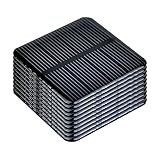
- 【Accurate power】All data are actually measured under the condition that the solar light is sufficient. In full sunlight, the voltage will be higher than 2V.
- 【Product Parameter】10Pcs Monocrystalline silicon solar panels;Power:2V 160mA;Size:1.96"x1.96";Epoxy resin AB glue, PCB+ glass fiber base plate
- 【Experience the fun of DIY】 Build your DIY powered models/solar toys / solar displays/Solar Powered String Lights.
- 【Widely used and Widely temperature range】Suitable for outdoor activities, emergencies and outdoor work. Power is continuously supplied even on cloudy days;Suitable for outdoor activities, emergencies and outdoor work. Power is continuously supplied even on cloudy days.
- 【High Conversion EffIciency】 Constructed of high-efficiency solar arrays,convert up to 21.5-23.5% of solar power into free energy.
How much energy did the modules generate in seawater?
The researchers also tested modules outdoors near Weizhou Island in the South China Sea. Mounted with an underwater robot, a module with a 115 cm² active area was submerged at three depths. During two hours of outdoor illumination, the study reports these amounts of electrical energy:
| Test depth | Energy generated in two hours |
|---|---|
| 2 m | 1,416 mWh (Joule study) |
| 6 m | 752 mWh (Joule study) |
| 10 m | 324 mWh (Joule study) |
At 10 m, the reported energy was enough to charge lithium-ion batteries and support an LED demonstration. The paper does not identify a battery brand, model, or capacity. These results establish a real-water demonstration at the tested site, depths, and duration; they do not establish output at other locations or in other ocean conditions.
Rank #3

- Lightweight and Portable Design: with its ultra-thin and lightweight construction, this solar panel is nice for those convenient situations; Although it's fragile and requires careful handling, its compact size makes transportation effortless, allowing you to harness solar energy wherever you are; Ideal for outdoor enthusiasts and travelers alike
- Powerful Polycrystalline Efficiency: equipped with 200 pcs of high efficiency polycrystalline silicon, this panel offers a potent energy output at 0.5V and 400mA, easily meeting your power needs; Experience up to 18% energy conversion, ensuring maximum solar energy utilization even on cloudy days
- Easy DIY and Customization: unlock your creativity with our solar cells, ideal for building DIY powered models, solar things, and displays; Easily adjust power and voltage by connecting in series or parallel, empowering you to tailor the output to your specific requirements
- Versatile Outdoor Application: engineered for versatility, this solar panel suits a variety of outdoor activities, emergencies, and work scenarios; Depend on continuous energy supply regardless of weather conditions, keeping your devices charged up and ready
- Seamless Connectivity: ensure correct connections with the color-coded design: blue side for negative (-) and the other side for positive (+); For enhanced power delivery, use solder strips, thus effectively stabilizing your solar projects for optimal performance
Could underwater solar cells power sensors?
Potentially. Charging a battery and lighting an LED show how a photovoltaic module could contribute to an energy system, while autonomous underwater sensors and monitoring equipment are among the applications the researchers discuss. A deployed system would still need suitable energy storage and integration with the equipment it powers. The reported test does not validate a particular sensor, product, or commercial deployment.
Zhang, a study author at Yunnan University and Southwest United Graduate School, said that earlier underwater-cell studies had focused on very shallow depths of two meters or less, which he considered far from practical requirements. (Yunnan University) The new 10-meter tests extend the demonstrated depth in this study, but do not establish performance beyond 10 m.
Rank #4

- Easy : Simple to set up and use, making it ideal for junior high school students to learn about solar energy conversion.
- sturdy Construction: Made of premium material for long-lasting durability, ensuring years of educational use.
- Motor & Music Demonstrations: Includes ability to drive a motor and music sounder, providing hands-on experience with solar power.
- Real-Time Energy Conversion: Students can observe the conversion of solar energy into electrical energy with the included voltmeter.
- Complete Experiment Kit: Comes with all necessary components for a comprehensive solar energy experiment, including solar panel, wind blade, connecting cables, and base.
What do the durability results show?
Under simulated 10 m underwater conditions, the study reports 1,160 hours of maximum-power-point tracking with no significant degradation. It also gives a T80 estimate of 48,094 hours, or about 5.49 years, at 25°C under simulated 10 m submerged illumination. T80 is the estimated time for a device to retain 80% of its initial efficiency. The 5.49-year figure is derived from accelerated aging under specified assumptions; it is not five and a half years of observed, continuous operation in seawater. (Joule study)
Quick Recap
Best Value

- [HIGH DRIVING EFFICIENCY] This solar light control panel features high driving efficiency and long discharge time, providing a superior user experience.
- [DESIGNED FOR] Our solar lawn light control panel designed for use with 1.2V NiMH batteries, is for meeting your specific needs. This solar light control panel charging during the day, turning on the lights in the evening
- [DISCHARGE ] With a built-in 2V solar charging module, our solar light control panel offers various protective features, including , discharge , and constant current drive.
- [ MATERIAL] This solar lawn lamp control board kit is made of high-quality PCB material, our solar light control panel ensures durability and stability for long-term use.
- [PACKAGE INCLUDING] The package list has 2 x solar panel, 2 x light control board, 2 x battery slot, 2 x storage box, 1 x instruction manual
What still needs to be solved?
- Biofouling: Marine growth on a submerged panel can interfere with its operation over time. Zhang described biofouling as a critical challenge for long-term underwater photovoltaics and said addressing it requires collaboration across disciplines. (Physics World)
- Long-term field reliability: The outdoor test covered specified depths and a two-hour energy-generation period; it is not a multiyear field trial.
- Deeper operation and varied environments: The reported outdoor results reach 10 m at one South China Sea site. They do not establish output at greater depths or across changing water clarity, weather, and marine conditions.
- Meaningful comparisons: Underwater solar-cell results are difficult to rank without matching the illumination spectrum and depth, active area, test method, energy-generation duration, environmental protection, and whether durability was measured directly or extrapolated. The available results do not support a broad ranking against all other underwater photovoltaic approaches.
- Commercial readiness: The modules described are research prototypes, not identified retail products. The study demonstrates a promising direction, not a validated off-the-shelf power system for marine deployment.
Product prices and availability are accurate as of the date/time indicated and are subject to change. Any price and availability information displayed on Amazon at the time of purchase will apply.
Recommended Free Tools

