
Exentio’s Koyomi board is an open-hardware design for connecting an HDMI or DVI video source to a specific Sony Vaio P display—not a proven universal laptop-screen adapter. Its concept is to convert digital video to parallel RGB and then to LVDS, but the project README said the board had not been tested. A working related board and expectations about individual subsystems do not establish that this complete adapter works end to end.
What the Koyomi board is designed to do
The Koyomi project targets reuse of the Toshiba LT080EE04100 display identified by its author as the panel used in the Sony Vaio P. The author says it should be the same across Vaio P units, but that compatibility claim is not independently verified for every hardware revision. It is not evidence that other laptop LVDS panels will fit or work. Exentio’s project repository names the display connectors as I-PEX 20374-030E-31 and 20374-R30E-31, with the 20374-030E-31 variant described as more common.
The signal path uses a Texas Instruments TFP401 DVI receiver followed by an SN75LVDS83B LVDS transmitter. The TFP401 receives HDMI/DVI video and outputs parallel RGB; the transmitter converts that data to LVDS for the panel. This is a hardware conversion path rather than a firmware-driven scaler, but it still needs EDID information: the TFP401 does not handle EDID, so an EEPROM must provide it, as Arya Voronova’s May 14, 2024 Hackaday review explains.
TI specifies the TFP401 for pixel rates up to 165 MHz and 24-bit true-color output. TI describes HDMI support as video-only. Those are receiver-chip specifications, not a guarantee that the assembled Koyomi board, its EDID, or a particular panel will be compatible. See the TI TFP401 product page and the TFP401 datasheet, revision H, revised March 25, 2022.
Recommended Free Tools
#1 Best Overall
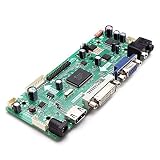
- CHIPSET: NT68676(UFG)
- MARKET AREA :Asia-Pacific
- OSD LANGUAGE: Simplified chinese, Traditional chIese, English, French, German, Italian, Spanish, Portuguese, Japanese, Korean (optional)
- KEY FUNCTION : POWER, MENU, VOL+, VOL-, ADJUST/EXIT
Panel timing values published by the project
The Koyomi README gives these reference timings for its target display and credits an external blog. They are project-published values, not independently verified panel limits or a substitute for confirming the display’s requirements.
| Timing | Project-published value |
|---|---|
| Active resolution | 1600 × 768 |
| Pixel clock | 83.6 MHz |
| Horizontal front porch / sync / back porch | 32 / 65 / 97 pixels |
| Horizontal blanking total | 194 pixels |
| Vertical front porch / sync / back porch | 1 / 1 / 8 lines |
| Vertical blanking total | 10 lines |
These figures describe the intended video mode; they do not show that the complete adapter successfully generates it or that another panel accepts it. The project README is in the Koyomi repository.
Rank #2

- CHIPSET: NT68676(UFG)
- MARKET AREA :Asia-Pacific
- OSD LANGUAGE: Simplified chinese, Traditional chIese, English, French, German, Italian, Spanish, Portuguese, Japanese, Korean (optional)
- KEY FUNCTION : POWER, MENU, VOL+, VOL-, ADJUST/EXIT
What the PCB review says about the layout
Voronova’s Hackaday review examines the original two-layer board as a design exercise, including component orientation, connector selection, differential-pair routing, ground return paths, and power distribution. The reviewer proposes rotating the TFP401 to improve routing and considers an SMT signal-pin HDMI connector in place of a through-hole signal connector to make routing and sourcing easier. These are review recommendations, not a fabricated redesign or evidence from measured signal-integrity tests.
The review also discusses matching HDMI pair lengths and routing high-speed connections carefully, but says the proposed routing was draft work without calculated trace impedance. The design therefore should not be described as impedance-validated or as having passed HDMI compliance testing. The review’s power-layout discussion includes separate filtered 3.3 V supply groups for the LVDS device, local decoupling, and ground vias; those are design considerations, not proof of measured performance.
The Tool Desk
Outbyte PC Repair FREEClear out junk files and repair common Windows errorsFree Scan →Outbyte Driver Updater FREEFix the driver behind crashes, sound loss and screen glitchesFind Drivers →Rank #3

- LVDS to HDMI adapter board lvds to hdmi output supports multiple resolutions standard 720P 1080P
What has—and has not—been demonstrated
The repository warned that the HDMI-to-LVDS board had not been tested when its README was written. Hackaday reported that a separate DPI-to-LVDS board from a preceding review worked and that the DPI and LVDS portions of this design should work. The reviewer also noted that backlight work remained. A successful related board and an expectation about subsystems do not establish that Koyomi’s HDMI input, EDID, video timing, LVDS output, panel connection, and backlight all work together.
For anyone considering a build, treat it as an experimental open-hardware project. Check the exact panel and connector, confirm the panel’s pinout and timing requirements, and account for EDID and backlight needs before ordering or assembling a board. The published sources do not establish a success rate, broad panel compatibility, or completed-board reliability.
Quick Recap
Best Value

- Please select the option that best suits your needs.
- Product Name:Controller board
- Model Number : AXY267
- Compatible Audio & Video Equipment Style : Digital-to-Analog Converter (DAC),Audio Equipment,Display Equipment
- Current integration board modules, TV power supply boards, and power control boards designed for your convenience.
Rank #4

- Video Output: Converts LVDS signals to HDMI, supporting resolutions up to 1080P for crystal-clear visuals.
- Versatile Compatibility: Works seamlessly with various LVDS displays, making it ideal for multiple applications including monitors and TVs.
- Easy to Use: Plug-and-play design ensures quick setup without the need for additional drivers or software.
- Compact and Lightweight: The portable design makes it easy to carry and perfect for both home and office use.
- Construction: Built with materials to ensure long-lasting performance and reliability in any environment.
Product prices and availability are accurate as of the date/time indicated and are subject to change. Any price and availability information displayed on Amazon at the time of purchase will apply.

