
Quick wins for a faster PC:
Scan for outdated or missing drivers - takes under a minuteDriver Scan →Clear out junk files and repair common Windows errorsFree Scan →Password spraying is a login attack that tests a small number of likely passwords against many accounts. For administrators, the key clue is often a coordinated pattern of failures across users—not one person mistyping a password. Correlate sign-in and identity-provider records, check for successful access and unusual follow-on activity, then contain affected accounts and strengthen authentication controls.
What is password spraying?
Password spraying is a form of credential guessing in which an attacker tries a limited set of likely passwords against many accounts. MITRE ATT&CK classifies it as sub-technique T1110.003. Microsoft describes the approach as trying “a few of the most used passwords against many different accounts” in its Password spray investigation guidance.
The tactic differs from conventional brute-force guessing, which commonly means trying many passwords against one account. Spreading attempts across users can avoid per-account failure thresholds. Activity may also be distributed or throttled, so a simple lockout rule may not reveal a slow, coordinated attempt.
Which accounts and services can be targets?
Password spraying can be directed at an organization’s account population, especially where authentication services are exposed or reachable externally. Weak, commonly used, or unchanged default passwords increase the risk. There is no established universal ranking of the industries, roles, or account types most targeted; avoid treating any one group as the usual target.
Windows Errors? Fix Them Before They Spread
Repair common Windows errors and clear accumulated junk for a smoother, more stable PC - no reinstall needed.Free scan · no reinstallOutdated Drivers Are Slowing You Down
One free scan finds every outdated or missing driver and matches the right update for your exact hardware.Free scan · exact hardware match#1 Best Overall

- POWERFUL SECURITY KEY: The YubiKey 5 NFC is the most versatile physical passkey, protecting your digital life from phishing attacks. It ensures only you can access your accounts
- WORKS WITH 1000+ ACCOUNTS: Compatible with popular accounts like Google, Microsoft, and Apple. A single YubiKey 5 NFC secures 100+ of your favorite accounts, including email, password managers, and more
- FAST & CONVENIENT LOGIN: Plug in your YubiKey 5 NFC via USB and tap it, or tap it against your phone (NFC), to authenticate. No batteries, no internet connection, and no extra fees required
- MOST SECURE PASSKEY: Supports FIDO2/WebAuthn, FIDO U2F, Yubico OTP, OATH-TOTP/HOTP, Smart card (PIV), and OpenPGP. That means it’s versatile, working almost anywhere you need it
- PRIMARY & SPARE KEYS: Just like having a spare house key, we recommend buying two YubiKeys - one for daily use and one as a spare. That way you’ll never get locked out of your accounts
What warning signs should administrators look for?
No single sign-in anomaly proves a spray. Look for several signals that align across users, time, and authentication records:
- Failed sign-ins affecting multiple accounts, potentially from the same address or from several addresses or regions.
- Repeated attempt timing or a similar sign-in pattern across accounts. Regular intervals can point to automation, though attackers may deliberately vary timing.
- Unfamiliar locations, IP addresses, internet providers, devices, or browsers. These are investigation leads to compare against each user’s normal activity, not proof by themselves.
- A password accepted but MFA rejected, unexpected MFA prompts, or other unusual authentication activity. MFA may have stopped access even if a password was guessed.
- Successful sign-ins followed by unusual mailbox, file, or application activity.
- Legacy-authentication attempts, especially when they coincide with other suspicious signals.
How should you investigate a suspected password spray?
- Preserve and scope the records. Collect relevant sign-in, identity-provider, firewall, and SIEM logs. Set a time window and identify affected accounts, authentication types, source addresses, user agents, and applications. In a federated environment, failed sign-ins may be recorded at the identity provider.
- Correlate failures across accounts and time. Check for repeated timing, account patterns, changing IP addresses or locations, and shared source infrastructure. Do not rely on a threshold that only catches many failures against one account: a low-and-slow spray may stay below it.
- Review successful authentication separately. Look for successful sign-ins and cases where password validation succeeded but MFA failed. Compare the location, device, provider, browser, and activity with the user’s normal pattern.
- Check identity-provider and MFA activity. Review unexpected prompts and other unusual authentication events. Microsoft’s Entra password-spray detection signals confirmed successful credential validation; unsuccessful spray attempts do not generate that specific detection. Consequently, the absence of that alert does not establish that no attempts occurred.
- Inspect activity after any possible compromise. Review associated mail, forwarding rules, files, cloud applications, delegated access, and other resources for misuse or persistence.
- Document the assessment. Record the timeline, affected accounts, source addresses, confirmed successes, evidence considered, and actions taken; classify the alert based on the correlated evidence.
What should you do if an account may be compromised?
- Reset credentials for accounts whose passwords may have been discovered. Block or otherwise contain an account if needed to prevent continued access.
- Revoke active sessions or access tokens for compromised accounts.
- Investigate mail, file storage, and connected services for misuse or persistence, including forwarding rules and added delegation.
- Block legacy authentication where feasible, after checking which services depend on it.
- Consider blocking malicious source addresses, but keep monitoring: attackers can change addresses or use legitimate VPN services.
- Require MFA where possible and review whether affected accounts need stronger authentication controls.
Which controls help prevent or limit password spraying?
Use layered controls rather than relying on any single setting. The table compares what each control contributes and its operational trade-off.
Rank #2

- Security Key : Protect your online accounts against unauthorized access by using FIDO2 and U2F authentication with T120. It's the world's most protective security key that works with windows, Mac OS, Linux as well as Chrome, Firefox, Edge and many other major browsers.
- Certified with the new FIDO2 standard, T120 provides the benefit of fast login and strong protection against phishing, account takeover as well as many other online attactks.
- Works with : Bank of America, Github, Google, Microsoft, DUO, Twitter, Facebook, Dropbox, Apple, ebay, BINANCE, mor and more.
- Fits USB-C port : Insert the T120 security key into the USB-C port of each service and log in conveniently with one touch
- For the driver download and user guide, please visit TrustKey Solutions Home support page.
| Control | What it does | Trade-off or limit |
|---|---|---|
| MFA | Can prevent a guessed password from being sufficient to access an account. | A successful password check followed by failed MFA still warrants investigation. Choose methods supported by the organization’s identity platform. |
| Legacy-authentication restrictions | Reduce exposed authentication paths when legacy authentication can be blocked. | Assess service impact first; some services may depend on these paths. |
| Sign-in monitoring and alerting | Helps identify cross-account patterns, unusual authentication, and successful credential validation. | A specific vendor detection may require a successful credential check, so its absence does not rule out unsuccessful attempts. Product behavior and availability can vary. |
| Account-use and password policies | MITRE lists these among mitigations that can reduce the risk of password guessing. | Policies should address weak or default passwords without assuming that policy alone detects an attack. |
| Account lockout policies | Can impede repeated guessing against an account. | Excessively strict thresholds can let an attacker trigger lockouts across many accounts, creating a denial-of-service problem. Do not make lockout the sole defense. |
Microsoft’s response guidance also recommends enabling MFA, blocking legacy authentication, reviewing identity risk, and configuring alerting. Exact features and licensing depend on the Microsoft product and plan, and can change; check current vendor documentation when configuring them.
Quick Recap
Best Value

- Ultra-Compact FIDO2 Security Key - Plug-and-stay or carry on a keychain. This USB-A hardware security key offers portable, always-on protection for desktop and mobile use. (Item Size: 0.75 X 0.74 IN x 0.25 IN)
- USB-A Hardware Key for All Devices - Works with USB-A ports on PC, Mac, Android, and other laptop/notebook device. Enables secure, cross-platform login with FIDO2.0 passkey support.
- FIDO Certified Security Key - Meets FIDO and FIDO2 standards. Works with Google, Microsoft, GitHub, Dropbox, and more. Please check service compatibility before purchase.
- Passwordless Login with Passkey - Supports passkey login via WebAuthn and CTAP2. Enjoy password-free sign-ins where supported. Not all websites or services currently support passkeys.
- Advanced Multi-Factor Authentication - Offers 200 FIDO2 passkey slots and 50 OATH-TOTP slots. Strong, flexible 2FA/MFA support across various apps and authentication platforms.
Rank #4

- ✅ PROTECT ONLINE ACCOUNTS – A password manager, two-factor security key, and secure communication token in one, OnlyKey can keep your accounts safe even if your computer or a website is compromised. OnlyKey is open source, verified, and trustworthy.
- ✅ UNIVERSALLY SUPPORTED – Works with all websites including Twitter, Facebook, GitHub, and Google. Onlykey supports multiple methods of two-factor authentication including FIDO2 / U2F, Yubico OTP, TOTP, Challenge-response.
- ✅ PORTABLE PROTECTION – Extremely durable, waterproof, and tamper resistant design allows you to take your OnlyKey with you everywhere.
- ✅ PIN PROTECTION – Locking your device means that if this device is stolen, data remains secure, after 10 failed attempts to unlock all data is securely erased.
- ✅ EASY LOG IN – No need to remember multiple passwords because by plugging OnlyKey to your computer, it automatically inputs your username and password. It works with Windows, Mac OS, Linux, or Chromebook, just press a button to login securely!
Rank #3
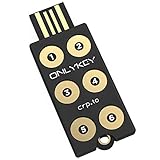
- ✅ PROTECT ONLINE ACCOUNTS – A password manager, two-factor security key, and secure communication token in one, OnlyKey can keep your accounts safe even if your computer or a website is compromised. OnlyKey is open source, verified, and trustworthy.
- ✅ UNIVERSALLY SUPPORTED – Works with all websites including Twitter, Facebook, GitHub, and Google. Onlykey supports multiple methods of two-factor authentication including FIDO2 / U2F, Yubico OTP, TOTP, Challenge-response.
- ✅ PORTABLE PROTECTION – Extremely durable, waterproof, and tamper resistant design allows you to take your OnlyKey with you everywhere.
- ✅ PIN PROTECTED – The PIN used to unlock OnlyKey is entered directly on it. This means that if this device is stolen, data remains secure, after 10 failed attempts to unlock all data is securely erased.
- ✅ EASY LOG IN –No need to remember multiple passwords because by plugging OnlyKey to your computer, it automatically inputs your username and password. It works with Windows, Mac OS, Linux, or Chromebook, just press a button to login securely!
Product prices and availability are accurate as of the date/time indicated and are subject to change. Any price and availability information displayed on Amazon at the time of purchase will apply.

