
What’s actually slowing this PC down?
Pick the symptom - the matching free tool is one click away.
The Nintendo 64 changed what console games could ask players to do: its analog Control Stick made fine-grained movement through real-time 3D worlds practical, while games such as Super Mario 64 turned that capability into a new way to play. Its cartridge format was a deliberate trade-off, not an unqualified win: it kept access fast but limited storage and raised software-manufacturing costs.
What made the Nintendo 64 a design breakthrough?
Nintendo launched the system in Japan on 23 June 1996, followed by the United States in September 1996 and Europe in March 1997. Nintendo described it as a 64-bit home system capable of colorful 3D worlds, real-time lighting and CD-quality sound. The crucial change, though, was the way the hardware and controller worked together: the Control Stick could register direction across a full 360 degrees rather than restricting movement to a small set of digital directions.
| # | Preview | Product | Price | |
|---|---|---|---|---|
| 1 |

|
Nintendo 64 Console, Premium Bundle (Renewed) | $168.00 | Buy on Amazon |
| 2 |

|
Nintendo 64 System - Video Game Console (Renewed) | $124.99 | Buy on Amazon |
| 3 |
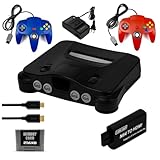
|
Nintendo 64 (Renewed) | $169.98 | Buy on Amazon |
| 4 |

|
Nintendo 64 System - Video Game Console | $109.99 | Buy on Amazon |
| 5 |

|
N64 System with Controller, Hookups, and Mario 64 Game (Renewed) | $213.19 | Buy on Amazon |
That analog input let games vary both a character’s direction and movement speed. A player could make a careful adjustment, walk, or push farther into a run—all through the same control. Nintendo’s official hardware history calls the stick a breakthrough in input-device design. A 1996 Dataquest report likewise praised early games for “stunningly realistic 3-D graphics and smooth, highly responsive control.” Those qualities came from the combined experience of rendering, movement and response, not from a single specification.
A controller built around 3D play
The controller’s three-pronged shape put the Control Stick on the center grip and a D-pad on the left. It also had a center Z button and a four-button C cluster, which games could use for camera control or other context-sensitive actions. The layout was unusual: the Digital Game Museum notes that its M-shaped design could be confusing. Players generally held the center and right grips to use the analog stick and face buttons, rather than gripping all three at once.
#1 Best Overall
- Nintendo 64 Console (Black): Retro gaming console in a sleek black finish.
- Two Controllers (Red & Blue): Includes two vibrant controllers for multiplayer gaming.
- 256KB Memory Card: Save your game progress easily with ample storage.
- HDMI Adapter: Modern connectivity for easy setup with today’s TVs
- Power Adapter: Essential power supply included for immediate play.
Because the stick came with every console, developers could design around continuous directional input instead of treating it as an optional peripheral. The Electronic Design chapter by Jon Peddie describes the “3D stick” as allowing players to choose an angle in 360 degrees and control character speed. That made analog movement a standard platform assumption at a moment when D-pad control remained common.
How did Super Mario 64 and Ocarina of Time use that design?
Super Mario 64: movement and space
Nintendo identifies Super Mario 64, a launch title directed by Shigeru Miyamoto, as a world-changing game. Its importance lies in showing how an analog stick and a 3D world could support one another: players could steer Mario freely through open spaces, adjust how he moved, and explore from a viewpoint that had to be managed as well as the character. The game made spatial movement—not simply choosing a direction on a flat screen—a central part of play.
Ocarina of Time: exploration and interaction
The Legend of Zelda: Ocarina of Time extended the same design logic to exploration and action. Nintendo says the game “set new standards” and broke videogame pre-order records at the time; that is Nintendo’s own historical characterization. Together, the two games demonstrated how 3D movement, camera handling and interaction could become conventions rather than technical novelties.
Other defining releases included Mario Kart 64, Mario Party and Donkey Kong 64. They used the platform’s capabilities in different ways, from racing and party competition to expansive 3D play. Nintendo’s history presents these games as part of the system’s signature library.
Do these 3 things before closing this tab:
1Scan for outdated or missing drivers - takes under a minute2Clear out junk files and repair common Windows errors3Fix the driver behind crashes, sound loss and screen glitchesRank #3
- Sleek Black N64 Console: A classic Nintendo 64 reimagined in a bold black finish, blending retro charm with a modern aesthetic.
- Two Vibrant Controllers: Jump straight into multiplayer fun with a red and blue controller included, perfect for head-to-head gaming sessions.
- Save & Store with Ease: The included 256KB memory card gives you plenty of space to save game progress across your favorite titles.
- Modern Display Ready: An HDMI and cable are included, delivering a clean, high-quality connection to today's TVs right out of the box.
- Everything You Need to Play: Complete with a power and all essentiala, this is ready for instant setup — ideal for nostalgic fans and curious newcomers alike.
Why did Nintendo keep using cartridges when rivals used CDs?
The N64’s ROM cartridges reduced loading friction because the console could access game data without waiting for an optical drive to seek across a disc. Contemporary technical reporting connected the system’s responsive 3D performance to its Silicon Graphics/MIPS-derived architecture. Cartridges were one part of that hardware strategy, but they imposed a clear trade-off: they offered less storage capacity and cost more to manufacture per unit than pressed optical media.
That difference mattered to publishers. A cartridge’s higher manufacturing cost and tighter storage limit could make large releases more expensive or constrain what they could contain. Optical discs offered competitors a lower-cost way to distribute more data. The result was not that cartridges made N64 games inherently better or worse; the choice shaped what publishers could afford to produce and how much software they were willing to bring to the platform. An archived industry comparison gives historical cost figures, but it is a secondary compilation and does not establish a universal cost for every game or publisher.
Rank #4
- 64-Bit Graphics
- Cartridge based game system (no scratched games!)
- Excellent game library available (over 300)
- Inexpensive compared to newer gaming systems
The European Commission’s 2003 decision reports that U.K. retail sales of N64-compatible cartridges reached £63 million (or €91 million) in 1997. That figure describes retail sales in one country and year, not Nintendo’s global revenue or the cost of making cartridges.
Independent reader supportYour contribution helps us test, update, and keep practical guides available for everyone.How did the N64 make multiplayer and accessories part of the console?
Four controller ports were built into the console, making four-player play available without a multitap add-on. Nintendo described this as a “party machine” feature. Games such as Mario Kart 64 and Mario Party made that design choice visible: local multiplayer was not merely supported, it was built into the hardware’s basic setup.
Best Value
- Nintendo 64 game console
Nintendo also extended the system through accessories that plugged into the controller or console:
- Memory Pak: a controller-port accessory used for game data storage.
- Rumble Pak: introduced in 1997, it added vibration feedback to compatible games.
- Transfer Pak: enabled communication with compatible Game Boy and Game Boy Color games.
- Expansion Pak: added memory for additional detail and color. Some games, including Donkey Kong 64 and Majora’s Mask, required it.
These add-ons gave the platform a modular feel: the controller could provide storage, feedback or connectivity, while the Expansion Pak could increase what certain games could do.
How successful was the Nintendo 64?
Nintendo’s historical account records more than 500,000 systems sold in Japan on launch day and 2.3 million systems sold in Europe during the first year. These figures show strong early demand in those markets, but they are not a worldwide lifetime sales total. The official historical pages cited here do not provide a directly citable global lifetime figure, so a broader total should not be presented as Nintendo-confirmed on this evidence.
Why was the N64 genuinely disruptive—but not without limits?
The N64’s disruption came from making analog 3D control a default expectation, then giving designers games and accessories that made that expectation useful. Its bundled Control Stick, real-time 3D capabilities and four controller ports influenced the feel of a whole platform, from solo exploration to local multiplayer.
Quick wins for a faster PC:
Scan for outdated or missing drivers - takes under a minuteDriver Scan →Clear out junk files and repair common Windows errorsFree Scan →The cartridge decision shows the limits of that success. Fast access suited responsive play, but lower capacity and higher manufacturing costs made the platform less attractive for some software economics than disc-based alternatives. Nintendo’s approach produced landmark games and a distinctive hardware identity, alongside a smaller, more curated library than rivals’ broader third-party strategies. Its achievement was not winning every trade-off; it was changing the design problem that console games were trying to solve.
Quick Recap
Product prices and availability are accurate as of the date/time indicated and are subject to change. Any price and availability information displayed on Amazon at the time of purchase will apply.

