
Crashes, No Sound, or Screen Glitches?
Random freezes, missing sound and display glitches usually trace back to one bad driver. Find and replace yours safely.Free scan · under a minuteWindows Errors? Fix Them Before They Spread
Repair common Windows errors and clear accumulated junk for a smoother, more stable PC - no reinstall needed.Free scan · no reinstallFor each MCP tool invocation, record when it happened, which agent and run were involved, which server and tool were called, what parameters were used (subject to a documented privacy policy), what response came back, and whether authorization or human approval was granted. Correlate the event across the host, client, MCP server, and downstream services where possible. Those records can make an incident easier to reconstruct, but a log written by the component that performed an action is still that component’s account—not independent proof that every recorded event happened or that nothing was omitted.
What to record for each MCP tool call
Use structured events rather than free-form messages. OWASP’s 2025 MCP Top 10 entry names timestamp, agent ID, session ID, invoked tool, parameters, response summary, and user identity where applicable. Its MCP Security Cheat Sheet recommends logging invocations with parameters, user context, and timestamps, while also redacting secrets and personally identifiable information (PII). These are security recommendations; MCP itself does not prescribe a universal audit-event schema.
| Event data | What to capture | Why it matters and limits |
|---|---|---|
| Time and recording context | UTC event time, event type, recorder or component identity, and whether recording succeeded | Helps order events and identify gaps. A timestamp supplied by the recorder is an assertion unless supported by a trusted time source or other evidence. |
| People, agent, and run | User or tenant identity where applicable (or a privacy-preserving pseudonym), agent identity, session or run ID, and trace/correlation ID | Connects a call to a user request and related activity. An identifier is useful for correlation but does not by itself authenticate the agent or user. |
| Server, tool, and definition | MCP server identity as configured or independently established, tool name, and tool-definition or schema version/digest | Shows which capability was invoked and helps interpret parameters. A name reported by a component is not automatically a verified identity. |
| Input and output | Parameters under a documented redaction/minimization policy; response status and an operationally useful summary; a protected reference or digest if a separately secured full payload is retained | Supports debugging and review without making every log store a copy of sensitive data. A digest can bind a record to bytes later presented, but cannot prove that those bytes were the actual input or output. |
| Authorization and approval | Authorization decision, applicable policy/version, approval request and outcome for sensitive actions, and downstream request/result IDs when available | Records whether the relevant control was applied, not whether the underlying decision was correct or the action was harmless. |
| Integrity and access | Integrity-protection metadata, retention information, access history, and recording failures or known gaps | Helps detect later alteration or identify who accessed records. Integrity controls cannot recover events that were never recorded. |
For sensitive operations, log the authorization and consent decision alongside the call. OWASP advises asking for human confirmation for destructive, financial, or data-sharing calls, displaying the full parameters for review, and treating tool responses as untrusted data. Enforce authorization and validation in trusted application code; a log entry documents the outcome but does not enforce the control.
Choose a payload policy deliberately
OWASP’s guidance to log full parameters should not be read as a requirement to keep every raw prompt or payload indefinitely in every environment. Define what is collected, what is redacted or pseudonymized, who may access it, and how long it is retained. Where the full payload is needed for a defined purpose, consider storing it separately with stronger access controls and recording a protected reference in the operational event. If sensitive fields are removed, record that minimization occurred so investigators do not mistake a redacted record for the original complete payload.
#1 Best Overall

- Fortinet Web Application Firewall - virtual appliance for all supported platforms. Supports up to 2 x vCPU core
- Fortinet HW FWB-VM02
- Manufacturer Part: FWB-VM02
OWASP’s MCP Top 10 entry gives HMAC/SHA-256 integrity checks and append-only or write-once storage as examples of tamper-evident controls. Treat them as controls to evaluate, not a guarantee that a particular deployment is tamper-proof. Set retention according to applicable organizational and legal requirements; the example retention period discussed in that OWASP entry is not a universal MCP rule.
Correlate the call across the tool chain
A single tool call may generate related events in the agent host, MCP client, MCP server, and downstream service. Use stable run and trace identifiers to connect those records, and preserve the parent-child relationships where your instrumentation supports them. The reviewed MCP specification materials dated 2026-07-28 describe W3C Trace Context propagation for following activity across the SDK, server, and downstream calls. Those materials are identified as a release candidate in the reviewed project material; the status of that specification can change, so do not treat the cited material as confirmation of the current release status.
Trace context is for correlation, not proof. Missing spans may reflect a recording gap, unsupported instrumentation, a boundary the trace did not cross, or activity outside the trace’s scope. A trace ID does not establish that all components used it honestly or that every event was captured.
Rank #2

- APPLIANCE ONLY: Hardware unit sold without a service subscription — security services, firmware updates and support are NOT included and must be purchased separately to activate protection.
- PERFORMANCE: Up to 2.5 Gbps firewall inspection, 1 Gbps threat prevention and 1.2 Gbps IPSec VPN throughput driven by SonicWall's patented Reassembly-Free Deep Packet Inspection (RFDPI) engine.
- CONNECTIVITY: 8x1GbE + 2x1G SFP in a desktop form factor; zero-touch deploy and manage on-box or via cloud Network Security Manager (NSM).
- THREAT PROTECTION: SonicOS 8 delivers intrusion prevention, gateway anti-malware, application control, TLS/SSL decryption, Capture ATP multi-engine sandboxing (RTDMI) and reputation-based content & DNS filtering with an active service subscription.
- BUILT FOR SMALL BUSINESS & BRANCH: Secure SD-WAN, IPSec and SSL VPN plus Zero-Trust Network Access through Cloud Secure Edge keep distributed sites and remote workers protected.
Do not treat implementation labels as authentication
The MCP basic specification describes clientInfo and serverInfo values as sender-reported and unverified, intended for display, logging, and debugging. They may be useful in an event record, but those values alone do not establish an authenticated server identity and should not drive security decisions. MCP’s reviewed materials describe an authorization framework for HTTP; STDIO implementations should use environment credentials rather than assuming that HTTP authorization flow applies. Record the identity and authorization evidence available in the deployment you actually run.
What a log can—and cannot—prove
Evidence strength depends on who controlled the recorder, what it could observe, whether the record is bound to the expected artifact and run, and whether another source can corroborate it. OWASP’s Verifying Third-Party Agent Execution Evidence Cheat Sheet distinguishes a supplier’s account from independently supported execution evidence. Use language that matches the evidence: “the supplier’s record says the agent called the tool,” unless independent observation supports a stronger claim.
| Evidence available | What it supports | What remains unestablished |
|---|---|---|
| Supplier-exported trace without corroboration | The supplier provided a record making those claims. | Whether the described events occurred, whether the record is complete, or whether events were omitted or altered before export. |
| Verified signature plus expected artifact digest and unique run ID | The identified signer asserted those bytes about the expected artifact and execution. | Whether the assertion is true or complete. A signature identifies a signer’s assertion; it is not a truth oracle. |
| Verified transparency-log inclusion/consistency and a trusted timestamp | The signed record existed by the time supported by the timestamp and appears in the checked log state. | When each event was captured, whether the events happened, or whether events were omitted before submission. |
| Reconciliation against an independent boundary observer | Whether the record includes activity that the observer saw across its monitored boundary during a defined window. | Internal actions the observer could not see, activity across other boundaries, or events outside its observation window. |
Independent observation improves a specific claim only to the extent of its coverage. A gateway may corroborate requests crossing that gateway, but it cannot establish local file writes or in-process actions it did not observe. Encrypted traffic may also limit what an observer can inspect unless it has access to plaintext at an appropriate point. Document the observer’s position, visibility, and observation window, then reconcile its records with the agent’s trace.
Rank #3
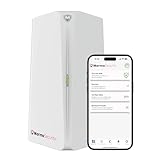
- BUSINESS CYBERSECURITY SOLUTION: SafeBiz is an advanced cybersecurity solution that protects your work network and safeguards your Business data and all internet connected devices in your business from cyber threats and hackers. SafeHome blocks phishing, malware, ransomware, online scams and dark web threats.
- ADVANCED THREAT PREVENTION: SafeBiz includes a Next-Gen Firewall, DNS Security, Web Filtering, Dark Web Protection, Geo-fencing and other AI Powered cybersecurity features protecting your Business and Sensitive Data from internet threats and hackers.
- BUSINESS DATA & IDENTITY SECURITY: Safeguards your Official and financial data, protecting them from online theft and unauthorized access.
- EASY SETUP: Connects effortlessly to any existing wireless router or internet connection, setting up in minutes without the need for any changes to your Business internet connection.
- HIGH SPEED CONNECTIVITY: Supports an aggregate throughput of up-to 4.3 Gbps, maintaining high-speed browsing and streaming performance for up to 128 devices.
Understand timestamp, nonce, signature, and immutability separately
- A supplier timestamp is the supplier’s assertion about time.
- A fresh, unpredictable challenge (nonce) signed with execution claims can support that the signing occurred after challenge generation, once the signature and nonce are verified. It does not establish when the individual claims were captured.
- A trusted timestamp bound to a signed record supports that the record existed by the supported time; it does not validate the events described in it.
- A signature can identify who signed particular bytes, while tamper-evident or immutable storage can help show whether stored bytes changed. Neither mechanism proves the record was truthful, complete, or created from a complete event stream.
Compare the two main collection approaches
| Consideration | Component or supplier log | Independent boundary observation plus reconciliation |
|---|---|---|
| Recorder independence | Controlled by the component or supplier whose account is being assessed. | Can provide a distinct observer, depending on who operates it and how it is protected. |
| Coverage | May include useful internal details, but completeness depends on the recorder and its instrumentation. | Strongest for activity visible at the observed boundary during the defined window; not a record of unseen internal actions. |
| Integrity and run binding | Can be strengthened with protected storage, signatures, and artifact/run identifiers, without proving truth by themselves. | Can be reconciled with the component record and bound to an observation window; both records still need sound integrity controls. |
| Timing assurance | Depends on the recorder’s time source and any external timestamp evidence. | Supports timing only within the observer’s own clock and coverage assurances. |
| Privacy and operational burden | Often easiest to obtain, but may contain sensitive payloads and requires access and retention controls. | Requires deployment and reconciliation work; encrypted content may be opaque without plaintext access at the observer. |
Neither approach proves every internal event in a distributed agent workflow. The useful question is narrower: which claim must be supported, which component could observe it, and what independent record can be reconciled against that component’s account?
Turn the event design into an audit trail
- Define the claim and scope. Decide whether the goal is operational debugging, incident response, authorization audit, or evidence about execution. Name the boundaries, expected artifact, unique run, and observation window relevant to that goal.
- Instrument decisions as well as calls. Emit structured events for invocation, authorization, approval, result, and recording failure where applicable. Include stable agent, run, tool, and trace identifiers.
- Apply data handling rules before storage. Redact secrets and PII, restrict access, and document retention. If full payloads are necessary, protect them separately and link them to the event using a controlled reference or digest.
- Protect and monitor the records. Use suitable integrity protections and append-only or write-once controls where appropriate. Record access and detect gaps; do not describe the resulting store as proof of event completeness.
- Corroborate when the claim warrants it. Collect an independent observer’s records at a boundary that can see the relevant activity, then reconcile by run, time window, and request/result identifiers. State explicitly what that observer could not see.
- Report conclusions at the right strength. Separate what the component reported, what cryptographic checks established, and what an independent observer corroborated. Do not upgrade a supplier assertion into a fact merely because it is signed or stored immutably.
What this means for MCP deployments
MCP logging is an application and operations responsibility, not a protocol guarantee of complete audit evidence. OWASP’s MCP Security Cheat Sheet and 2025 MCP Top 10 provide practical logging and safety recommendations; the protocol’s trace and implementation metadata can help connect records but do not substitute for authenticated identity, authorization enforcement, privacy controls, or independent evidence. A trustworthy audit trail is therefore not just a detailed log: it is a scoped record with controlled handling, declared gaps, and corroboration appropriate to the claim being made.
Quick Recap
Product prices and availability are accurate as of the date/time indicated and are subject to change. Any price and availability information displayed on Amazon at the time of purchase will apply.

