
Quick wins for a faster PC:
Repair Windows errors before they cause bigger problemsFix Now →Scan for outdated or missing drivers - takes under a minuteDriver Scan →Clear out junk files and repair common Windows errorsFree Scan →Kioxia’s LC9 is an enterprise NVMe SSD family, not an 8-petabyte drive. The “8 PB or more in 2U” idea refers to the combined capacity of many drives in a server: Kioxia’s July 2026 example is a future 40-slot E3.L 2U system with 40 × 245.76 TB drives, or more than 9.8 PB. Separately, each drive’s flash package uses a 32-die stack—not 32 NAND layers—and can hold up to 8 TB in one package.
What Kioxia showed at FMS 2025
FMS, the Future of Memory and Storage, took place in Santa Clara from August 5–7, 2025. In an August 4 preview, Kioxia said it would showcase the LC9 alongside other SSD and memory products (Kioxia’s FMS 2025 preview). The LC9 is an enterprise NVMe SSD family intended for data-center storage, not a consumer drive.


On July 22, 2025, Kioxia announced an LC9 capacity option of 245.76 TB and described it as the first NVMe SSD at that capacity in 2.5-inch and EDSFF E3.L form factors, based on the company’s survey as of that date. That “first” claim is Kioxia’s, not an independently established market-wide finding (Kioxia’s LC9 announcement). On August 6, Kioxia separately announced that the 245.76 TB LC9 won FMS Best of Show in SSD Technology (Kioxia’s award announcement).
How 32-die NAND relates to an 8 TB package
The title’s “32-layer die stacked NAND” wording is misleading. Kioxia describes the LC9’s BiCS FLASH generation 8 QLC architecture as a 32-die stack: 32 dies, each with 2 Tb capacity, combined using CBA (CMOS directly Bonded to Array) technology. Kioxia says this adds up to as much as 8 TB in one 154 BGA package. The 8 TB figure is package capacity, not the capacity of an LC9 SSD.
What’s actually slowing this PC down?
Pick the symptom - the matching free tool is one click away.
#1 Best Overall

- Data transfer rate: 40.0 gigabits_per_second
- Item dimensions: 8.75 inches
The distinction is one of scale. Multiple flash packages are assembled inside a drive; multiple drives are installed in a server. Kioxia’s current family overview lists LC9 drive capacities of 30.72, 61.44, 122.88 and 245.76 TB, with the maximum depending on form factor and model (KIOXIA America LC9 Product Overview, July 2026, v2.0).
How a 2U server can exceed 8 PB
“2U” describes server height, not a standard drive count. Kioxia’s July 2026 overview gives these example configurations, using decimal drive capacities:
Rank #2

- KIOXIA PM7-V Series KPM7VVUG6T40 - SSD - Enterprise, Mixed Use - encrypted - 6400 GB - internal - 2.5" - SAS 24Gb/s - Self-Encrypting Drive (SED)
| Example server | Drive configuration | Aggregate capacity |
|---|---|---|
| Future E3.L 2U rack server | 40 × 245.76 TB | Over 9.8 PB |
| Typical 2.5-inch 2U server | 24 × 122.88 TB | Over 2.9 PB |
| Typical E3.S 1U server | 32 × 122.88 TB | Over 3.9 PB |
These are manufacturer-provided example chassis configurations, not a promise that every 2U server accepts 40 E3.L drives. The 9.8 PB example is explicitly a future 40-slot E3.L configuration. Actual usable capacity can be lower after formatting, redundancy, or other system design choices. Kioxia notes that operating systems may report less capacity when they display powers-of-two units instead of decimal drive capacities.
Which LC9 capacities fit each form factor?
Kioxia’s detailed July 2026 breakdown lists the family’s maximum drive capacity by form factor as follows. A server must support the physical drive format and interface; the family maximum does not apply to every model.
| Form factor | Maximum listed capacity |
|---|---|
| U.2 (2.5-inch) | Up to 122.88 TB |
| E3.S | Up to 122.88 TB |
| E3.L | Up to 245.76 TB |
The 2025 announcement described the new 245.76 TB option in 2.5-inch and E3.L, while the July 2026 overview’s detailed form-factor bullets assign up to 122.88 TB to 2.5-inch and E3.S and up to 245.76 TB to E3.L. Buyers should confirm current SKU documentation and server qualification before ordering; the overview is not a substitute for an exact model compatibility check. Kioxia’s LC9 FAQ, July 2026, v1.1 also identifies U.2, E3.S, and E3.L as supported form factors.
What the LC9 specifications say—and do not say
Kioxia’s July 2026 overview lists PCIe 5.0, NVMe 2.0, and support for OCP Datacenter NVMe SSD specification v2.5. It also lists dual- and single-port support and optional security configurations including SIE, SED, and FIPS 140-3 Level 2 SED validation. These are product specifications; whether a feature is present depends on the selected configuration.
Rank #4
| Manufacturer-listed measure | LC9 Series figure |
|---|---|
| Sequential read | Up to 12,000 MB/s |
| Sequential write | Up to 3,500 MB/s |
| Random read | Up to 1,000 KIOPS |
| Random write | Up to 45 KIOPS |
| Endurance rating | 0.3 drive writes per day (DWPD) |
The performance figures are Kioxia’s specifications, not independent benchmark results. The company says performance depends on host and workload conditions and that specifications may change. The 0.3 DWPD rating identifies the series as read-intensive; it is a key consideration for write-heavy applications, not a guarantee that every workload will suit the drive.
Workloads the LC9 targets
Kioxia positions the LC9 for AI and machine learning, high-performance computing, data lakes, object storage, and content delivery or media storage where reads dominate. High per-drive capacity can reduce the number of drives needed for a given raw-capacity target, but capacity alone does not establish lower total cost or better fit. System qualification, power and cooling, redundancy, security, workload performance, and write endurance all matter.
Best Value
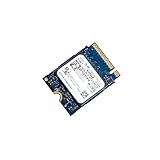
- 【SSD】 Upgrade your laptop/desktop computer with the Kioxia SSD and feel the difference. Faster OS boot times, shut-downs and app load times
- 【Storage Capacity】512GB
- 【Hardware Interface】PCIe Gen3 x 4 512GB NVMe M.2 2230 Internal Solid State Drive, Please check your motherboard manual and make sure your motherboard's M. 2 slot supports PCIe NVMe
- 【Performance】With an SSD, you’ll enjoy faster launch times, data retrieval, and overall performance for seamless multitasking
- 【Compatible Devices】Laptop, Desktop
For AI and HPC deployments, the overview names Weka, MinIO, Ceph, Hammerspace, and PEAK:AIO as examples of software-defined storage products. This is an ecosystem illustration from Kioxia, not a compatibility certification or endorsement of those products.
Independent reader supportYour contribution helps us test, update, and keep practical guides available for everyone.What to check before planning a deployment
- Capacity at both levels: determine the required usable capacity per drive and per chassis, accounting for redundancy and formatting rather than relying only on raw decimal totals.
- Bay and form-factor compatibility: verify whether the server supports U.2, E3.S, or E3.L, and confirm the exact LC9 model and slot count.
- Workload mix: compare the application’s read/write pattern with the LC9’s read-intensive positioning and 0.3 DWPD rating.
- Performance in the target system: validate host support and workload-specific performance; published maximum specifications are not independent tests of a particular server.
- Operational requirements: check power, cooling, security configuration, redundancy, firmware, and system qualification for the intended deployment.
Kioxia’s figures establish how large a configured system could be; they do not by themselves establish usable capacity, real-world performance, or suitability for a specific server.
Quick Recap
Product prices and availability are accurate as of the date/time indicated and are subject to change. Any price and availability information displayed on Amazon at the time of purchase will apply.

