
What’s actually slowing this PC down?
Pick the symptom - the matching free tool is one click away.
ESP32 is a family of Espressif microcontrollers with Wi-Fi and Bluetooth built into the chip. To get started, choose an ESP32-DevKitC-compatible development board, a matching USB data cable, and a computer; then use Arduino-ESP32 for a gentler first coding experience or ESP-IDF for Espressif’s full development framework.
What is an ESP32?
ESP32 is a system-on-chip (SoC) family for embedded projects. Espressif’s ESP-IDF guide describes the original ESP32 as integrating 2.4 GHz Wi-Fi, Bluetooth, dual high-performance 32-bit Xtensa LX6 CPU cores, a low-power co-processor, and multiple peripherals. The exact capabilities differ among ESP32 family members, so do not assume every board has the same cores, memory, or radio features. See Espressif’s ESP-IDF getting-started guide.
For a beginner, built-in wireless is the key practical benefit: a project can start with a local LED or sensor and later communicate with a phone, web service, or home network without a separate radio module. ESP32 is a microcontroller platform for embedded devices, not a general-purpose desktop computer.
Which ESP32 board should a beginner buy?
An ESP32-DevKitC-compatible development board is a sensible first choice. Espressif describes its ESP32-DevKitC V4 as a small ESP32-based development board. Most I/O pins are available along the board’s sides, so you can connect components with jumper wires or use a breadboard. Check Espressif’s ESP32-DevKitC V4 guide for board-specific details.
Quick wins for a faster PC:
Scan for outdated or missing drivers - takes under a minuteDriver Scan →Repair Windows errors before they cause bigger problemsFix Now →#1 Best Overall

- 2.4GHz Dual Mode WiFi + Bluetooth Development Board
- Support LWIP protocol, Freertos
- SupportThree Modes: AP, STA, and AP+STA
- Ultra-Low power consumption, Compatible with Arduino IDE
- ESP32 is a safe, reliable, and scalable to a variety of applications
Before ordering, confirm the precise board revision, module, and USB connector. The V4 guide lists module variants such as ESP32-WROOM-32E and ESP32-WROOM-32UE, and notes that boards may use USB Type-C or micro-USB. Connector fit matters: a cable with the wrong plug will not connect, and a charging-only cable may not carry data.
What to check when comparing boards
- ESP32 variant and module: Features can vary between family members and board revisions.
- Wireless support: Check the listed Wi-Fi band and Bluetooth mode for the exact model.
- Memory: Compare flash and PSRAM capacity if your project needs them.
- Prototyping pins: Check which GPIO and analog-capable pins are exposed.
- USB and power: Confirm the connector and how the board is powered.
- Antenna and documentation: Review the antenna arrangement and availability of clear documentation.
For one model-specific example, Espressif’s ESP32-DevKitC-1 documentation lists 802.11b/g/n Wi-Fi, Bluetooth 4.2 BR/EDR and BLE, 4 MB SPI flash, 8 MB PSRAM, and peripherals including GPIO, ADC, DAC, I2C, and SPI. These are specifications for that documented board, not a promise that every ESP32 has the same features.
Rank #2
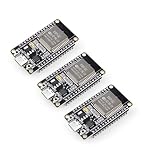
- Dual-Core Performance Up to 240 MHz: Run sensor processing, wireless communication, automation logic and connected-device tasks on a 32-bit dual-core ESP32 platform designed for responsive embedded and IoT projects
- Built-in Wi-Fi and Bluetooth 4.2: Connect to 2.4 GHz Wi-Fi networks or use Bluetooth Classic and BLE for wireless sensors, smart devices, remote controls, home automation and other connected projects
- Flexible Power-Saving Modes: ESP32 power-management features support dynamic clock scaling and low-power operating modes, helping developers reduce energy use in compatible sensing, monitoring and connected-device applications, suitable for battery-powered Internet of Things (IoT) devices.
- USB-C Programming with CP2102: Connect through USB-C for power, sketch uploads and serial monitoring, while GPIO, UART, SPI and I2C interfaces support sensors, displays, motor drivers and other modules (USB-C cable not included)
- Over-the-Air Update Support: Configure OTA functionality through a compatible ESP-32 software framework to update deployed firmware over Wi-Fi without reconnecting the board by USB for every revision
What cable and parts do you need?
For a basic setup, start with the board, a USB data cable that matches its connector, and a Windows, Linux, or macOS computer. Those are the essentials identified in Espressif’s DevKitC V4 guide.
A solderless breadboard and male-to-male jumper wires make it easier to try components without soldering. Add a simple LED and resistor or a button for early GPIO experiments. Check the board documentation and each component’s voltage and pin requirements before wiring; pin labels and reserved or boot-related pins differ between models.
The Tool Desk
Outbyte Driver Updater FREEScan for outdated or missing drivers - takes under a minuteDriver Scan →Outbyte PC Repair FREEClear out junk files and repair common Windows errorsFree Scan →Rank #3

- Powerful ESP-32 Board: Unlock the world of Internet of Things (IoT) and advanced electronics with the heart of this kit: the ESP-32 board. It features a powerful dual-core processor, integrated Wi-Fi and Bluetooth 4.2, making it perfect for building connected, smart devices that communicate with your phone or the cloud. It's fully compatible with the Arduino IDE for easy programming.
- Super Starter Kit: This kit contains over 35 different modules and electronic components, including sensors, displays, motors, and input devices. From LEDs and buttons to an OLED screen, servo motor, and keypad, you have everything needed to explore a vast range of projects in one box.
- Step by Step Online Tutorial: Jump right in with our detailed, beginner-friendly tutorial. Access 30+ projects with complete code, clear circuit diagrams, and step-by-step instructions. Learn the fundamentals of electronics, coding, and how to utilize the ESP-32's unique capabilities without any prior experience.
- Hands-on Learning for All Skill Levels: Perfect for students, makers, engineers, and hobbyists. Start with basic circuits and coding, then progress to intermediate and advanced IoT applications. Build practical projects like weather stations, smart home controllers, remote-controlled devices, and interactive gadgets. The skills you learn are the foundation for real-world innovation.
- Quality & Great Support: Elegoo is committed to quality. We provide a clear, detailed tutorial guide, refined code, and a well-organized component kit. All modules are carefully selected for reliability and ease of use. Our dedicated technical support team and active online community are ready to help you succeed in your learning journey.
Should you use Arduino or ESP-IDF?
Both are valid ways to program an ESP32. Arduino-ESP32 is often the easier starting route for short sketches using the familiar setup() and loop() structure. ESP-IDF is Espressif’s full framework, with a more comprehensive toolchain and project workflow.
| Path | Good fit when | What the workflow involves |
|---|---|---|
| Arduino-ESP32 | You want a straightforward first sketch and access to the Arduino ecosystem. | Install Espressif’s Arduino-ESP32 support using the official installation instructions, select the board and serial port, then build and upload a sketch. |
| ESP-IDF | You need menu configuration, lower-level APIs, a production-style project structure, or Espressif’s full feature set. | Follow Espressif’s getting-started flow to install the toolchain and build tools, create a project, build it, flash firmware, and monitor serial output. |
Starting with Arduino does not lock you into that workflow. The board and chip stay the same if you later move to ESP-IDF; the development tools and project structure change.
Rank #4

- 2.4GHz Dual Mode WiFi + Bluetooth Development Board
- Support LWIP protocol, Freertos;ESP32 is a safe, reliable, and scalable to a variety of applications
- SupportThree Modes: AP, STA, and AP+STA
- Ultra-Low power consumption, Compatible with Arduino IDE
- 1PCS 30Pin ESP32 Development Board 2.4GHz WiFi Dual Cores Microcontroller Integrated with Antenna RF Low Noise Amplifiers Filters
How do you program an ESP32 for the first time?
- Identify the board. Read its silkscreen and product listing to confirm the ESP32 family or module, board revision, and USB connector.
- Choose and install a development environment. Use the official Arduino-ESP32 installation instructions for Arduino, or install ESP-IDF and its toolchain using Espressif’s guide.
- Connect the board. Use a data-capable USB cable. In the development environment, select the board and the serial port that appears for it.
- Upload a minimal example. Try a blink sketch or an example that prints text. If using serial output, open the serial monitor to see whether the board is reporting as expected.
- Add one local input and output. Try a button or sensor as an input and an LED, buzzer, or display as an output. Verify wiring, voltage, and pin assignments for the specific board and peripheral.
- Add wireless after local I/O works. Then test Wi-Fi or Bluetooth behavior, including what happens if a connection drops and needs to reconnect.
This order lets you check the USB connection, GPIO wiring, and serial output before introducing network setup as another possible source of problems.
Independent reader supportYour contribution helps us test, update, and keep practical guides available for everyone.What should you learn first?
Build up in small steps: power and USB connection, GPIO input and output, serial monitoring, and then wireless communication. Treat board pin labels as model-specific rather than interchangeable; consult the exact board documentation before connecting a component, especially to a pin that may be reserved or involved in boot behavior.
Quick Recap
Best Value

- 2.4GHz Dual Mode WiFi + Bluetooth Development Board
- Ultra-Low power consumption, works perfectly with the Arduino IDE
- Support LWIP protocol, Freertos
- SupportThree Modes: AP, STA, and AP+STA
- ESP32 is a safe, reliable, and scalable to a variety of applications
Product prices and availability are accurate as of the date/time indicated and are subject to change. Any price and availability information displayed on Amazon at the time of purchase will apply.

