
For a clearly defined task that repeats, a purpose-built construction robot is the more evidence-backed choice today. Humanoids could become useful where human-scale access, ordinary tools, or switching among tasks matters, but construction is not yet a routine deployment setting for them. Choose by the work, the site, and the evidence for that specific job—not by whether a robot looks human.
What kind of construction work are you trying to automate?
Start with the task rather than the robot category. A robot suited to drilling a repeated pattern or placing rebar may be a poor fit for a job that changes location and requirements throughout the day. A humanoid’s ability to move and handle objects in human-scale spaces is potentially useful, but it does not establish that the machine can perform a construction task reliably, safely, or economically.
Purpose-built robots: a defined operation
Purpose-built systems are designed around a narrower task or operating environment. Examples discussed by McKinsey include rebar work and ceiling drilling pilots; the article also reports more successful pilots in groundworks and roadworks using specialized equipment such as driverless pavers and autonomous rollers. These are reported applications and pilots, not a guarantee that a system is available or suitable for a particular contractor. IEEE’s Construction Robotics committee also lists platforms including Hilti Jaibot and a Gravis Robotics robotic excavator for dry stone construction; those listings establish examples, not current availability, price, or measured performance.
Humanoids: a possible flexible platform
A humanoid is intended to take on multiple kinds of work using human-scale movement and manipulation. McKinsey describes possible construction tasks such as carrying small panels or buckets, pulling wire, installing pipes in tight spaces, installing sensors, and cleanup. Treat these as potential applications rather than established routine deployments: McKinsey says humanoids are not yet a fixture on construction sites. The UK Government likewise places construction in a high-challenge, longer-time-horizon category and notes uncertainty about cost-effectiveness; it says the most advanced systems are being trialed in more structured settings such as factories or warehouses.
#1 Best Overall

- Valued Carpenter Pencil Set: You will get 2 pcs solid carpenter pencils with 26 piece 2.8 mm refills, 1 replaceable sharpener, 1 plastic storage box.The complete carpenter pencils combination allows you to finish your work faster and more easily
- Deep Hole Marker Pencil: The deep-hole construction pencils adopts 45mm elongated tip design, which is more convenient to mark in the small hole or in other tight areas that other carpenter markers cannot reach
- Carpenter Pencils with Sharpener: The sharpener is screwed into the top of the work pencil, which won't get lost either. Built-in pencil sharpener that keep the lead with pointed and smooth to Improves line of sight in fine work
- Stronger Solid Lead: This work pencil is matched with a 2.8 mm thick lead , which is much thicker and stronger during the drawing process of construction work, it will not break or damage easily
- Marks on Various Surfaces: 3 colors solid construction pencil can marks on various surfaces,such as metal, plastic, wood, paper etc. Ideals for woodworkers, contractors, craftsmen, builders, merchants and masons
How do the options compare for a real project?
| Decision factor | Purpose-built robot | Humanoid robot | Question for the project team |
|---|---|---|---|
| Task scope | Usually designed for a narrower operation. | Aims to cover multiple tasks. | Is the work stable and repeated often enough to justify a specialized system? |
| Worksite fit | May require particular layouts, materials, or setup. | Designed around human-scale environments and tools, but that alone does not prove it can work on a site. | Will either option need site changes, mapping, or controlled access? |
| Evidence and maturity | Specific pilots and applications are reported; adoption varies by task. | Construction use remains prospective and constrained. | Is there evidence from a comparable jobsite performing the same task? |
| Adaptability | Can be efficient within its intended task. | Potentially more flexible across tasks. | How often do the task, access conditions, and site layout change? |
| Safety and oversight | Assess its movement, tools, and proximity to workers. | Assess movement and tools as well as balance, locomotion, manipulation, and worker interaction. | What safeguards, operating procedures, training, and human oversight are needed? |
| Economics | Account for equipment, setup, utilization, service, and labor impact. | Account for cost, uptime, charging, supervision, and local labor alternatives. | Can a task-specific pilot demonstrate value against the project’s actual baseline? |
The sources do not establish a universal cost-per-task, productivity, or safety ranking between the two categories. The comparison has to be made on the specific work and site.
When should you consider each type?
Start with a purpose-built system for repeatable work
Consider one when the operation can be specified clearly, repeated at sufficient volume, and supported by a suitable site setup. The reported drilling, rebar, groundworks, and roadworks examples indicate where specialized systems have been explored; they do not mean every system is ready for every project. Check that the example matches your materials, task geometry, operating conditions, and required output.
Rank #2

- Ergonomically Designed: Work in tight areas with a compact design that gets into tough spots
- Compact and Lightweight: Both tools are designed to fit into difficult to reach spaces. The 1/4" impact driver has a length of 5.55 in. and weighs just 2.8 lbs, while the 1/2" drill/driver measures only 7.5 in. and weighs 3.6 lbs
- Both the DEWALT impact driver and electric drill driver feature integrated LED work lights with a convenient 20-second delay, ensuring enhanced visibility in dimly lit or challenging work areas
- One-Handed Loading - Keep one hand free with a 1/4 in. hex chuck that accepts 1 in. bit tips
- Power drill cordless with 1/2" single sleeve ratcheting chuck provides tight bit gripping strength, making bit changes faster and more secure
Consider a humanoid as a pilot candidate when flexibility matters
A humanoid may warrant a controlled trial if a job involves human-scale access, varied tools, or several small tasks that would otherwise require different forms of automation. The proposed tasks—such as wire pulling or carrying small items—are possibilities, not proof of dependable construction performance. Require evidence for the actual task before treating flexibility as a deployment advantage.
What makes construction sites difficult for robots?
Construction environments change as work progresses: layouts, project phases, equipment, and worker activity can all shift. Dust, clutter, glare, bad weather, uneven ground, changing paths, task switching, and coordination among trades can complicate perception, mobility, and safe operation. A 2025 review of construction robotics literature identifies these as general challenges, not proof that every system fails in those conditions.
Do these 3 things before closing this tab:
1Clear out junk files and repair common Windows errors2Fix the driver behind crashes, sound loss and screen glitches3Repair Windows errors before they cause bigger problemsRank #3

- 【Great Compatibility】This Katerk 1/4 inch hex shank bit holder is specifically designed for 1/4 inch hex shank drill bits. It's compatible with most 1/4 fast hex handles, hex sockets, various electric screwdrivers, and handheld screwdrivers. The bit holder makes it a valuable addition for any handyman.
- 【Secure and Safe】Built with a secure backup nut design, each drill bit holder securely locks onto your bits, ensuring they stay firmly in place. Additionally, our bit holder incorporates a high-quality steel ball rolling design that holds up to several kilograms of weight, ensuring your various drill bits don't fall off.
- 【Easy One-Handed Operation】The bit holder for impact driver allows you to change bits single-handedly, simplifying your workflow. Its multi-color design further allows for quick identification of the drill bit you need.
- 【Compact and Convenient】Thanks to its compact size, this 1/4 inch bit holder is easy to carry around. The bit holder allows for easy attachment to various tools, making this a convenient addition to your construction accessories. The Katerk bit holder is cast from high-quality alloy material, promising a long product lifespan. Despite its rugged strength, the bit holder remains lightweight, making it portable.
- 【Cool Christmas Gift For Men Stocking Stuffers】 This screwdriver bit holder, driver bit holder, impact bit holder, can be given as a gift to your loved one, especially for anyone involved in construction or electrical work. It's a must-have for stocking stuffers for men and women, tools gifts for dad, tech gadgets for men, gifts for dad, gifts for him, gifts for husband, gifts for boyfriend, cool gadgets for men, and cool gifts for dad.
NIOSH notes that construction robotics need advanced sensing and computational capability to operate and interact with workers in changing environments. Its bulletin states: “These active and ever-changing jobsites create unique challenges for automation, compared to more controlled and predictable environments such as manufacturing.” Human-like movement or access to ordinary tools does not remove those environmental demands.
What should a safety assessment cover?
Assess the robot’s actual motion, work tools, and operating area in the context of the site. A moving component or tool can strike or push a worker; with a humanoid, the assessment also needs to account for balance, locomotion, manipulation, and interactions with people nearby.
Rank #4

- Long Nib and Deep Hole Marker: Our mechanical carpenter pencil with 45mm nib is designed for easy marking of deep holes or narrow areas. These construction pencils are the great choice for woodworking tools, construction tools, carpenter tools, contractor tools, wood carpentry tools and architect tools
- Extra Refills in 2 Colors for Versatile Marking: The construction mechanical pencil comes with 12 extra 2.8mm refills, including 6 red and 6 black refills. The black refill is suitable for light surfaces, while the red wax is perfect for dark surfaces. Our carpenter mechanical pencil makes sure that you'll have an ample supply for extended use
- Built-in Sharpener: Our construction pencil comes with a built-in sharpener to ensure the mechanical pencil tip is always sharp and ready for use. Never buy an extra pencil sharpener again. A great tool for any woodworker pencil, contractor pencils. The refill can easily be extended or retracted with a simple click of the pencils mechanical, allowing you to work more efficiently and accurately
- Portable Clip Design: Our deep hole construction pencil features a portable clip design, easy to carry and attach to your pocket or tool box, so that you can keep the carpenter pencils mechanical close at hand, making it a convenient tool to have on the go. Great gifts choice for carpenters
- Stronger Pencil Lead: The black refills are made of lead, sturdy and smooth. The red refills are made of wax, clear and light. These marking pencils are much thicker and stronger than normal pencils during the marking process of construction work, suitable for various surfaces, such as glasses, metal, boards, floors, walls, furniture, etc. The written marks can be easily wiped with a wet paper towel when needed
NIOSH describes safety concepts such as monitored stops, force limits, speed and separation monitoring, and hand guiding. Guidance developed for controlled settings can be harder to apply on an active construction site, so a project team should establish site-specific safeguards, procedures, and human oversight rather than assuming a general safety concept settles the question.
Independent reader supportYour contribution helps us test, update, and keep practical guides available for everyone.How can you evaluate a deployment before scaling?
- Specify the job. Record the task, materials, work area, expected output, quality requirements, and how often the task repeats. Note which conditions change during the project.
- Set a human-work baseline. Measure the current task’s output, time, quality, labor, interruptions, and relevant safety requirements. Use the same task definition when evaluating a robot.
- Check comparable evidence. Ask for demonstrations or deployment evidence from a similar task and worksite. Confirm the system’s setup needs, operating limits, supervision, and what happens when it encounters an exception.
- Run a controlled pilot. McKinsey describes a possible progression from teleoperation to experiments in dedicated environments and then autonomous site use. Keep people and equipment within defined operating procedures, and test representative site conditions before expanding the operating area or task scope.
- Track performance and interventions. Evaluate output, repeatability, precision, adaptation to changes, safety events, human interventions, uptime, downtime, and integration effort. A successful demonstration alone does not establish dependable performance across a project.
- Compare total project cost before scaling. Include equipment and setup, utilization, service, charging where applicable, supervision, downtime, integration, and the labor impact. Scale only if the measured results meet the project’s requirements.
What do the available price estimates establish?
McKinsey discusses a potential future target range of $20,000 to $50,000 per humanoid for scaling, contrasted with $150,000 to $500,000 “today” in that article’s discussion. These are estimates reported by the article, not verified current vendor quotes, universal prices, or a complete cost of deployment. They do not provide an apples-to-apples comparison with purpose-built construction robots or establish a return on investment for a project.
Best Value
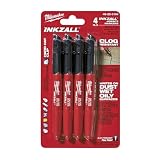
- Milwaukee Ink all Fine Point Marker, Black, 4 Per Pack
- 4 per pack Features Clog Resistant Marker Tip Writes through Dusty, Wet and Oily Surfaces Durable Marker Tip for Writing on Concrete, OSB and Rough Surfaces
- Clog resistant tip writes on dusty, wet and oily surfaces and is optimized for rough surfaces such as OSB, cinderblock and concrete
- Hard hat clip- attaches for easy access
- Quick dry time with reduced smearing and marking
A 2026 systematic review in Results in Engineering states that its Scopus search covered construction robotics publications from 2015–2025. That period describes the review’s literature corpus; it is not a count of deployed robots, a market-size estimate, or a productivity benchmark.
Quick Recap
Product prices and availability are accurate as of the date/time indicated and are subject to change. Any price and availability information displayed on Amazon at the time of purchase will apply.

