
To measure resistance with an ohmmeter—or a digital multimeter set to resistance mode—first turn off and disconnect power to the circuit, then discharge any high-voltage capacitors. Connect the leads to the meter’s correct terminals, select Ω, and place the probes across the component or circuit section. Never measure resistance on an energized circuit.
What an ohmmeter measures
An ohmmeter measures electrical resistance, expressed in ohms (Ω). Most digital multimeters (DMMs) include this function: set the selector to Ω to use the meter as an ohmmeter. The meter sends a small test current through the test object and uses the response to determine resistance. Fluke describes this operation in its 283 FC Users Manual (2024).
Resistance mode is for an unpowered circuit. Measuring resistance on a live circuit can create a shock hazard or damage the meter or circuit. Fluke’s guidance is direct: “Turn off power to the circuit.” See its DMM application guide and the model-specific warnings in your meter’s manual.
How to measure resistance
- Make the circuit safe. Turn off and disconnect its power source. Discharge high-voltage capacitors using the appropriate procedure for the equipment. Do not rely on a meter’s protection features to make a live resistance measurement safe.
- Set up the meter. Turn the selector to resistance (Ω). On a meter with separate input jacks, insert the black lead into COM and the red lead into Ω or VΩ. Check the meter’s manual for the correct terminals and any model-specific instructions.
- Place the probes across the test object. Touch one probe to each side of the component or circuit section. Resistance is measured across the element, not by putting the probes in series with it.
- Read the value and unit. Note the displayed number and whether it is in Ω, kΩ, or MΩ. For conversion, 1 kΩ = 1,000 Ω and 1 MΩ = 1,000,000 Ω.
- Interpret the result in context. Compare the measurement with the expected resistance only after considering other connected circuit paths and the meter’s measurement range. If those paths could affect the result, follow the appropriate lab procedure to isolate the component before testing it.
How to interpret the display
A numerical resistance value
A numerical reading is the resistance the meter detects between the probe tips. It does not necessarily represent only the component you intended to test: current may also flow through parallel or other alternate paths in a connected circuit. A reading taken in-circuit can therefore differ from the component’s standalone value.
Quick wins for a faster PC:
Repair Windows errors before they cause bigger problemsFix Now →Scan for outdated or missing drivers - takes under a minuteDriver Scan →#1 Best Overall

- Versatile Digital Multimeter - Accurately measures AC/DC Current, AC/DC Voltage, Capacitance, Frequency, Duty Cycle, Resistance, Diode, Continuity and Temperature.
- Thoughtful Design - Support Data Hold, Large LCD Backlit Screen, Auto Shut-off and Kickstand make the process of measurements easier. Professional level is reflected in some features include Auto-Ranging capability, and True RMS for measuring both AC Current and Voltage.
- Suitable For Many Occasions - This Multimeter is a golden partner to help to troubleshoot a variety of automotive and household electrical problems safely and accurately.
- Ensure Safety - Double ceramic fuse is anti-burn and protects from overloading,and it will be more secure and reliable; F400mA/600V and F10A/600V explosion-proof ceramic fuse tubes can protect the multimeter effectively.
- Additional Tips - Please take off the cap before using the test leads. Check the manual for more usage information.
“OL” or an over-range indication
On Fluke meters, “OL” indicates resistance beyond that meter’s measurement capability. Display conventions vary, so consult the manual rather than assuming every model uses “OL” the same way. An over-range display is not, by itself, proof that a component is faulty.
Continuity beep
Continuity mode gives a quick open-or-closed indication based on a meter-specific threshold. Use resistance mode when the numerical resistance matters; a beep does not tell you the precise value, and the threshold varies by meter.
Rank #2
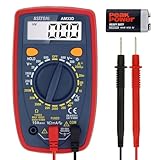
- Additional Tips - The following incorrect operations may cause the multimeter not to show results: Firstly, the plugs of test leads are not fully inserted or not inserted into the correct sockets. Secondly, the manual rotary switch is not placed in the correct position. In addition, this meter can not test all AC Current and below 100mV AC Voltage. Please check the user manual carefully before measurement.
- Versatile Digital Multimeter - Accurately measures AC/DC Voltage, DC Current, Resistance, and Diode. This Multimeter is a really useful tool for solving industrial and household electrical issues. Suitable for Household Outlets, Fuses, Batteries (including Vehicles), Automotive Circuit Troubleshooting, Charging Systems, Testing electronics in Cars etc.
- Troubleshooting with Accuracy - This Multimeter has a sampling speed of 2 times per second; Built-in a backlight LCD display with 3 ½ digits (1999 count) 0.6”, and high polarity including negative and positive readings.
- Ensures Safety - Double fuse is anti-burn and protects from overloading. The silicone cover can protect the multimeter from failing damage and prevent electric shocks. And low battery indication will be displayed when battery power is low.
- Ease of Use - Support Data Hold and Continuity Buzzer. Includes Convenient feature like LCD Backlit Screen makes it easy to use in dimly light areas. Batteries/Set of Test Leads/User Manual are Included.
Accuracy limits that can affect your reading
Meter range and resolution
Resistance ranges and resolution vary by model. For example, the Fluke 283 FC manual lists ranges of 600.0 Ω, 6.000 kΩ, 60.00 kΩ, 600.0 kΩ, 6.000 MΩ, and 50.00 MΩ. Those are specifications for that meter, not a universal set of ranges. Fluke’s 2023 guide broadly says most DMMs measure down to 0.1 Ω and some as high as 300 MΩ; those figures do not guarantee the capability of a particular meter. Check your own meter’s specified range and resolution.
Test-lead resistance on low-resistance measurements
Lead resistance can influence an accurate low-resistance measurement. Fluke’s 2023 guide gives 0.2 Ω to 0.5 Ω as typical for the leads discussed there; the actual value depends on the lead set. Check your leads and use the meter’s documented procedure for accounting for lead resistance when measuring small values.
Recommended Free Tools
Quick Recap
Best Value
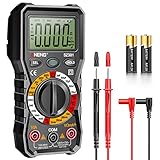
- Versatility: ANENG multi meter is a highly adaptable electronic tool that can be used to measure a wide range of electrical properties, including AC/DC voltage, current, resistance,continuity,diode and Live wire.This makes it an essential tool for anyone working with electronics or electrical systems,also widely used by hobbyists, students, and professionals in various fields, including engineering, automotive repair, and electricians.
- Precision: Multimetro typically have two probes that can be inserted into the circuit being measured, allowing for precise and accurate readings. This makes them ideal for detecting even small changes in voltage or current.
- User-friendly display: ANENG Multi Tester have a clear and easy-to-read display screen that shows the measurement values, as well as various settings and modes that can be adjusted to suit different measurement tasks. This Voltmeter makes it easy for users to quickly and accurately obtain the information they need.
- Safety & Portable: ANENG electrical tester is designed with safety features, such as anti-burn with double fuses,overload protection and insulated probes, to ensure safe and reliable use.Amp meter is compact and lightweight, making it easy to carry around and use on the go.
- Customer Service: ANENG offers exceptional customer service and after-sale support and technical assistance for their digital multimeter. This electrical tools comes equipped with two AA batteries that are pre-installed, and includes a silicone protective case and two high-quality cable leads for added convenience and protection.
Rank #4

- 【Safety】:This Digital Multimeter Ensures Accurate Measurements of AC/DC Voltage to 600v, AC/DC Current,AC Current MAX to 10A, Overload Protection On All Ranges To Ensure Long-Term Service Life
- 【Widely Used】:Accurate AC/DC Voltage, AC/DC Current, Resistance, Circuit Continuity Test, Battery Check, Diode/ Transistor Etc. Works as A Voltmeter, Ammeter, Ohmmeter, Car Battery Tester, Ampere Meters, Voltage Tester. Great To Check Household Outlets, Fuses, Batteries (Including Vehicles), Automotive Circuitry, Etc
- 【Backlight LCD】:Professional Multimeter Tester'S Display Is Visible From Different Angles, Making Value Easily Readable In Low Light and Dark Places. Data Hold Function Makes Measuring Easier
- 【Non -Slip And Bracket】:Our Multi Meter Can be Hand Held Or Stood Using Its Fold Out Stand. Removable Thick Rubber Cover Is Made of Kind of Non-Slip Slightly Soft Plastic That Will Help With Drop Protection and Minor Bumps Protection
- 【After -Sales and Packaging】:Prioritize Customer Satisfaction ,If You Have Any Questions or Concerns, Our Dedicated Support Team Is Always Ready to Assist You. Package Includes 1 Multimeter, 2 Test Leads, 2 AA Batteries, And A User Manual
Rank #3

- 【More Versatile than Expected】MS8233D multimeter can accurately measure DC/AC voltage, DC/AC current, resistance, capacitance, frequency, and duty cycle, test continuity and diode, and detect live wire and NCV.
- 【User and Device Protection】The digital multimeter conforms to IEC61010-1 CAT III 600V safety standard. Two built-in fuses provide overload protection on all ranges. Insulated rubber holster prevents the user from electric shock.
- 【6000-Count LCD Screen】Equipped with a 6000-count (3 5/6 digits) LCD display, the multimeter tester gives clear and accurate readings. Bright backlight allows for working in the dark places.
- 【More Powerful Features】The multi tester features practical functions, such as switchable manual/auto range modes, max/min value, data hold, low battery indicator, and auto power off. The multimeter has a sampling speed of 3 times per second.
- 【Non-Contact Voltage Detector】Non-contact voltage testing has sound and light alarms. When AC voltage is detected, the buzzer beeps and light flashes. The stronger the AC voltage is detected, the faster the buzzer beeps.
Before you trust the result
- Confirm that the circuit is disconnected from power and high-voltage capacitors have been discharged appropriately.
- Verify that the meter is set to Ω and that both leads are in the correct jacks.
- Make sure the probes contact opposite sides of the test object.
- Check the displayed unit and the meter’s resistance range.
- Consider whether other circuit paths or lead resistance could influence the reading.
- Consult the meter manual for its display conventions, limits, and measurement instructions.
Product prices and availability are accurate as of the date/time indicated and are subject to change. Any price and availability information displayed on Amazon at the time of purchase will apply.

