
Do these 3 things before closing this tab:
1Fix the driver behind crashes, sound loss and screen glitches2Repair Windows errors before they cause bigger problems3Scan for outdated or missing drivers - takes under a minuteiTechGuides is reader-supported. When you buy through links on our site, we may earn an affiliate commission. As an Amazon Associate I earn from qualifying purchases. Learn more
Track each disposal package as an identifiable record linked to its generator, characterization, packaging checks, certification, and shipment documents. Record mass and volume with their methods and units, and describe package geometry to the level required by the approved package design and receiving facility’s current waste acceptance criteria (WAC). There is no single geometry schema that applies to every waste type and disposal route.
This U.S.-oriented guide draws on Department of Energy (DOE) characterization guidance and Nuclear Regulatory Commission (NRC) low-level radioactive waste materials. Actual requirements depend on the waste, jurisdiction, transport route, and receiving facility.
Build a traceable package record
Give each package a unique identifier and preserve the generator facility or work identity. Link the identifier to records for characterization, packaging and monitoring, certification, and shipment. DOE assessment guidance asks whether processes maintain traceability between packages, their generating work, and characterization and packaging-monitoring data, and whether records can be audited and retrieved. See the DOE waste characterization program assessment criteria.
Define your inventory fields, units, measurement methods, dates, and responsible procedures. For any dimension or volume, specify whether it refers to the waste contents, package interior, or package exterior. These are useful record-design practices, not a universal regulator-mandated schema; the site’s approved procedures and receiving facility’s requirements control.
#1 Best Overall

- 【Nuclear radiation detector】GQ GMC-800 is the latest upgraded model of USA GQ Electronics Geiger Counters. Portable, personal & group use. Detect ionizing nuclear radiation Beta, Garma, X-ray. Quick, sensitive, precise & Easy-to-use. Simply power-on, reading instantly shows at screen. One press shortcut key transit among four function screens. Readable under the sun, suitable indoor & outdoor.
- 【Multifunctional】Traditional Geiger counter function to find the instantaneous radiation flux on a location/spot; Real-time & timeframe measuring function to display radiation data; Dosimeter function to obtain the real-time & accumulated radiation on human body; Radiation monitoring function to monitor radiation over time at a location.
- 【The measurement accuracy】is ensured via compliant design meets USA national standard (NIST & NRC). The calibration is done to further strengthen the accuracy and data quality. Easy access rechargeable & replaceable battery. Type C data transfer & charging cable. Light, thin & anti-drop. Handheld, stand on both sides, or lay down at the surface.
- 【Five types of radiation alarms】Visual LED, Audio, Vibration, Voice. Four alarm types provide everyone including vision-impaired & hearing-impaired users. The alarm level threshold can be set by users. Exclusive Advanced Features are integrated in. Built-in Clock, Memory for data storage up to 10 years. Free data processing software & firmware updates & open protocol & online data storage & history data preview. Navigate menu & submenu to explore.
- 【User Friendly Interface UI】Shorten learning curve, easy- to-navigate. The larger clear TFT color LCD display. Fast speed, immediate reading. Main screen simultaneously show reading in dosimeter units. User selectable color change scheme, customized light/dark mode for user preferences & visual comfort; Graphic, large font mode.
Record mass with its measurement basis
DOE’s Waste Characterization Program Manual, revision 5, dated July 2023, describes calculating waste mass by subtracting disposal-container tare from gross package weight. It also allows the weights of individually weighed packages or cuts to be summed. The manual uses waste weight in calculating radionuclide activity or chemical concentration per unit weight. Consult the DOE Waste Characterization Program Manual, revision 5 and the applicable site procedure for the authorized method.
When using the gross-minus-tare method, retain the two input values and the resulting net waste mass rather than storing only the final number. A useful record also identifies units, measurement date, scale or method, and applicable measurement-control information. These provenance details support audit and review; follow the site’s approved procedure for required records and controls. DOE says scales used for waste-weight determinations are maintained under its referenced measurement and test equipment procedure. Its tolerance exception is narrowly limited to cases where measurement differences have an insignificant impact on radionuclide quantification; it should not be generalized beyond that procedure.
Rank #2

- All-in-One Detection: RT-100S 3-in-1 EMF Reader measures Electric (EF), Magnetic (MF), and Radio Frequency (RF) fields to monitor radiation in your home, office, or outdoors.EF (Electric Field): Detects radiation from appliances like microwaves, refrigerators, and power lines.MF (Magnetic Field): Measures magnetic radiation from devices like motors, microwaves, and refrigerators.RF (Radio Frequency): Monitors radiation from Wi-Fi routers, cell phones, and 5G signals.It’s also great for paranormal investigations, detecting EMF changes linked to ghostly activity.
- Easy to Use: ERICKHILL Radiation Detector ready to measure instantly upon powering on—no complicated setup required. All three field strengths display directly on the screen, letting you see electric, magnetic, and RF readings at a glance. Ideal for users of all experience levels.
- Clear Color-Coded Screen: The large display features a three-color backlight indicator (green, orange, and red) that changes based on radiation levels, giving you instant visual feedback on EMF exposure to easily assess low, moderate, and high radiation zones.
- Triple Alarm Modes: Equipped with sound, screen, and light alerts that help you identify areas with higher radiation levels, this EMF meter ensures you’re always aware of your environment. You can easily turn off the sound alerts if preferred, while the visual and light indicators will still highlight areas with higher radiation, making it ideal for both indoor and outdoor use.
- Convenient and Energy-Saving Design: Our emf detector equipped with unit switching for customized readings, a Type-C charging port for fast, easy charging, and an automatic shutoff feature to save battery, this EMF detector is portable, energy-efficient, and made for frequent use.
Record volume without confusing container capacity with waste volume
DOE Manual 1S permits using container volume as waste volume only under stated conditions: for a thin-walled container (less than 0.75 inch), actual waste volume must be within 10% of the empty container volume. Under that procedure, compacted waste volume is defined as the container volume. Those conditions are specific to the manual and are not a general rule for all packages or facilities.
The manual lists the following standard-container volume examples. Treat them as values from that DOE procedure, not guaranteed usable capacity or universal package values.
Rank #3

- ✅【Rechargeable EMF Detector】TEMIRUP radiation meters are compact and portable, allowing users to carry them conveniently. This portability enhances their usability, making them suitable for travel, outdoor activities, or simply moving around different areas within a home or office. TEMIRUP EMF devices empower users to assess and mitigate potential risks associated with prolonged exposure to electromagnetic fields, It helps you with room layout and avoids placing you in high-radiation environments
- ✅【Accurate Measures All Emfs】Emf Meter measures magnetic with optional units mG/µT, electric with unit V/m, and radio frequency radiation with unit uW/cm²; RF mode can detect WiFi signals, 5G signals (30MHz ~8GHz), and microwave radiation from appliances like microwave ovens. ELEC and MAG modes can measure electromagnetic radiation emitted by household appliances such as televisions, induction cookers, rice cookers, refrigerators, computers, and power lines. If you care about EMF radiation in your home, you need to be able to measure all types of radiation
- ✅【User-Friendly & Versatile Utility】EMF Meter equipped with a built-in electromagnetic radiation sensor, which can display the radiation value on an Large Colour LCD Screen after processing by the micro-control chip; Auto Power Off after 15 minutes without operation; Unit switch (℃/℉); The meter can test average or peak value (Maximum) reading and Hold the data for a view with a single key;Low Battery Indication so you never accidentally run out of juice
- ✅【Informative Display & Audio Alarm】Sound and the analog display warnings to remind you of the safe range, you can determine actual EMF radiation levels of certain things and locate EMF radiation sources; 3 Colors analog display Alarm Reminder, Hold the instrument in hand, and slowly close the probe to the radiation source. When the radiation value is displayed on the screen and the analog display reaches the yellow area, the instrument starts to give an audible alarm prompt, indicating that the radiation exceeds the standard, please take protective measures or keep it away from the radiation source
- ✅【What you get】1 * EMF Meter, 1 * charging cable, 1 * Emf meter carry bag and 1 * User manual; If you have any questions, please feel free to contact us, our professional team will solve your problem in time
| Container example in DOE Manual 1S | Example volume |
|---|---|
| 55-gallon drum | 7.4 ft³ |
| B-25 | 90.0 ft³ |
| B-12 | 45.0 ft³ |
| Skid pan | 162.0 ft³ |
| 20-foot intermodal container | 1,173.0 ft³ |
| 40-foot intermodal container | 2,394.0 ft³ |
Record which volume method was used and whether the figure represents the waste, a stabilized or compacted contents volume, or the container. DOE’s characterization criteria explicitly include “Volume, including the waste and any stabilization or absorbent media;” alongside other package and waste information. See the DOE characterization criteria.
Describe geometry to match the package and receiving facility
There is no single cross-cutting geometry standard established by the cited guidance. The appropriate description depends on waste type, package design, disposal route, and the receiving facility’s current WAC. Record external dimensions and configuration when needed for package identification, loading, storage, transport, or facility acceptance. Confirm exact required fields, dimensional limits, and restrictions in the current WAC, transport rules, and approved packaging procedure.
Rank #4
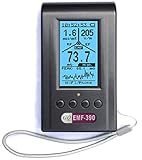
- Multiple high sensitivity sensors installed for detecting Power line, Smart meter, Cell phone, Microwave etc.
- Identify/recognize the common possible sources, such as Power line, Cell Tower, Microwave, Static etc.
- Safety suggestion lets you understand current situation instantly.
- Detects 5G network signal and RF up to 10Ghz
- Built-in RF Spectrum analyzer and GQ RF Browser for real time RF monitoring.
NRC guidance says low-level waste packages must use approved shipping containers, identify radionuclides and amounts, and comply with the facility license and applicable State, NRC, and Department of Transportation requirements. Its low-level radioactive waste disposal guidance is a starting point; the receiving facility and relevant Agreement State instructions determine what applies to a shipment.
Free tools Windows power users keep installed
One-click scans. No signup required.
Connect dimensions and quantities to characterization
Mass, volume, and geometry are only part of a disposal record. DOE characterization criteria call for physical and chemical characteristics; waste volume, including stabilization or absorbent media; weight of the container and contents; radionuclide data; characterization date; and generating source. Keep these fields linked to the package identifier so that a reviewer can determine which waste the measurements describe and how they support acceptance.
Best Value

- Detects: Magnetic fields, electric fields, and RF (20 MHz–6 GHz; includes most 5G but not experimental millimeter waves). Does not detect radioactivity.
- Displays EMF fluctuations fully: bars update instantly for fast digital signals, while RF and number averages refresh 4 times per second. Other meters over-average or filter field peaks, giving slower, less complete readings.
- Features: 3-axis magnetic, single-axis electric (with standard or weighted frequency responses), and single-axis RF readings (unweighted). Weighted readings emphasize effects on the human body.
- Measures: 4G and 5G cell phones, cell towers, WiFi routers, Bluetooth, AC Powerlines, and Smart Meters. The TF2 responds to RF very fast compared to other meters.
- Includes: Trifield TF2 meter, 9V battery, Quick-start Card, Detailed Instruction Manual, and soft-shell, zipper carry case.
DOE assessment criteria also emphasize appropriate measurement, analysis, calibration, maintenance, and measurement-quality controls. Data-quality objectives should identify parameters and acceptable uncertainty. Retain enough information about the method and its controls for the facility to assess the data and for the record to be reviewed later. See the DOE assessment guidance.
A specialized historical example is the 2014 WIPP compliance application, which describes a qualified inventory-database enhancement that tracked waste and packaging materials and chemical components in kilograms and radionuclide activities in curies. It illustrates one program’s inventory design, not a current software requirement for other disposal programs. See the WIPP 2014 compliance application.
Use the right records for applicable U.S. low-level waste shipments
For qualifying U.S. low-level radioactive waste shipments intended for licensed land disposal, 10 CFR Part 20, Appendix G requires a manifest using information requested on applicable NRC forms. The NRC describes the forms as follows:
Recommended Free Tools
- Form 540: shipping paper.
- Form 541: container and waste description.
- Form 542: index and compact tabulation, when needed.
The NRC permits equivalent substitute forms and electronic completion, transmission, and storage under stated conditions; for relevant electronic forms, shipper and consignee agreement is required. Applicability and field requirements depend on the shipment. Check the receiving facility and relevant Agreement State instructions, and consult the NRC’s Uniform Low-Level Radioactive Waste Manifest guidance and NUREG/BR-0204, Revision 3 before shipment.
Choose and document a method that supports acceptance
Where an approved program allows more than one way to establish a value, assess the method against the purpose of the data and the facility’s requirements. A method should be authorized by the waste program and receiving WAC, have suitable measurement quality and uncertainty, make clear whether it describes contents or the whole package, preserve traceability, and support the radionuclide concentration or disposal calculation for which the value will be used. DOE’s criteria call for measurement controls, data-quality objectives, and acceptance criteria; the receiving facility’s current rules and site-approved procedures remain decisive.
Quick Recap
Product prices and availability are accurate as of the date/time indicated and are subject to change. Any price and availability information displayed on Amazon at the time of purchase will apply.

