
To restrict LMCache network access, expose only the request endpoint required by vLLM clients, keep the separate HTTP management frontend on loopback unless remote access is essential, and allow traffic only from trusted clients and administrators. LMCache’s HTTP admin API has no authentication, so a reachable management listener must be treated as sensitive.
Which LMCache interfaces need protection?
In an LMCache MP deployment, distinguish the request endpoint from the HTTP frontend. vLLM uses the request endpoint to communicate with LMCache; the HTTP frontend serves health, status, management, and metrics functions. They have separate host and port settings, so changing one does not necessarily change the other.
The LMCache Quickstart documents localhost:5555 as the default MP request endpoint and port 8080 for the HTTP frontend. These are documented defaults, not proof of what a running deployment exposes. Check process arguments, environment variables, configuration, container port mappings, Kubernetes Services, and firewall rules.
The Quickstart uses ZMQ by default and also describes gRPC. Clients and servers need matching transport configuration; a remote request host must be deliberately configured at both ends. The Request Transport documentation covers the available transport choices.
PC Slower Than It Used to Be?
A free scan shows the junk files, broken settings and background clutter dragging Windows down - then fixes them in one click.Free scan · Windows 10 & 11Outdated Drivers Are Slowing You Down
One free scan finds every outdated or missing driver and matches the right update for your exact hardware.Free scan · exact hardware match#1 Best Overall

- ✅【Professional Firewall PC MGSRN305】MOGINSOK Firewall Appliance Mini PC--MGSRN100, with Intel Processor Alder Lake-N100 (4C/4T,up to 3.4GHz) processor Intel UHD Graphics TDP only 6W, supported AES-NI With HDMI 2.1+DP 1.4 Support Dual 4K@60Hz Display, a fanless & silent professional firewall router pc with multi-functions like AES-NI, ESXI, Watchdog, Auto power on, RTC, PXE boot, Wake-on-LAN etc. bring you a secured and encrypted network environment.
- ✅【DDR5 Ram & PCIE 3.0 SSD】MOGINSOK Micro Firewall Appliance MGSRN100 with Barebone No Ram(1x Single slot support maximum 32GB DDR5 4800MHz) and No SSD(1*M.2 PICE 3.0 slot) configurations, you can install your own ram and ssd for DIY depends on your application.
- ✅【Professional OS installed】MGSRN305 Pre-installed pfsense plus 23.0X OS and you can install OPNsense, OpenWrt, Unbutun, windows 10 or 11 and other popular open-source software solutions on this Firewall Router. Which you can use it as an Firewall, Netgate, Softrouting, NAS, Firewall, ESXI, PVEvirtualization platform(support VT-X,VT-D).
- ✅【Intel I226 2.5GbE Network Card】This Firewall Router equipped with 4*Intel I226 Network card maximum up to 2.5GbE, bring you more faster and professional network usage(some system suppliers maybe have not released compatible driver to match yet, suggest to install newest version of following systems: pfSense 23.01(or 2.7.0), Untangle( via virtual machine) OPNsense 22.1, OpenWrt, ROS7, ESXI, Proxmox, CentOS etc).
- ✅【Quality With Warranty】If you have any questions on MOGINSOK Firewall Appliance MGSRN100, feel free to contact us(if you want to get the latest bios update, you can send us message via Amazon). We offered 12 Months warranty for it and WE'LL REPLY YOUR Questions within 12 hours(during Workdays).
How should you bind LMCache listeners?
Keep same-host request traffic local
If vLLM and LMCache run on the same host and the deployment supports it, bind the request endpoint to loopback rather than a network-facing interface. This avoids making that listener reachable from other machines.
Configure remote request clients deliberately
If vLLM runs on another machine, configure the request server to listen on the intended reachable address and set the vLLM connector to that same endpoint. The Quickstart illustrates a private-IP example. Do not expose the listener on every interface simply to make connectivity work; select the needed interface and restrict which clients can reach it.
Rank #2

- More Secured Server Mounting Setup: RM-CI-T14 by Rackmount.IT IU rack mount kits have dedicated slots to safely install compatible Cisco Meraki models, including Cisco Meraki MX68, MX68W, MX68CW, and MX75.
- Improves Cable Management: All console ports of the Cisco Meraki appliance are brought to the front for easy access and user convenience — all while preventing overheating with custom-made cut-outs.
- Straightforward Installation Process: Mounting your appliance to a 19 inch shelf only takes 2-5 mins. as our network tray kits have everything a user needs — bolts, hex keys, zip ties, port labels, cables, and an assembly guide.
- Suitable for Any Type of Business: Our 1U rack shelf kits are designed to fit your appliance in 19-inch network rack shelves, making them ideal for small business owners, large corporations, and government agencies looking to improve their cloud management and network connectivity.
- Passionate for Smart Design and Customization: Rackmount.IT offers innovative solutions to common user needs by producing high-quality custom rack mounted shelf with excellent features that support major desktop appliance manufacturers.
Keep the HTTP frontend separate
The LMCache HTTP API documentation gives 127.0.0.1 as the HTTP host default and port 8080 as the default port. It states that the admin API has no authentication and recommends a non-loopback binding only on a trusted network. Leave the frontend on loopback when local access is sufficient. If remote administration is necessary, bind it only where trusted administrators can reach it and add network controls.
Restrict traffic to required clients
After choosing listener addresses, restrict network paths with the controls available in your environment: host firewall rules, container networking, cloud security groups, or Kubernetes network policies. Allow only the vLLM clients that need the request endpoint and the administrators or monitoring systems that need the HTTP frontend. Use the actual configured addresses, ports, and transport rather than assuming a universal LMCache rule set.
Rank #3

- Optimized for Firewall & Router Applications-Powered by Celeron N3160 quad-core processor, this 1U rackmount firewall appliance is designed for pfSense, OPNsense, OpenWRT, VPN, router and network security solutions. Ideal for home lab, SMB and enterprise edge deployments
- 4x 2.5GbE Intel I226 LAN – High-Speed Networking, built with 4× I226 2.5 Gigabit Ethernet ports, supporting multi-WAN, load balancing, VLAN, and advanced routing, delivering faster throughput than standard Gigabit firewall boxes
- Flexible Storage (mSATA + SATA) & Expansion-Supports mSATA SSD + SATA storage, 2.5/3.5 inch SSD bay), making it a versatile mini server / network appliance platform
- 19inch 1U Rackmount Industrial Design-Standard 19-inch 1U rackmount chassis, easy to deploy in server racks, network cabinets, and data centers, saving space while ensuring professional installation
- Industrial Reliability & Low Power Consumption-Designed for 24/7 continuous operation, wide temperature range -20°C to 55°C, ultra-low 6W TDP, stable performance for industrial control, edge computing, and network security environments
LMCache’s documentation establishes the endpoint separation and the HTTP frontend’s trusted-network requirement; it does not prescribe a particular firewall product, universal policy, or authentication scheme for request transport. Network restriction is therefore an operational control you must implement in your deployment.
How to keep LMCache private in Kubernetes
The Kubernetes Operator documentation describes ClusterIP Services for in-cluster engine discovery and the coordinator. Prefer these internal service paths for cluster traffic rather than publishing endpoints externally. If external access is genuinely needed, limit it to the necessary clients and protect management access with restrictive network controls.
Rank #4

- 【Processor & OS】Firewall Mini PC with Intel J3710 CPU up to 2.64GHz, 4Cores 4threads 2MB L2 Cache, TDP 6.5w, supports AES-NI. It tested with pf-sens/opn-sense linux ubuntu and other popular open source os. ("DEL" key to enter BIOS)
- 【Interfaces】The firewall pc has 4 * Intel I226 lan ports, 2 * USB3.0 ports, 1 * RS232COM port, 2 * HD port, 1 * DC port. Equipped with VESA mount, you can install the micro pc behind the monitor to save space.
- 【Fanless Design】only 6.5W; fanless heat dissipation design, aluminum alloy shell, efficient and fast heat dissipation, which can withstand temperatures up to 60°C. support 24/7 hours working, no noise.
- 【RAM & Storage】The firewall router equipped with 8G DDR3 RAM, max support 8GB; 128GB mSATA SSD, up to 512GB. Not support HDD. Size:5.27 * 4.98 * 1.43 inches, Weigh:500g, small but powerful.
- 【12 Months Service】You will get a firewall pc and accessories,If you encounter any problems during the use, please contact us through Amazon, we have a professional and efficient team dedicated to serving you.
Host networking changes the pod’s network namespace and can cause port conflicts. Use hostNetwork only when the deployment requires it, and account for conflicts with other processes or pods on the node.
Reduce host exposure if a pod is compromised
IPC settings do not restrict network traffic, but they affect what a compromised container may access on its host. The operator documents isolated IPC as the default. Retain it unless a specific deployment requirement calls for broader access.
Best Value
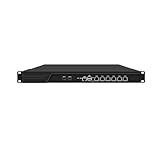
- HUNSN RJ16 equipped with 3th gen core i5 3320m, 3340m processor, compatible with many freebsd based router systems, linux distros, or win.os supported, easy configuration and management, support aes new instructions
- Please note, this is a barebone only. A system memory, a storage drive and an operating system are needed to complete this system
- Standard 1u, atx power, with power cord, make sure to use a big brand memory and ssd with quality assurance, ready to run straight out of the box
- Designed with rst, gpio, console, 2 x usb2.0, 6 x lan, 2 x sfp+, vga, power switch, ac socket, size at 440 x 255 x 45mm
- Original industry network motherboard, low power consumption, low heat, use dedicated turbo silent cooling fan to ensure long-term operation
- Isolated IPC: avoids granting host-level IPC access.
- Legacy mode: mounts the host’s
/dev/shm; the operator says to use legacy-mode engines only in trusted environments. hostIPC: true: exposes the host IPC namespace.- Privileged mode: is opt-in and grants additional device access.
Use broader IPC or privilege settings only when required, and consider their effect on host exposure separately from network policy.
Keep the run-script API disabled unless needed
The LMCache configuration reference describes the /run_script API as executing caller-supplied Python in-process and warns that restricted builtins are not a security boundary. It is disabled by default. Keep it disabled unless there is a specific, reviewed need; if enabled, assess the access controls around it as a separate high-risk capability.
Deployment checklist
- Identify the actual request and HTTP listeners, including their configured addresses, ports, and transport.
- Bind the request endpoint to loopback for same-host clients, or to the intended private interface for remote clients.
- Configure the vLLM connector to match the request server’s host, port, and transport.
- Keep the HTTP frontend on 127.0.0.1 unless remote management is required; never place its unauthenticated admin API on an untrusted network.
- Apply firewall, container, cloud, or Kubernetes network controls so only required clients can reach each listener.
- In Kubernetes, prefer the operator’s internal ClusterIP service patterns and avoid host networking unless needed.
- Retain isolated IPC and leave the run-script API disabled unless a documented need justifies broader exposure.
These configuration practices reduce unnecessary reachability; they are not a security audit or a guarantee against compromise.
Quick Recap
Product prices and availability are accurate as of the date/time indicated and are subject to change. Any price and availability information displayed on Amazon at the time of purchase will apply.

