
Quick wins for a faster PC:
Scan for outdated or missing drivers - takes under a minuteDriver Scan →Clear out junk files and repair common Windows errorsFree Scan →Reheat restaurant soup gently and stir it often, but do not stop short of the food-safety target: USDA and FDA consumer guidance says leftovers should reach 165°F (74°C), and reheated soup should be brought to a boil. On the stovetop, warm a portion in a saucepan while stirring. In the microwave, use a covered, vented microwave-safe bowl, heat in short intervals, and stir between them. Check the temperature in several places with a food thermometer.
Choose the stovetop or microwave
Either method can work; the main trade-off is attention. A saucepan makes it easy to stir continuously, while a microwave is convenient but needs pauses for stirring and checks for uneven heating. In both cases, reheat only the portion you plan to eat.
| Method | Useful when | What to watch |
|---|---|---|
| Stovetop | You want to stir frequently and monitor the soup as it warms. | Stay nearby, stir the bottom and sides, and check thick soup or soup with solids in several places. |
| Microwave | You want to reheat a single portion conveniently. | Cover with a vent, pause to stir, allow standing time, and check for cold spots with a thermometer. |
How to reheat soup on the stovetop
- Transfer the amount you need to a saucepan.
- Warm it over moderate heat, stirring often so the soup heats more evenly and is less likely to scorch. This is practical kitchen technique, not a special temperature rule from food-safety agencies.
- Use a food thermometer to check the soup. USDA guidance calls for leftovers to reach 165°F (74°C), and says reheated soups, sauces, and gravies should be brought to a rolling boil. Stir thick soup thoroughly and check more than one spot.
There is no universal reheating time: the portion size, starting temperature, pan, and stove all affect how long it takes.
How to reheat soup in the microwave
- Move soup out of its takeout container unless that container is labeled microwave-safe. Put it in a microwave-safe glass or ceramic bowl.
- Cover the bowl with a microwave-safe lid or wrap, leaving a vent for steam.
- Heat in short intervals. Stir thoroughly between intervals, including around the edges and through any solids. FDA consumer guidance recommends stirring soups and stews periodically for even heating.
- Let the soup stand briefly after heating, then check its temperature in several places with a food thermometer. Microwave heating can be uneven; bubbling in one spot does not establish that the whole serving has reached 165°F (74°C).
- Continue heating as needed until the soup reaches 165°F (74°C) and has been brought to a boil, as advised for reheated soup.
What helps preserve texture—and what is not guaranteed
Gentle, gradual heating and frequent stirring are sensible ways to reduce scorching and uneven heating, especially for thick soups. They do not guarantee that a particular recipe will keep its original texture. The USDA and FDA guidance cited here addresses safe reheating, not texture outcomes for specific soup ingredients.
#1 Best Overall

- MICROWAVE SOUP MUGS: Ideal for heating soup, stews and hot drinks in the microwave
- STEAM RELEASE VENT: Allows for splatter-free heating to keep your microwave clean
- EASY TRANSPORTING: Convenient handle makes it simple to transport from microwave to bench
- DIMENSIONS: L 142 mm x H 119 mm x W 114 mm
- CARE INSTRUCTIONS: Dishwasher (top rack), microwave (with vent open), fridge and freezer-safe; designed and made in New Zealand; phthalate and BPA-free
For cream, cheese, or puréed soups, use the same cautious approach: heat gradually, stir well, and meet the safety target. Do not stop heating early to protect texture; the sources cited here do not establish a lower-temperature method that is both validated for safety and guaranteed to preserve texture.
Quick Recap
Best Value

- Airtight and leak proof seal
- Elevate your lunch with striking colors; your food is more appetizing when your food storage is appetizing
- Microwave safe; Dishwasher safe; Airtight and leak proof seal; stain and odor resistant
- High quality food storage container made of BPA-free plastic; Upgrade your lunch and snacks with vivid p
Rank #4

- Soup mug designed to heat Soup, noodles, hot beverages, and more in the microwave
- Steam release vent on lid allows for splatter-free heating
- Cool-to-the-touch, easy-lift tabs for easy opening of the mug
- 100% Virgin plastic; phthalate- and BPA-free
- Top-rack dishwasher-safe; fridge- and freezer-safe; microwave-safe with the vent open
Rank #3
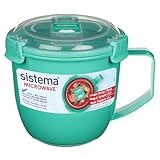
- Ideal for soups, stews, noodles, or hot drinks at home or at work, these convenient Sistema Soup Mugs let you heat the contents up in the microwave, and then eat or drink straight from the mug
- Comes in a set of 4, so everyone in the house can have one; great for meal prep
- Microwave safe (open vent when heating); top-rack dishwasher safe, and freezer safe; phthalate- and BPA-free
- Fun, colorful containers are designed and made in New Zealand
- Colors received may vary
Rank #2

- What's Included: Set includes three 660 mL soup mugs and lids.
- Heat and Go: The mugs are microwavable for quick meals any time.
- ZeroLeak Technology: The soup mugs are 100% leakproof for spill-free carrying.
- SplatterShield Protection: Special vents on the lids allow for mess-free microwaving.
- Easy to Clean: Top-rack dishwasher-safe for quick and easy cleaning.
Check that the soup was stored safely
- USDA consumer guidance says to refrigerate perishable food within two hours, or within one hour when the surrounding temperature is above 90°F (32°C). Discard food left out longer than those limits.
- Use most cooked leftovers within three to four days, according to USDA guidance.
- Reheating is not a way to make soup safe after improper storage.
- Do not use a slow cooker to reheat leftovers. USDA FSIS says food may stay too long in the 40°F–140°F (4°C–60°C) danger zone.
Product prices and availability are accurate as of the date/time indicated and are subject to change. Any price and availability information displayed on Amazon at the time of purchase will apply.

