
Reduce a data center’s energy use by measuring facility and IT loads, then fixing the largest avoidable sources of demand: underused IT, electrical conversion losses, poor airflow, and cooling that does not match equipment conditions. Protect uptime by monitoring server inlets and hot spots, retaining appropriate redundancy, and validating each change under real operating conditions. The right sequence depends on the site’s workloads, climate, water availability, equipment, and service requirements; there is no universally best design or guaranteed savings percentage.
Start with measurement, not a cooling setpoint
Measure total facility energy and IT equipment energy using consistent boundaries and time intervals. Power Usage Effectiveness (PUE) is total data-center energy divided by IT energy. It helps show how much facility energy supports the IT load, but it does not identify which system or operating practice should change. A lower PUE can also be misleading if the IT load, service demand, or metering boundary changed at the same time.
Pair PUE with measurements that help explain it: workload utilization, server inlet temperatures, cooling-system electricity, UPS and PDU losses, and availability indicators. Document the PUE measurement method and boundary. The ENERGY STAR Data Center Metrics Task Force identified source-energy PUE as a preferred metric in 2010; the Department of Energy’s 2024 guidance also considers other dimensions, including heat reuse, water, and carbon.
Build a baseline you can compare
- Record facility and IT energy on the same schedule and document what each meter includes.
- Capture workload or utilization data alongside energy so comparisons account for changes in service demand.
- Record inlet temperatures across locations, not just a room average, and include known hot spots.
- Track cooling electricity, UPS/PDU losses, alarms, and availability events as separate indicators.
- Use comparable operating periods when assessing a change, and note any differences in IT load or measurement boundaries.
Prioritize IT efficiency before facility changes
The Federal Energy Management Program’s 2024 data-center design guide treats IT systems and environmental conditions as early efficiency opportunities because reducing IT demand can also reduce the load that mechanical and electrical systems must support. Begin with an inventory of lightly used servers, duplicate or unnecessary data, storage practices, enabled power-management features, and older or poorly loaded electrical equipment.
PC Slower Than It Used to Be?
A free scan shows the junk files, broken settings and background clutter dragging Windows down - then fixes them in one click.Free scan · Windows 10 & 11Crashes, No Sound, or Screen Glitches?
Random freezes, missing sound and display glitches usually trace back to one bad driver. Find and replace yours safely.Free scan · under a minute#1 Best Overall

- Ventilation Fan: Designed to quietly ASUS GT/RT- AC5300 , cool Xboxs, CPU/ GPU, Playtations, Rokus, TVs, receivers, mondems, routers, DVRs, window fans ,network appliances, DIY aquarium cooling and other audio video electronics
- Variable Speed Control: 110V - 220V Fan power supply with speed control function, turn the knob to adjust the speed, 4V - 12V adjustable fan speed,and can turn off the fan . | Input: 100V - 240V 50/60Hz | Output: DC 3-12V 200-2000ma
- DIY Vertical Window Fan: Can both vertical and horizontal, provide efficient cooling and ventilation. Mining rigs rely on the cooling power of fans for optimal operation.Double Metal Protective, the fan is equipped with double metal protective net
- Easy to Install: Draw out air in refrigerators, provide ventilation in greenhouses, prevent amplifier overheating, and vent hot air from living room consoles like PS4. Y cable connects 2 fans, two fans can be 42cm/16.5 in far away from each other
- Dual Ball Bearing: 240mm x 240mm x 25mm / 9.45in(L) x 4.72in(W) x 1in(H) in in total. | Rated Voltage :12V | Rated Current: 0.93A at full speed | Airflow: (82CFM)x4 at 12V | Speed: 2500 RPMx4
Consolidate or retire systems only after capacity review
Ask application owners to confirm capacity, redundancy, licensing, security, and recovery requirements before consolidating workloads or retiring equipment. A server that appears lightly used may still provide failover capacity or support a recovery plan. Likewise, storage deduplication is appropriate only where the workload and data practices support it.
Use supported server power-management settings and review storage efficiency as part of the same capacity discussion. ENERGY STAR lists these as efficiency opportunities, but its examples are not guarantees for an individual facility.
Understand illustrative savings claims in context
ENERGY STAR’s operational guidance, accessed in 2026, gives examples including $500 in annual energy savings from removing one server, 2–3% greater efficiency for high-efficiency PDUs compared with conventional units, and up to 2% lower data-center energy costs from UPS eco-mode. These are source-reported examples, not universal or current guarantees; site conditions and equipment determine whether a change is suitable.
Rank #2
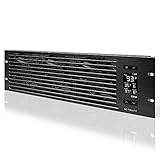
- An intelligent fan system designed for cooling audio video, DJ, server, network, and IT equipment racks.
- Protects rack-mount equipment from overheating, performance issues, and shortened lifespans.
- Programmable thermostat controller with automated speed control, alarm warnings, and backup memory.
- Premium anodized aluminum construction with CNC-machined detailing for a professional appearance.
- Size: 3U Rack Space | Design: Intake | Airflow: 60 to 300 CFM | Noise: 12 to 38 dBA | Bearings: Dual Ball
Correct airflow before adding cooling capacity
Airflow management helps cooling reach server inlets instead of mixing with hot exhaust. Check that rack fronts face cold aisles and exhausts face hot aisles. Seal cable openings and unused rack positions with suitable grommets and blanking panels, then confirm that supply air reaches equipment and hot exhaust does not recirculate into the cold side. Consider containment only when it fits the room’s cooling design and operating requirements.
Do these 3 things before closing this tab:
1Repair Windows errors before they cause bigger problems2Scan for outdated or missing drivers - takes under a minute3Clear out junk files and repair common Windows errorsENERGY STAR reports DOE estimates of 20–25% lower fan energy when hot/cold aisle layout is combined with containment. It also reports an estimated 5–10% lower energy expense from containment in facilities that already use hot/cold aisles. These figures are source-reported estimates, not site-specific forecasts. ENERGY STAR also cites a $360,000 annual saving in one large data-center airflow-management example, but its page does not establish enough facility context to generalize that amount.
Blanking panels can be a practical part of this work where they fit the rack and do not obstruct required airflow. They are not a substitute for checking supply paths, rack layout, and measured inlet conditions.
Rank #3

- [Adjustable] Adjustable temperature control helps ensure optimal performance for your rackmount such as network, server, music, and AV cabinets
- [Quiet and powerful] Equipped with three powerful 4” (120mm) noise control ball bearing fans capable of pumping 225 CFM of air, preventing overheating of expensive equipment
- [Optimal Airflow] This three fan cooling system will provide excellent cooling with its high-performance fans, which keep the hot air stream away from your setup with its top exhaust cool air system.
- [Compact Design] Device is standardized to mount to any 19" server rack or cabinet while taking only a single unit (1U) of space and has a wide variety of applications.
- [Programmable] Equipped with a programmable thermostat sensor controller for better temperature monitoring that will trigger fans based on your parameter configuration.
Match cooling controls to equipment conditions
Use environmental instrumentation and controls to adjust cooling capacity and airflow to actual heat load and server inlet conditions. Inlet sensors can reveal hot racks that a room average conceals. Controls can help avoid both unnecessary overcooling and undercooling that could put equipment at risk. Follow the operating limits for the specific servers and facility rather than assuming one room-wide target is safe everywhere.
ENERGY STAR describes instrumentation as a way to alert managers when safe operating temperatures are at risk. Its cited maximum cold-aisle temperature is guidance on that page, not a universal safe setpoint for all equipment. Setpoints and control sequences should be checked against applicable equipment limits and verified across locations and load conditions.
ENERGY STAR says data-center infrastructure management (DCIM) can reduce energy costs by as much as 30% in its guidance. Treat this as a source-reported upper estimate, not an expected result or a guarantee; monitoring and controls need suitable instrumentation, integration, and implementation to be useful.
Rank #4

- Adjustable temperature control helps ensure optimal performance for rackmount such as network, server, music, and AV cabinets
- Noise controlled fans makes the cooling system useful for a quiet office or business space
- Compact design mounts to any 19" inch cabinet and takes up only 1 unit of space
- Simple and easy to use LCD display allows user to control temperature
- Air pumped through to the top exhaust system of the fan
Evaluate economizers and heat reuse for the site
Air-side and water-side economizers can reduce reliance on mechanical cooling when outdoor conditions and system design are suitable. The DOE/FEMP 2024 guide places free cooling where appropriate in its efficiency-first sequence, followed by consideration of heat reuse and dry heat rejection. These options should be evaluated alongside energy, water, and carbon outcomes rather than on energy alone.
| Option | When it may fit | What to assess before relying on it |
|---|---|---|
| Air-side economizer | When climate and system design provide suitable outdoor-air conditions; ENERGY STAR notes it can provide cooling redundancy if mechanical cooling goes offline. | Suitable operating hours, air quality, filtration, humidity, contamination controls, maintenance, and failure behavior. |
| Water-side economizer | When the site’s cooling system, climate, and water conditions support it. | Water availability and impact, system design, controls, maintenance, and the effect of a failure on cooling redundancy. |
| Heat reuse | When a practical use for recovered heat and a compatible system design exist. | Whether a usable heat sink is available and how the design affects energy, water, and operational requirements. |
| Dry heat rejection | When it fits the site’s heat-rejection design and operating conditions. | Climate, equipment limits, expected operating conditions, and the resulting energy and water impacts. |
No single cooling option fits every data center. Compare climate and suitable operating hours, water availability, rack density and IT thermal limits, filtration and humidity needs, cooling redundancy, retrofit complexity, maintenance, and measured energy, water, and reliability outcomes. The DOE/FEMP guide applies across varied scenarios rather than prescribing one best design.
Independent reader supportYour contribution helps us test, update, and keep practical guides available for everyone.Use an efficiency-first sequence with reliability gates
The DOE/FEMP 2024 guide describes a sequence that starts with system optimization and PUE, keeps equipment within IT thermal guidelines while maximizing compute entering temperature, uses free cooling where suitable, optimizes fan and pump speeds and UPS operation, and then considers heat reuse, dry heat rejection, water, and renewable energy. Apply that sequence as a way to order evaluation, not as permission to bypass equipment limits or site-specific reliability requirements.
Quick wins for a faster PC:
Scan for outdated or missing drivers - takes under a minuteDriver Scan →Repair Windows errors before they cause bigger problemsFix Now →Fix the driver behind crashes, sound loss and screen glitchesFind Drivers →Best Value
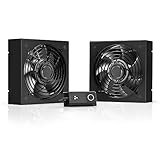
- A quiet fan kit designed for standard 19” racks, to be mounted on the roof or to replace existing fans.
- Features a speed controller utilizing PWM which can control the fan's speed without generating noise.
- Compatible with CLOUDPLATE series rack fans and can be linked to share the same programming.
- Heavy-Duty steel construction with spiral fan guards, mounting hardware, and power adapter.
- Size: Standard 120mm Rack Fans | Fans: 2 | Airflow 200 CFM | Noise: 26 dBA | Bearings: Dual Ball
- Measure and diagnose: Establish energy, workload, temperature, and availability baselines before changing operations.
- Review IT demand: Identify underused or unnecessary systems and verify application capacity, redundancy, licensing, security, and recovery needs.
- Improve airflow: Check aisle orientation, bypass gaps, rack openings, inlet supply, and exhaust recirculation.
- Optimize cooling and power: Adjust controls to measured conditions, and assess fans, pumps, UPS, and electrical equipment without weakening required redundancy.
- Assess site-dependent options: Evaluate economizers, heat reuse, dry heat rejection, water impacts, and renewable energy where the site conditions support them.
- Pilot and verify: Coordinate facilities and IT, monitor results under comparable workloads, and retain documented rollback criteria.
Validate energy savings and uptime together
Before a change, define how you will judge both energy performance and service reliability. After implementation, compare energy and temperatures at comparable IT workloads; inspect alarms, redundancy behavior, and availability indicators. Confirm that cooling and power systems respond as intended under relevant operating conditions, including failover behavior where applicable. If a change increases risk, triggers unexpected alarms, or violates a service or equipment limit, use the documented rollback plan.
DOE describes data centers as mission-critical, and ENERGY STAR connects monitoring with preventing thermal equipment failure. The practical implication is to keep reliability indicators beside energy metrics: an efficiency gain is not acceptable if it undermines required availability. The DOE/FEMP guide states that no design guide can identify the most energy-efficient design for every data center, while its guidelines can benefit a wide variety of scenarios.
Quick Recap
Product prices and availability are accurate as of the date/time indicated and are subject to change. Any price and availability information displayed on Amazon at the time of purchase will apply.

