
If a file is still in the Recycle Bin, select it and choose Restore. If it has been deleted from there, check your backups and any cloud recycle bin first; for a local file with no backup, Windows File Recovery can attempt a scan, but success is not guaranteed. Minimize use of the affected drive while you decide what to do, because new data can overwrite deleted-file data.
Choose the recovery path that matches where the file was stored
| Where the file was | What to check | What to expect |
|---|---|---|
| Local drive, still in Recycle Bin | Restore it from the Windows Recycle Bin. | Windows returns it to its original folder. Microsoft’s recovery guidance describes this restore route. |
| Local drive, no longer in Recycle Bin | Check File History or another backup; if none is available, consider Windows File Recovery. | Backups can restore saved copies. A scan is uncertain and can fail if the data has been overwritten. Microsoft’s Windows File Recovery guidance covers local storage recovery. |
| OneDrive file | Check the OneDrive website using the account that held the file, then open its recycle bin. | Cloud and local recycle bins are separate in some cases, especially for online-only files. Retention depends on account type; see Microsoft’s OneDrive recovery guidance. |
| Network share or cloud storage other than OneDrive | Use the service’s own recycle bin, version history or backup. | Windows File Recovery does not recover from cloud storage or network file shares. Availability of another restore route depends on the service or backup configuration. |
Restore an item that is still in the Windows Recycle Bin
- Open Recycle Bin from the desktop. If you do not see its icon, search Windows for “Recycle Bin.”
- Find the file or folder. Select it, or select multiple items if needed.
- Right-click the selection and choose Restore. Windows puts each item back in the location it occupied before deletion.
If the item is not listed, this route cannot restore it; move on to backups, cloud storage or local recovery.
Check File History and other backups
File History can restore previous versions of files, but only if it was set up before the deletion and had been saving copies. Microsoft says File History stores copies on an external drive or a network location. See Microsoft’s File History instructions for how to check and restore available versions.
Also check any backup system you already use, including a drive backup or a work-managed backup. Look for a version from before the file was deleted. Do not assume a backup exists merely because an external drive is connected: it must have been configured to save the relevant file.
Free tools Windows power users keep installed
One-click scans. No signup required.
#1 Best Overall

- Plug-and-play expandability
- SuperSpeed USB 3.2 Gen 1 (5Gbps)
Recover a deleted OneDrive file
Check the correct account and its recycle bin
Sign in to OneDrive on the web with the personal or work/school account that contained the file, and inspect its recycle bin. A deleted OneDrive item, particularly one that was online-only on the PC, may not appear in the computer’s local Recycle Bin. Microsoft documents recovery for up to 30 days for personal accounts and 93 days for work or school accounts; a work or school administrator can change the latter retention setting. See Microsoft’s OneDrive restore instructions.
If an item is no longer available in the OneDrive recycle-bin flow, that documented route cannot restore it. Check whether another backup or version history is available.
Rank #2
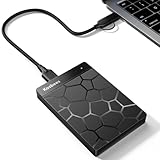
- 【Plug-and-Play Expandability】 With no software to install, just plug it in and the drive is ready to use in Windows(For Mac,first format the drive and select the ExFat format.
- 【Fast Data Transfers 】The external hard drives with the USB 3.0 cable to provide super fast transfer speed. The theoretical read speed is as high as 110MB/s-133MB/s, and the write speed is as high as 103MB/s.
- 【High capacity in a small enclosure 】The small, lightweight design offers up to 500GB capacity, offering ample space for storing large files, multimedia content, and backups with ease. Weighing only 0.35 Lbs, it's easy to carry "
- 【Wide Compatibility】Supports PS4 5/xbox one/Windows/Linux/Mac and other operating systems, ensuring seamless integration with game consoles,various laptops and desktops .
- Important Notes for PS/Xbox Gaming Devices: You can play last-gen games (PS4 / Xbox One) directly from an external hard drive. However, to play current-gen games (PS5 / Xbox Series X|S), you must copy them to the console's internal SSD first. The external drive is great for keeping your library on hand, but it can't run the new games.
Use Restore your OneDrive only for a broader rollback
Microsoft 365 subscribers may have the Restore your OneDrive option to roll back broader file activity from within the preceding 30 days. This is not the same as restoring one deleted file: it reverts changes across OneDrive to a selected point, and files created after that point are moved to the OneDrive recycle bin. Review Microsoft’s Restore your OneDrive instructions before using it.
Attempt local recovery with Windows File Recovery
If the deleted file was on a local internal, external or USB drive and no Recycle Bin or backup copy is available, Microsoft’s Windows File Recovery app can attempt a recovery. It is a command-line tool available from the Microsoft Store. It does not support cloud storage or network file shares. Follow Microsoft’s current Windows File Recovery instructions for the exact syntax and filtering options.
Rank #3

- [Upgraded Version] - This external hard drive features a mirrored logo stripe combined with a striped anti-slip design, and the rounded corners of the casing make it easier to grip. The stripes also have a heat dissipation function, ensuring stable and fast data transfer.
- 【Ultra-thin and quiet】 - The motherboard adopts JMicron 578 noise-free solution, giving you a quiet working environment. Lightweight and portable size designed to fit in your pocket for easy portability.
- 【Ultra-Fast Data Transfers】 - Pairing this external hard drive with JMicron 578 solution USB 3.0 and USB 2.0 interfaces enables blazing-fast data transfer. It boasts theoretical read speeds of up to 125MB/s and write speeds of up to 103MB/s.
- 【Plug and Play】 - With no software to install, just plug it in and the drive is ready to use.The hard disk chip is wrapped with an aluminum anti-interference layer to increase heat dissipation and protect data.
- 【What You Get】 - 1 x Portable Hard Drive, 1 x USB 3.0 Cable, 1 x User Manual, Gift-type shell packaging ,Three-year manufacturer's warranty and free technical support services.
Use a separate destination drive
The general command structure Microsoft documents is:
winfr source-drive: destination-drive: [/mode] [/switches]
Rank #4

- High capacity in a small enclosure – The small, lightweight design offers up to 6TB* capacity, making WD Elements portable hard drives the ideal companion for consumers on the go.
- Plug-and-play expandability
- Vast capacities up to 6TB[1] to store your photos, videos, music, important documents and more
- SuperSpeed USB 3.2 Gen 1 (5Gbps)
The source is the drive to scan; the destination is where recovered files are written. Use a different drive for the destination when possible. If your PC has only one drive, connect a USB or external drive and save recovered files there rather than writing them back to the drive being scanned.
Select a mode and understand its limits
Windows File Recovery offers Regular and Extensive modes. Microsoft suggests trying Extensive if Regular does not find the file, where the mode is supported. Extensive scanning is still an attempt, not a guarantee, and the command’s exact syntax depends on the drive and file you are seeking.
Best Value

- 【Versatile Storage Expansion – For Gaming, Work & Everyday Use】 Running out of space on your PS5 or Xbox Series X/S? This external hard drive lets you store and play PS4 / Xbox One games directly, instantly freeing up your console’s internal storage for next‑gen titles. At the same time, it handles work file backups, media libraries, and cross‑device data transfers with ease. One drive, all your needs. *(Note: PS5 / Xbox Series X|S games cannot be run or stored directly from the external hard drive. However, by offloading your PS4 / Xbox One games, you can free up valuable space for newer titles.)*
- 【Patented Silicone Sleeve – Data Protection You Can Count On】 Worried about drops? We’ve got you covered. The patented built‑in silicone sleeve acts like a shock‑absorbing armor, cushioning your drive against bumps and falls. Whether it’s important work documents, precious family photos, or hard‑earned game saves, your data deserves this level of protection.
- 【Plug & Play, Compatible with Computers & Consoles】 No complicated setup—just plug in and go. Works seamlessly with Windows, Mac, and Linux computers, as well as PS4, PS5, Xbox One, and Xbox Series X/S. Process files at the office, back up data at home, or enjoy gaming in your downtime—one drive handles all your devices, simply and hassle‑free.
- 【USB 3.0 Ultra‑Fast Transfer – No More Waiting】 Tired of watching progress bars crawl? With USB 3.0 speeds up to 5Gbps, large files transfer in seconds. Whether you’re moving work documents, transferring hundreds of gigs of games, or backing up a year’s worth of photos, you get more done in less time.
- 【Sleek, Lightweight, and Ready to Go】 Weighing just 0.16 kg—lighter than a can of soda—this compact drive features a stylish mirror‑and‑frosted finish. Toss it in your bag and go, whether you’re heading to the office, visiting a friend for a gaming session, or giving a presentation on the road.
Why recovery may fail—and what to do immediately
Deleting a file marks its storage space as available; the file’s data may remain until something else overwrites it. Microsoft advises: “If you want to increase your chances of recovering a file, minimize or avoid using your computer.” Avoid saving or downloading files, installing recovery software on the affected drive, or using it for routine work while deciding what to do.
Quick Recap
- Do not save recovery output to the scanned drive. Use a separate destination so the recovery attempt is less likely to overwrite other recoverable data.
- Expect lower certainty after continued use. Normal computer activity can write new data into free space that held deleted-file data.
- SSD recovery can be especially uncertain. Microsoft warns that free space on an SSD may be overwritten, which can prevent recovery.
- Do not treat a scan as proof the file is recoverable. If data is overwritten, Windows File Recovery may not be able to retrieve it.
Product prices and availability are accurate as of the date/time indicated and are subject to change. Any price and availability information displayed on Amazon at the time of purchase will apply.

