
Quick wins for a faster PC:
Clear out junk files and repair common Windows errorsFree Scan →Scan for outdated or missing drivers - takes under a minuteDriver Scan →Repair Windows errors before they cause bigger problemsFix Now →iTechGuides is reader-supported. When you buy through links on our site, we may earn an affiliate commission. As an Amazon Associate I earn from qualifying purchases. Learn more
A battery runtime estimate based only on amp-hours divided by load current can be badly wrong because rated capacity changes with discharge rate, an inverter may draw power even with no AC load, and only part of a battery’s capacity may be usable under its supplier’s guidance. A useful TypeScript model makes those assumptions explicit instead of treating amp-hours as a fixed energy bucket.
Why amp-hours divided by current is not enough
The simple calculation time = capacityAh / currentA assumes the battery can deliver its full rated capacity at any discharge rate and that the current draw stays constant. Neither assumption is generally safe. A battery’s amp-hour rating is tied to a stated discharge rate, while actual current may include inverter consumption and other loads. A discharge limit can also stop the usable portion of capacity before the battery is empty.
Start by recording the battery’s rated capacity in amp-hours and the rating basis, such as C20, along with system voltage, discharge current or load profile, elapsed time, chemistry, and the inverter’s operating mode. Keep units consistent: a watt load becomes an approximate DC current by dividing by battery voltage only when voltage and conversion losses are accounted for appropriately. Do not silently equate AC watts with battery-side amps.
PC Slower Than It Used to Be?
A free scan shows the junk files, broken settings and background clutter dragging Windows down - then fixes them in one click.Free scan · Windows 10 & 11Outdated Drivers Are Slowing You Down
One free scan finds every outdated or missing driver and matches the right update for your exact hardware.Free scan · exact hardware matchHow Peukert’s law changes available capacity
Peukert behavior represents the fact that faster discharge reduces the capacity a battery can deliver. Victron explains that lead-acid batteries are more affected by discharge rate than lithium batteries. Its example says a lead-acid battery rated at 100 Ah at C20 could provide 56 Ah when completely discharged in two hours; that is an illustration for that example, not a universal derating factor. See Victron’s explanation of battery capacity and Peukert exponent.
#1 Best Overall

- 1% Accuracy Measurement: Shunt-type battery monitor design provides much more accurate real-time voltage and current draw measurement.
- Protect the batteries: With High and low capacity alarm functions, our battery tester with shunt will alarm, and backlight and voltage value will flash simultaneously to protect the batteries from getting over-discharged.
- Fit for all battery: The energy monitor is compatible with various battery types, including Lead Acid (AGM, GEL), Lithium Iron Phosphate, Lithium-ion, Nickel-metal hybrid. 12V battery monitor compatible with batteries operating at 12 volts, 24 volts, and 48 volts.
- Easy To read: Renogy battery monitor displays multiple electronic parameters, including Voltage, Current, Consumed Power, Battery Capacity, and battery degradation rate with a customized brightness high-definition Backlight Display.
- Easy to Install: Transparent shunt holder makes the renogy lithium battery monitor easier to mount the shunt. And the 20ft Shielded cable allows you to monitor the battery status from a distance.
Use battery-specific ratings to estimate the exponent
The relationship is commonly written as Cp = I^n × t, where Cp is a constant for the battery model, I is discharge current, n is the Peukert exponent, and t is discharge time. Solving for n requires capacity ratings at different discharge currents. Victron recommends using two ratings with substantially different currents—often ratings such as C20 and C5—rather than trying to infer the exponent from one rating alone.
Prefer the battery supplier’s exponent or enough supplier data to estimate it. Victron’s monitor documentation describes an exponent setting range of 1.00–1.50 and a default of 1.25; those are settings for the cited monitor, not universal values for all batteries. Its configuration guidance gives fallback values of 1.25 for lead-acid and 1.05 for lithium when a supplier value is unavailable, with supplier specifications taking precedence. See Victron’s monitor configuration guidance.
Peukert’s law is an empirical approximation, not a complete electrochemical model. Victron cautions that at very high currents, actual capacity can be lower than a fixed exponent predicts. Do not present a single exponent as a guarantee across battery age, temperature, current peaks, or different chemistries.
What’s actually slowing this PC down?
Pick the symptom - the matching free tool is one click away.
Rank #2

- 🔋High Value Battery Tester: BM200 is your go-to solution for 12V lead-acid and lithium battery. Equipped with advanced features like voltage & cranking & charging system test, abnormal alarm and real-time trip records.This battery monitor ensures your car battery is always in optimal condition. Whether it's for your car, motorcycle, truck, RV or boat, this 12V battery tester has got you covered. Get it, and forget winter breakdown worries.
- 🚗Keep Your Journey Smooth: Ever lose your car in a crowded parking lot? Not anymore! From real-time battery monitoring and smart alerts to multi-vehicle management and location tracking, the BM200 12v battery tester isn't just a battery tester—it’s your all-in-one vehicle management companion. Perfect for drivers who want to avoid battery surprises and keep their vehicles running smoothly every day. Note: Seek car function requires GPS permissions to be authorized for the device to identify the vehicle's location.
- 🎄Cranking & Charging System: The cranking test helps you assess the battery's performance during vehicle startup, while the charging test lets you evaluate the operational efficiency between the battery, alternator, and electrical system——keeping your vehicle running smoothly without any surprises. With reliable accuracy, the BM200 car battery tester gives you the info you need to stay ahead, no matter the conditions.
- ✌️Effortless Battery Testers: Enjoy hassle-free battery monitoring with Bluetooth 4.2 technology. No need to stand by your car's hood—sit back in your car or within a 15~30FT range to access real-time battery information. Whether it's hot, cold, or rainy, you can conveniently monitor your battery's condition. Plus, the enhanced Bluetooth connection provides faster pairing and a stable, reliable connection.
- 📈Accurate Data, Every Time: With this battery checker tester smart chip tech, you’ll get razor-sharp accuracy every time you check your battery health. Compatible with both iOS and Android, the ancel BM200 battery tester app lets you monitor up to 4 devices all at once—keeping you effortlessly connected. Additionaly, this saves the day by recording battery data every 2 minutes and stashing 70 days' worth of history, so you can always track back and see what's up with your power. It is recommended to install the device after the vehicle has been switched off for two hours, when the voltage will be stable and the data will be more stable.
Keep the reference rating consistent in a runtime calculation
A calculation needs a consistent reference current and capacity rating. If a battery is specified at C20, that capacity and its corresponding discharge current provide the reference point; a different load should be adjusted using the battery-specific Peukert relationship rather than treated as though the C20 amp-hours were available unchanged. When comparing batteries, record both the nominal Ah number and the discharge-rate basis.
Include inverter tare power, even at a small AC load
An inverter can consume DC power while producing little or no AC output. That no-load draw is a real battery load whenever the inverter remains on, so modeling only the devices plugged into its AC outlets will overstate runtime.
Use the actual inverter’s specification for its model and operating mode. For example, Victron lists zero-load consumption of 4.2 W for the SUN Inverter 12/250 and 5.2 W for the 24/250; its default ECO-mode zero-load values are 0.8 W and 1.3 W, respectively. These figures apply only to those models and listed modes, and ECO-mode behavior should not be treated as equivalent to continuous inverter operation. See the SUN Inverter specifications.
Rank #3

- 【Convenient】DROK batter meter can measure and display battery voltage, capacity, remaining battery capacity percentage with upgraded bigger screen. Make it more convenient to use comparing to others cause no need to switch interfaces.
- 【Reliable and Safe】This waterproof panel can protect internal components from moisture and corrosion. Further more, DROK batter monitor provides reverse polarity protection, automatic save on power outage, low power consumption and low voltage alarm.
- 【Applicable Battery Type】 DROK digital battery monitor is suitable for 8-100V 12V 24V 36V 48V 72V lithium battery, lead acid battery, ternary lithium battery, polymer lithium-ion battery, and more.
- 【Accuracy】With a voltage calibration potentiometer design from the back that can be rotated to adjust the voltage, DROK battery tester is convenient and more accurate to use.
- 【Wide Application】Can be used as battery voltage meter, battery capacity tester panel for motorcycle, golf carts, car, marine, RV, boat, solar generator etc.
For each interval in which the inverter is on, multiply its specified zero-load power in watts by the interval duration in hours to obtain watt-hours. Relate that energy to the battery model using system voltage and the assumptions for conversion efficiency and voltage behavior. If the inverter is off during part of the scenario, do not charge its tare draw for that period. Keep idle power and operating mode as explicit inputs rather than burying them in the load value.
Recommended Free Tools
Apply a chemistry-appropriate discharge floor
Nominal capacity is not automatically usable capacity. A runtime estimate should stop when the modeled state of charge reaches a configured discharge floor, or equivalently limit the capacity available to the calculation. Set the floor from the battery supplier’s guidance and the system’s requirements, not from a generic rule applied to every battery.
Victron’s cited monitor guidance uses a 50% discharge floor as a default for lead-acid and gives a 10–20% setting range for lithium unless the battery supplier advises otherwise. These are device settings and manufacturer guidance, not a universal safety standard. See the BMV-710H Smart and SmartShunt manual.
Rank #4

- APPLICATION --- The battery testers can be used for testing battery voltage and capacity for electric motorcycle, motorcycle,golf cart, automotive , car, marine, RV, boat, etc.
- APPLICABLE BATTERY --- The digital battery monitor is suitable for 7-100V (12v 24v 36v 48v 60v 72v 84v) Ternary lithium battery, lead-acid,AGM battery, LiFePO4 battery. Default 12 volt lead acid battery .
- PROTECTION ---The smart battery monitor with fully colsed protective shell, dustproof ,IPX7 Waterproof ,It can be used for indoor and outdoor. Even if you soak in water for 72 hours, it will not get water.Input reverse connection protection.
- INSTALLATION --- The red wire for the positive and the black wire for the negative. The wires length are 23.62 inches(60.0cm),we provide mounting bracket,double-side adhensinve and screw for conventient installing.
- Buzzer Alarm&Temperature--- The battery monitor can set low and high voltage buzzer alarm and short press"M"key can switch voltage and temperature(Celsius).
Keep the floor explicit in the model, along with chemistry and the source of the chosen value. That makes it possible to compare scenarios without accidentally treating a lithium-oriented assumption as suitable for a lead-acid battery, or vice versa.
Independent reader supportYour contribution helps us test, update, and keep practical guides available for everyone.Translate the assumptions into TypeScript inputs
Model the physical assumptions first; then implement them. The sources describe the battery and inverter behaviors, but do not prescribe a TypeScript library, algorithm, or validated code implementation. A clean input model should make assumptions visible and configurable:
- Battery chemistry and rated capacity, including the stated C-rate.
- Reference discharge current or the supplier’s capacity ratings at distinct currents, plus the Peukert exponent when available.
- Battery/system voltage and the discharge current or time-varying load profile.
- Configured discharge floor, labeled with its supplier or system basis.
- Inverter model, operating mode, and zero-load power while it is on.
- Charge efficiency and temperature assumptions if those are included in the calculation.
For an interval-based simulation, track the battery-side load and inverter energy for each interval, update modeled state of charge using the selected battery assumptions, and stop when the configured floor is reached. Avoid presenting this as a universal formula: battery voltage variation, inverter efficiency, temperature, degradation, load transients, wiring losses, and battery-management-system cutoffs can all affect real runtime, and the manufacturer sources do not establish one model that covers every combination.
Best Value
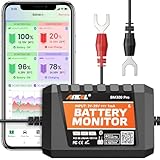
- 6V, 12V & 24V MONITORING - View voltage, estimated state of charge and temperature through the ANCEL BM300 Pro app. On supported 12V and 24V vehicle systems, review cranking and charging voltage tests. For 6V systems, use voltage, SOC and temperature monitoring; cranking and charging tests are not supported.
- MONITOR UP TO 4 BATTERIES - Each BM300 Pro connects to one battery. Add up to four BM300 Pro devices in the app to view four batteries from one phone, useful for multiple vehicles or separate battery banks. This package includes one monitor; additional batteries require additional monitors
- BLUETOOTH 5.3, NOT REMOTE CELLULAR - View live data and receive supported alerts when your phone is within Bluetooth range. The monitor stores up to 72 days of history while disconnected and syncs data when you reconnect. It does not provide Wi-Fi, cellular, or unlimited-distance monitoring
- APP DATA FOR BETTER CONTEXT - Review voltage, estimated SOC, temperature, cranking and charging results, trip records, and historical graphs. Trip and Find Car features use the phone’s location services and require permission; the monitor itself does not contain a GPS or cellular tracker
- MADE FOR LONG-TERM INSTALLATION - Average current draw is approximately 1mA. Built-in reverse-polarity and short-circuit protection support permanent installation, while the IP67-rated housing is designed for engine-bay conditions. For the best signal, mount away from thick metal obstructions and secure both terminal leads
Check a model against measured current and state of charge
A shunt-based battery monitor can help check whether the assumed battery current and state-of-charge trajectory resemble the system’s operation. Victron says its monitor continuously measures current flow and integrates it over time; it also accounts for Peukert efficiency, temperature to a lesser extent, and charge efficiency when estimating state of charge. The reading depends on correct configuration and synchronization, so it is useful measurement evidence rather than perfect ground truth.
Configuration matters particularly for deeply discharged lithium batteries: Victron’s manual warns that even residual current can cause harm in that state. Set monitor parameters according to the battery supplier and system design instead of relying on a default as a substitute for battery-specific instructions.
Why two batteries with the same Ah rating can have different runtime
Equal nominal amp-hour ratings do not guarantee equal usable runtime. A meaningful comparison keeps the important conditions aligned or makes each difference visible:
- Chemistry and supplier-rated capacity discharge basis, such as C20.
- Supplier Peukert exponent or the distinct-rate capacity data used to estimate one.
- Discharge current and whether the load is steady or varies over time.
- Configured discharge floor and the supplier guidance behind it.
- Inverter model, zero-load draw, and operating mode.
- Temperature, if the model accounts for it.
Battery specifications are the place to obtain discharge-rate capacities and chemistry-specific limits; the inverter’s own specification sheet is the source for its zero-load power. Without those inputs, a precise runtime number can look more certain than the available information supports.
Quick Recap
Product prices and availability are accurate as of the date/time indicated and are subject to change. Any price and availability information displayed on Amazon at the time of purchase will apply.

