
What’s actually slowing this PC down?
Pick the symptom - the matching free tool is one click away.
Measure a carbon quantum dot (CQD) emission spectrum on a calibrated fluorimeter at a stated excitation wavelength, then report the photoluminescence quantum yield (PLQY) using either a relative comparison with a known fluorescent standard or an absolute integrating-sphere measurement. In both cases, the result depends on sample and instrument conditions: report the solvent or matrix, concentration, excitation wavelength, scan range, acquisition and correction settings, and the calculation method.
What the measurements tell you
An emission spectrum shows the light emitted by a sample across a wavelength range after excitation at a chosen wavelength. It is not a single condition-free curve: the observed spectrum depends on excitation wavelength, sample state, solvent or matrix, instrument settings, and the range collected. A PLQY is the fraction of absorbed excitation photons that are re-emitted as photoluminescence. It requires either a comparison against a reference with a known yield or an absolute measurement, commonly using an integrating sphere.
Measure the emission spectrum
Prepare and blank the sample
- Use a calibrated fluorimeter or spectrofluorometer. Choose a cell compatible with the excitation wavelength, solvent, and instrument holder. One published absolute-QY protocol uses a 10 mm-path-length UV quartz cuvette and ethanol in a quartz cuvette as the blank; these are examples, not universal requirements. Check cell transmission and geometry for your setup.
- Prepare the CQD sample in its measurement solvent or matrix and record the concentration and sample state. Measure a solvent or matrix blank under the same conditions so background signals can be identified or subtracted as appropriate.
- Measure sample absorbance at the intended excitation wavelength. Keep absorbance low to limit reabsorption and inner-filter effects. Carbon-dot protocols commonly use absorbance below 0.1; treat this as a practical protocol target, not a universal metrology limit.
Acquire and document the scan
Select an excitation wavelength relevant to the sample’s absorption and keep it fixed for comparisons. Set an emission scan range that captures the emission band and any relevant spectral features. Published examples include excitation at 365 nm with emission collected from 385 to 850 nm, and measurement at 320 nm for a pH series; neither setting is universal.
Record the excitation and emission wavelengths or scan limits, slit widths, detector or gain settings, spectral correction status, cell path length, solvent or matrix, and sample concentration. Use the same excitation, acquisition settings, sample handling, and correction approach for samples you intend to compare. Apply instrument spectral correction when available and appropriate, and state whether the reported spectrum was corrected.
Recommended Free Tools
#1 Best Overall

- Valued Carpenter Pencil Set: You will get 2 pcs solid carpenter pencils with 26 piece 2.8 mm refills, 1 replaceable sharpener, 1 plastic storage box.The complete carpenter pencils combination allows you to finish your work faster and more easily
- Deep Hole Marker Pencil: The deep-hole construction pencils adopts 45mm elongated tip design, which is more convenient to mark in the small hole or in other tight areas that other carpenter markers cannot reach
- Carpenter Pencils with Sharpener: The sharpener is screwed into the top of the work pencil, which won't get lost either. Built-in pencil sharpener that keep the lead with pointed and smooth to Improves line of sight in fine work
- Stronger Solid Lead: This work pencil is matched with a 2.8 mm thick lead , which is much thicker and stronger during the drawing process of construction work, it will not break or damage easily
- Marks on Various Surfaces: 3 colors solid construction pencil can marks on various surfaces,such as metal, plastic, wood, paper etc. Ideals for woodworkers, contractors, craftsmen, builders, merchants and masons
Determine PLQY by the relative method
The relative method compares CQD emission with a fluorescent reference whose PLQY is known under specified conditions. Quinine sulfate in 0.1 M H2SO4 is used in the cited carbon-dot examples, but the reference value must match the standard’s solvent and excitation conditions. Do not treat a value reported for one excitation wavelength as transferable to another.
Run a matched comparison
- Choose and identify a reference standard, its solvent, and the adopted reference PLQY. Prepare a solvent blank for each solution system as needed.
- Prepare several dilute concentrations of both the CQD sample and reference. Measure absorbance at the chosen excitation wavelength and keep it low; cited protocols commonly recommend less than 0.1.
- Collect emission spectra using matched excitation wavelength and instrument settings. Integrate the corrected emission over a stated wavelength range for each solution. Use integrated emission rather than peak height unless the method specifically validates peak height as a proxy.
- For a single matched pair, calculate using the formula and definitions of the method you follow. A commonly used form is Φx = Φr × (Ix/Ir) × (Ar/Ax) × (nx/nr)2, where Φ is PLQY, I is integrated emission intensity, A is absorbance at the excitation wavelength, n is the solvent refractive index, and x and r indicate sample and reference. Check that the equation’s correction convention matches the source method; published methods may define corrections differently.
Prefer a concentration-series slope when practical
A slope method uses several dilute solutions rather than relying on one sample-reference pair. Plot integrated emission against absorbance separately for the CQD sample and reference, fit the linear region, and calculate the yield from the slope ratio, reference PLQY, and refractive-index correction specified by the method. This approach is used in published carbon-dot protocols. State the fitted range and calculation convention so the reported value can be reproduced.
Rank #2

- Ergonomically Designed: Work in tight areas with a compact design that gets into tough spots
- Compact and Lightweight: Both tools are designed to fit into difficult to reach spaces. The 1/4" impact driver has a length of 5.55 in. and weighs just 2.8 lbs, while the 1/2" drill/driver measures only 7.5 in. and weighs 3.6 lbs
- Both the DEWALT impact driver and electric drill driver feature integrated LED work lights with a convenient 20-second delay, ensuring enhanced visibility in dimly lit or challenging work areas
- One-Handed Loading - Keep one hand free with a 1/4 in. hex chuck that accepts 1 in. bit tips
- Power drill cordless with 1/2" single sleeve ratcheting chuck provides tight bit gripping strength, making bit changes faster and more secure
Choose the reference value with its conditions
Quinine sulfate values reported in carbon-dot studies include 54% at 350 nm excitation in a 2025 Scientific Reports study, 54% at 360 nm in a 2021 study, and 54 ± 0% in a 2022 study. These are study-specific adopted values, not an unconditional universal constant. Report the exact value and conditions used, including the standard, solvent, excitation wavelength, and source.
Determine PLQY with an integrating sphere
An integrating sphere provides an absolute measurement in principle, without an external fluorescent reference. The instrument compares emitted photon signal with excitation light absorbed by the sample, using its blank and correction procedure. Carbon-dot studies report commercial integrating-sphere accessories; an instrument application note describes measuring incident light with no sample in the holder.
Do these 3 things before closing this tab:
1Fix the driver behind crashes, sound loss and screen glitches2Clear out junk files and repair common Windows errors3Scan for outdated or missing drivers - takes under a minuteRank #3

- 【Great Compatibility】This Katerk 1/4 inch hex shank bit holder is specifically designed for 1/4 inch hex shank drill bits. It's compatible with most 1/4 fast hex handles, hex sockets, various electric screwdrivers, and handheld screwdrivers. The bit holder makes it a valuable addition for any handyman.
- 【Secure and Safe】Built with a secure backup nut design, each drill bit holder securely locks onto your bits, ensuring they stay firmly in place. Additionally, our bit holder incorporates a high-quality steel ball rolling design that holds up to several kilograms of weight, ensuring your various drill bits don't fall off.
- 【Easy One-Handed Operation】The bit holder for impact driver allows you to change bits single-handedly, simplifying your workflow. Its multi-color design further allows for quick identification of the drill bit you need.
- 【Compact and Convenient】Thanks to its compact size, this 1/4 inch bit holder is easy to carry around. The bit holder allows for easy attachment to various tools, making this a convenient addition to your construction accessories. The Katerk bit holder is cast from high-quality alloy material, promising a long product lifespan. Despite its rugged strength, the bit holder remains lightweight, making it portable.
- 【Cool Christmas Gift For Men Stocking Stuffers】 This screwdriver bit holder, driver bit holder, impact bit holder, can be given as a gift to your loved one, especially for anyone involved in construction or electrical work. It's a must-have for stocking stuffers for men and women, tools gifts for dad, tech gadgets for men, gifts for dad, gifts for him, gifts for husband, gifts for boyfriend, cool gadgets for men, and cool gifts for dad.
Follow the instrument’s validated protocol and report the sphere and instrument configuration, sample and blank arrangement, excitation wavelength, correction procedure, and calculation method. Suspensions or scattering samples may need particular care with geometry and blanking because these affect the measurement.
Independent reader supportYour contribution helps us test, update, and keep practical guides available for everyone.Choose a method and make the result reproducible
| Method | External reference | Main practical considerations |
|---|---|---|
| Relative comparison | Yes; a reference with a known PLQY under specified conditions | Requires compatible reference and solvent conditions, matched measurements, low absorbance, integrated emission, and refractive-index correction. Concentration-series slopes can reduce reliance on a single pair. |
| Integrating sphere | No fluorescent reference is required | Requires a suitable sphere configuration and validated blanking and correction procedure. Sample geometry and scattering can affect the measurement. |
For either route, report enough detail to distinguish the measured result from a value detached from its conditions:
Quick Recap
Best Value
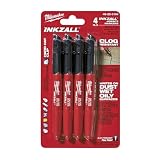
- Milwaukee Ink all Fine Point Marker, Black, 4 Per Pack
- 4 per pack Features Clog Resistant Marker Tip Writes through Dusty, Wet and Oily Surfaces Durable Marker Tip for Writing on Concrete, OSB and Rough Surfaces
- Clog resistant tip writes on dusty, wet and oily surfaces and is optimized for rough surfaces such as OSB, cinderblock and concrete
- Hard hat clip- attaches for easy access
- Quick dry time with reduced smearing and marking
Rank #4

- Long Nib and Deep Hole Marker: Our mechanical carpenter pencil with 45mm nib is designed for easy marking of deep holes or narrow areas. These construction pencils are the great choice for woodworking tools, construction tools, carpenter tools, contractor tools, wood carpentry tools and architect tools
- Extra Refills in 2 Colors for Versatile Marking: The construction mechanical pencil comes with 12 extra 2.8mm refills, including 6 red and 6 black refills. The black refill is suitable for light surfaces, while the red wax is perfect for dark surfaces. Our carpenter mechanical pencil makes sure that you'll have an ample supply for extended use
- Built-in Sharpener: Our construction pencil comes with a built-in sharpener to ensure the mechanical pencil tip is always sharp and ready for use. Never buy an extra pencil sharpener again. A great tool for any woodworker pencil, contractor pencils. The refill can easily be extended or retracted with a simple click of the pencils mechanical, allowing you to work more efficiently and accurately
- Portable Clip Design: Our deep hole construction pencil features a portable clip design, easy to carry and attach to your pocket or tool box, so that you can keep the carpenter pencils mechanical close at hand, making it a convenient tool to have on the go. Great gifts choice for carpenters
- Stronger Pencil Lead: The black refills are made of lead, sturdy and smooth. The red refills are made of wax, clear and light. These marking pencils are much thicker and stronger than normal pencils during the marking process of construction work, suitable for various surfaces, such as glasses, metal, boards, floors, walls, furniture, etc. The written marks can be easily wiped with a wet paper towel when needed
- Sample identity, state, solvent or matrix, and concentration.
- Excitation wavelength and absorbance at that wavelength.
- Emission scan limits and the wavelength interval integrated for PLQY.
- Instrument, cell path length, acquisition settings, and whether spectral correction was applied.
- Blank and background treatment.
- For a relative result: reference identity, solvent, adopted PLQY and its excitation conditions, calculation equation, refractive indices, and whether a single pair or slope method was used.
- For a sphere result: sphere configuration, sample and blank setup, corrections, and calculation method.
Product prices and availability are accurate as of the date/time indicated and are subject to change. Any price and availability information displayed on Amazon at the time of purchase will apply.

